Best ADU Layout for Your Orange County Lot Size: The 6,000 vs. 9,000 Square Foot Decision
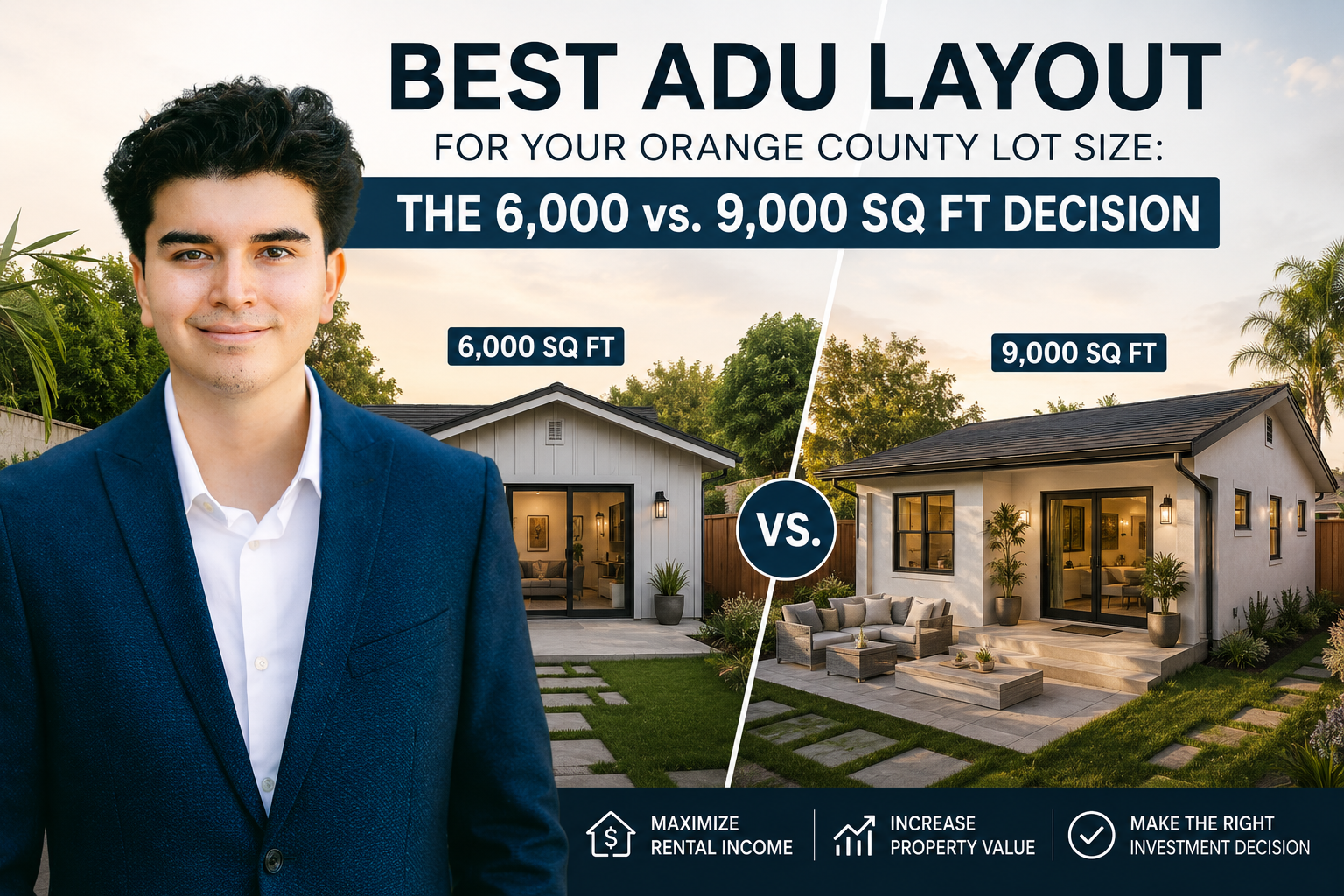
If you own a property in Orange County and you're thinking about adding an ADU, the most important number isn't your budget — it's your lot size. Lot size determines what you can legally build, what configuration makes financial sense, and whether a more aggressive strategy like an SB 9 lot split opens up. Get this right, and you're stacking rental income with a layout that pencils. Get it wrong, and you've either left money on the table or triggered impact fees you didn't plan for.
This post breaks down the two most common lot-size tiers we see across Orange County — the 6,000+ square foot standard lot and the 9,000+ square foot (often corner) lot — and walks through the optimal ADU layout strategy for each.
Why Lot Size Is the Starting Point for Every ADU Decision
Most property owners come into the ADU conversation focused on design: how many bedrooms, what finishes, detached or attached. That's understandable — those are the fun decisions. But in Orange County, the sequencing matters. Lot size and setback requirements dictate your buildable envelope before any design conversation can happen.
California state law, under the HCD's ADU framework, gives all single-family homeowners the right to add at least one ADU and one JADU. But local jurisdictions still control setbacks, height limits, and lot coverage — and those variables shrink or expand your options fast depending on the acreage underneath your home.
The 6,000 and 9,000 square foot thresholds aren't arbitrary. They map almost exactly to the two distinct strategic buckets we see play out across cities like Anaheim, Garden Grove, Costa Mesa, and Fullerton.
6,000+ Square Foot Lots: The Sweet Spot for a 2-Bed / 2-Bath ADU
A 6,000 square foot lot is the workhorse of Orange County's residential stock. You'll find them throughout Anaheim, Garden Grove, and large portions of Costa Mesa. They're common, they're buildable, and when sized right, the ADU on one of these lots can generate serious monthly income.
The Target Layout: 750–800 Square Feet, 2 Bed / 2 Bath
For a standard 6,000 square foot lot, the optimal ADU footprint lands between 750 and 800 square feet. A 2 bed / 2 bath layout in this range gives you the broadest renter pool — couples, roommates, small families — and commands meaningfully higher rents than a studio or 1-bed.
In markets like Garden Grove, a well-built 2-bed ADU in the 750–800 sq ft range is renting for competitive rates that support strong cash-on-cash returns. Across Orange County more broadly, ADU rental rates by square footage show that the jump from a 1-bed to a 2-bed unit often justifies the modest increase in build cost — you're buying a lot of monthly income for a relatively small step up in square footage.
The 750 Square Foot Line: Don't Cross It Without a Plan
Here's where a lot of property owners get tripped up. Under California law, ADUs under 750 square feet are exempt from most local impact fees — things like park fees, traffic mitigation fees, and affordable housing fees. The moment your ADU hits 750 square feet or above, those fees kick in, calculated proportionally based on the size of your primary dwelling.
So if you're targeting 750–800 square feet, you're not being reckless — you're making a deliberate tradeoff. An 800 square foot ADU may pencil out better than a 749 square foot one even after impact fees, because the additional rent it commands over its life outweighs the upfront fee cost. But you need to run that math before you finalize your plans. The break-even point depends on your city, your primary home's size, and local impact fee schedules — so this is a calculation worth doing with your contractor and agent before you pull permits.
One practical note: if your goal is to stay under 750 square feet and avoid fees entirely, design discipline matters early. Builders sometimes creep layouts up slightly during plan review, and crossing that line mid-process can mean a surprise fee invoice.
Layout Tips for the 6,000 Sq Ft Lot
On a standard 6,000 square foot lot, you're typically working with a detached or attached ADU tucked toward the rear of the property. A few things that make 2 bed / 2 bath work at this scale:
Efficient floorplan orientation. A rectangular footprint (roughly 25' x 30' or 20' x 37.5') maximizes interior livability without wasting square footage on hallways.
Private entrance. Even on tighter lots, a side-yard or rear-entry design that keeps the ADU's front door out of the main home's sightline makes the unit feel more autonomous — and renters pay more for that.
Laundry in-unit. At 750–800 square feet, you can almost always fit a stacked washer/dryer. This feature alone can move a unit to the top of a prospective renter's list in competitive markets.
One covered parking space. Where setbacks and lot coverage allow, a covered space attached to or adjacent to the ADU adds rental appeal and can satisfy parking replacement requirements in some jurisdictions.
9,000+ Square Foot Lots: Bigger Lot, Bigger Options
A 9,000 square foot lot opens a fundamentally different conversation. These parcels — frequently corner lots in older Orange County neighborhoods — give you the buildable area and the strategic flexibility to think beyond a single ADU.
Why Corner Lots Show Up Here
Corner lots disproportionately cluster in the 9,000+ square foot range for a structural reason: they were often platted wider to handle the dual street frontages. That extra width isn't just aesthetic — it creates side yard space that interior lots don't have, which matters enormously for ADU placement, setback compliance, and the kind of independent-feeling unit design that maximizes rent.
Option 1: A Full 3-Bed / 2-Bath ADU
At 9,000+ square feet, you have enough lot coverage room to go bigger. A 3-bedroom / 2-bath ADU in the 1,000–1,200 square foot range is realistic on many of these parcels, and it changes the renter profile entirely. You're now competing for families who want a real house-sized unit — not an apartment — and in markets like Costa Mesa and Anaheim, that tier of renter often pays a meaningful premium.
A 3-bed unit also gives you more optionality down the road. If your investment thesis changes, a larger ADU is easier to sell as a standalone asset in certain financing structures, and it's more likely to be counted as a separate unit in a future appraisal — which matters for HELOC and refinance scenarios.
If you're tracking what's happening in the Costa Mesa multi-family market right now, the August 2026 Costa Mesa market update gives a clear picture of how multi-unit inventory is moving and what numbers investors are actually seeing at close.
Option 2: SB 9 + ADU (The Power Move)
For the right 9,000+ square foot lot, the most aggressive value-creation strategy isn't just adding an ADU — it's using SB 9 to split the lot first, then building on the new parcel.
Here's how that can work on a corner lot: you split a 9,000 square foot parcel into two lots of roughly 4,500 square feet each. On the original parcel, you keep the primary residence (and potentially add a JADU). On the new lot, you build a new primary structure — which can then support its own ADU. In the right configuration, you've gone from one structure to three or four units on land you already owned.
The math on this can be compelling. But SB 9 isn't automatic — there are eligibility requirements around lot coverage minimums, existing structure preservation, and tenant protection provisions that can disqualify properties or complicate the timeline. The SB 9 eligibility checklist for Garden Grove walks through the specific criteria in detail, and most of the requirements translate directly to other Orange County cities. One provision that trips up a lot of investors: SB 9 has a built-in tenant protection rule that restricts what you can demolish if the property has been tenant-occupied in the past three years. Know this before you run numbers.
Impact Fees on Larger ADUs: Running the Math
Whether you're on a 6,000 or a 9,000 square foot lot, the 2026 HCD ADU Handbook is the authoritative document for understanding what fees apply and when. The core structure is straightforward:
Under 750 sq ft: Exempt from most impact fees (school district fees may still apply for units over 500 sq ft, at the school district's discretion)
750 sq ft and above: Impact fees apply, proportional to the ratio of your ADU's size to your primary home's size
The proportional calculation means the fee hit is often more manageable than people fear — but it's real money, and it varies significantly by city. Some Orange County cities have higher park fee schedules than others. If you're considering a 1,000+ square foot ADU on your 9,000 square foot lot, get the city's current impact fee schedule before you finalize square footage. A 50-square-foot adjustment in the design phase can sometimes save four to five figures in fees.
Comparing Markets: Where These Strategies Play Best
Not all Orange County cities offer the same comp support for larger ADUs. It matters a lot where your property sits.
Strong markets for 2-bed and 3-bed ADUs: Anaheim, Garden Grove, Costa Mesa, and Long Beach all have rental demand deep enough to support the higher rents that larger ADUs command. Garden Grove's ADU rental data in particular shows a strong step-up in achievable rents as you move from studio to 1-bed to 2-bed units — the demand is there.
Thinner comp markets: Cities like Cypress, Buena Park, and Fullerton have less transaction density around ADU-specific rentals. Buena Park's ADU rental data gives you a baseline, but in these markets, the premium for a 3-bed unit may be harder to achieve — the renter pool is narrower. That doesn't mean the strategy is wrong, but it means your underwriting assumptions need to be more conservative.
The city-by-city rental income context matters whether you're an owner-occupant looking at your first ADU or an investor underwriting a purchase. If you don't know what the unit will actually rent for — by bedroom count and square footage, in your specific city — the rest of the analysis is guesswork.
The Decision Tree
Here's how to think about it simply:
You have a 6,000–8,999 sq ft lot: → Target a 2 bed / 2 bath ADU in the 750–800 sq ft range → Decide intentionally whether you stay under 750 sq ft (avoid impact fees) or go to 800 sq ft (accept fees, capture higher rent) → Optimize for a private entrance and in-unit laundry
You have a 9,000+ sq ft lot, especially a corner: → Model both a 3-bed / 2-bath ADU AND an SB 9 lot split + ADU scenario → Check SB 9 eligibility first — tenant protection and structure preservation rules can eliminate this option → If SB 9 is viable, run it as a separate project with its own timeline; it's a longer path but potentially far higher value creation → If SB 9 isn't viable or doesn't pencil, build the 3-bed ADU and price it for families
Final Thought: Lot Size Is Strategy
Every ADU conversation should start with a site visit and a lot measurement. The difference between a 5,900 square foot lot and a 6,100 square foot lot may feel trivial on paper, but it can determine whether your ideal layout fits within setbacks. The difference between a 6,500 and a 9,200 square foot corner lot can determine whether SB 9 is even on the table.
If you're trying to figure out what your specific lot supports — and what the numbers look like for your city — that's exactly the kind of analysis we do before any client makes a move. Reach out here and we'll look at your property together.
Dylan Serna is an ADU specialist agent serving Orange County and LA County. He works with property owners, landlords, and investors focused on ADU additions, multi-unit acquisitions, and SB 9 strategies.
