Is Cypress a Good Place to Buy a Multi-Family Property Right Now? (September 2026 Market Update)
Cypress doesn't trade often — and that's exactly what makes it worth watching. There are only a handful of income properties moving through this market right now, but the signals are clear if you know what to look for. Here's where things stand heading into fall.
What's Active
There's one multi-family listing sitting on the market right now, and it's a legitimate income play.
8783 La Salle St just hit the MLS on September 7th — a triplex priced at $1,500,000. What makes this one interesting is the structure: three fully detached houses on a 10,300 sq ft lot, currently generating $5,264/month in actual rent with a gross scheduled income of $63,168/year. The seller is openly offering seller financing, which is a real differentiator in this rate environment. Buyer profile for this one is someone who wants to own a small portfolio under one roof, potentially house-hack, or hold with built-in upside — the pro forma rents push to $7,800/month, meaning current tenants are below market.
The active signal: One listing, priced at $511/sqft. It's priced to attract attention, not to sit.
What's Pending
One property went under contract and it moved fast.
6022 Lime Ave listed on July 22nd at $1,750,000 and was under contract by July 29th — seven days on market. That's not a coincidence. This is a 4-unit Covington-style building near Cypress College, fully metered, freshly renovated (brand new roof in June 2026, three of four units updated), with a 4.73 cap rate and 11% rental upside remaining. The gross operating income is $118,049 with a GRM of 14.47.
The pending signal: Quality, renovated product with real numbers gets absorbed quickly in Cypress. Buyers who've been watching this market know these don't come around often, and they're acting when they do.
What's Sold
Two closings in the last 30–60 days paint a clear picture of where buyers are drawing the line.
5572 Saint Ann Ave — listed at $1,100,000, reduced to $1,075,000, sold at $1,045,000 on August 18th. This was a two-home setup on a 7,400 sq ft lot — front house fully remodeled, back unit 1 bed/1 bath, with a large finished garage that had ADU conversion potential. It sat for 14 days before going into contract, and the buyer received $20,900 in concessions. Sold cash to new loan.
8651 La Homa — the bigger story. Listed at $1,999,000, went pending at 43 days, closed August 25th at $1,950,000. Main house is 4 bed/3 bath at 2,125 sq ft. Detached ADU (2 bed/1 bath) was operating as an Airbnb. R3 zoning. Large 4-car garage/workshop with real conversion potential. Buyer used conventional financing and received $39,000 in concessions.
The sold signal: Both properties closed below asking — 2.8% and 2.5% respectively — and both involved concessions. Sellers got deals done, but buyers had negotiating room. This isn't a seller's market. It's a negotiating market.
What This Means Right Now
Rates are still the defining variable for every buyer running numbers on income property in Cypress. The deals that are moving — like Lime Ave going pending in seven days — are the ones with strong fundamentals and real upside. The ones that required price reductions and concessions are the ones that were either overpriced at launch or harder to underwrite at today's rates.
For sellers: Your pricing strategy has to be tight from day one. Cypress buyers are sophisticated — they're running cap rates and GRMs before they call, and they'll wait out an overpriced listing.
For buyers: The negotiating window is real. Both closed sales had concession room. If you've been watching Cypress and waiting for signals that sellers are flexible — this is it.
For ADU investors specifically: The R3 zoning story on La Homa is the kind of deal that defines this niche. Large lot, detached structures, income in place, upside in the garage. That property sold in 43 days. If you're looking for those setups, Cypress is one of the few cities in Orange County where they still exist at a scale that pencils.
Browsing for Multi Unit Properties?
Click Link Here to View Multi-Units Right now!
Want to know what your Cypress property is worth in today's market — or what income properties are realistically trading at right now? Reach out and let's run the numbers together.
📞 (714) 860-2868
📧 dylan@serna-realestate.com
🌐 adurealtor.net
Dylan Serna | The ADU Realtor | eXp Realty | DRE #02217359
North Long Beach Multi-Unit Market Update — September 2026: What the Numbers Actually Say for Buyers and Sellers
If you've been watching the North Long Beach multi-unit market and wondering whether now is the time to move — as a buyer or a seller — this post is going to give you a real answer. Not a spin. Not a headline. The actual data from active listings right now in the 90805 zip code, plus my honest read on what it means.
Let's get into it.
What's on the Market Right Now
As of September 2026, there are roughly 20 active multi-unit listings in North Long Beach ranging from a $520,000 triplex all the way up to a $3,295,000 twelve-unit apartment building. The spread is significant, and the spread tells you a lot.
Here's a snapshot of the active inventory by size tier:
Small (2–3 units):
350 E South St — 3-unit triplex, $520,000 — value-add play, 2 units currently vacant
800 E South St — 2-unit, $764,000 — mixed-use zoning, development potential
3404 E 65th — 2-unit duplex, $810,000 — North Long Beach/Lakewood border, ADU conversion potential noted
5940 Gundry Ave — 2-unit duplex, $899,000
6160 Gundry — 2-unit with an existing rear ADU, $995,000 — ADU built 2019, $4,900/month current income
6140 Orange Ave — triplex, $1,020,000 — been on market since February 2025 (more on that below)
Mid-size (4–6 units):
45 E 69th Way — 6-unit, $900,000 (reduced from $1,150,000) — 6.55 cap rate, $77,140 NOI
5174 Linden — 4-unit, $1,088,800 — 4.7 cap, ADU development potential on large backyard lot
92 E Louise St — 4-unit, $1,100,000 — all 2-bed/1-bath units, $72,365 NOI, priced at $275K/unit
246 E Hullett St — 4-unit, $1,245,000 — 3.84 cap rate, below-market rents
496 E 52nd St — 3-unit with 2 brand-new ADUs completed in 2026, $1,265,000 — 5.57 cap, $70,412 NOI
489 E 55th St — 4-unit, $1,499,000 — 6.36 cap rate, $95,347 NOI, garage ADU conversion potential
486 E Adair — 4-unit, $1,549,800 (reduced from $1,598,000) — Section 8-secured income
Larger (8–17 units):
46 E Plymouth — 8-unit, $2,195,000 — 6.08 cap, $133,486 NOI, strong unit mix
436 E Market — 10-unit, $2,195,000 — front ADU duplex newly built in 2024
174 E Plymouth — 9-unit, $2,200,000 — $118,925 NOI, community laundry income
6626 Orizaba Ave — 9-unit across 2 parcels, $2,275,000 — dual-parcel deal, ADU conversion play
1005 E Harding St — 10-unit, $2,400,000 — 7.03% proforma cap, SB 721 balcony inspections complete, $200K in recent capital improvements
5503–5511 Cherry Ave — 17-unit, $3,000,000 — 5.17 cap, $155,114 NOI, $85K in 2025 capital improvements
6068 Atlantic Ave — 12-unit, $3,295,000 — 7.25% cap rate on current income, $238,911 NOI, 8 additional ADUs proposed
The Cap Rate Story: Wide Spread = Price Discovery Still Happening
This is the most telling signal in the entire dataset. Active cap rates in North Long Beach right now range from 3.84% to 7.25%. That is an enormous spread for a single zip code.
What does that mean in plain English? Buyers and sellers haven't fully agreed on what these properties are worth yet. Sellers who bought or refinanced during the low-rate era are still anchored to valuations that assumed cheap debt. Buyers underwriting at today's rates need higher yields to make the math work — and they're holding the line.
The 6068 Atlantic Ave at a 7.25% current cap is the benchmark for what a strong, fully-renovated operator can achieve in this market. It required a $600K renovation, full vacancy to retenant, and significant capital. That's not the standard — it's the ceiling. Most of the inventory is trading in the 5%–6.5% range, which is where realistic buyer-seller negotiations are landing.
The outliers are instructive. The 246 E Hullett listing at a 3.84% cap is priced for a buyer who believes rents will be pushed dramatically. That may be true — the notes mention below-market rents with long-term tenants — but a 3.84% cap on today's cost of capital is a tough pencil. It's been on the market a while. That's not a coincidence.
What the Days-on-Market Data Is Telling Us
I'm going to be direct here: this is a softening market for sellers of multi-unit property in North Long Beach.
The evidence isn't subtle:
45 E 69th Way — listed at $1,150,000 in February 2026. Now sitting at $900,000 after nearly seven months on market. That's a $250,000 price reduction — 21.7% — and it still hasn't closed. The listing description says "Priced to sell." Buyers are not moving just because a seller says that.
6140 Orange Ave — a triplex listed in February of 2025. It has been on the market for over 18 months. The listing notes rents that are far below market due to long-term tenants. That's an upside story, but the market is telling us it's a complicated one.
486 E Adair — just reduced from $1,598,000 to $1,549,800. Small reduction, but it signals a seller who is feeling the pressure.
Multiple listings in this dataset accept 1031 exchange terms, note seller financing willingness, or describe sellers as "very motivated." That's the language of a market where supply is sitting and buyers have leverage.
My Take: What's Actually Happening — and Why
Here's my honest opinion on what's driving the North Long Beach multi-unit market right now.
Buyers are disciplined. The era of buying on rent upside alone is over. Investors at today's interest rates need a property that cash-flows from day one, or at minimum has a clear, near-term path to positive carry. Buyers are running the numbers hard, and they're walking away when the numbers don't work. The properties that are moving are the ones with realistic cap rates and genuine ADU upside that can be documented — not just hoped for.
ADU potential is a real premium driver. I've said this for a while, and the data keeps confirming it. The 496 E 52nd St listing — a classic 1929 Spanish front home with two brand-new ADUs completed in 2026 — is priced at a 5.57% cap with $70,412 NOI. That's a fair premium for a turnkey, income-producing asset with modern construction on the back of the lot. Similarly, 6160 Gundry (2-unit with a 2019 ADU already renting at $2,800/month) has a strong income story relative to its price tier. Properties where someone has already done the ADU work command a premium — and rightfully so. If you want to understand how many ADUs a multi-unit property can legally add in California, that's worth reading before you tour anything.
Below-market rents are a double-edged sword. A lot of sellers in this dataset are pitching below-market rents as upside. And it is upside — but only if a buyer can actually get there. Long-term, month-to-month tenants protected by AB 1482 rent control limits don't just leave. The 45 E 69th listing explicitly notes tenants with 10–20 year rental histories. The 92 E Louise listing was described in its offering as priced below comparable four-unit sales because rents are embedded below market. Buyers are discounting that upside story heavily, and I think they're right to do so.
The garage conversion angle is getting more sophisticated. I'm seeing more listings where the ADU narrative isn't just "add a unit" but "add multiple units through garage conversion." The 489 E 55th listing specifically mentions potential to convert garages into additional units. California's 25% rule on garage conversions for multi-unit properties is something every serious buyer needs to understand before they get attached to that math, because it caps how many existing attached garages can be converted. That said, the flexibility California grants under its multi-unit ADU statutes — two detached ADUs plus one-per-unit attached — remains a powerful toolkit for owners of existing multi-unit lots.
The 350 E South triplex is worth watching. One of the most interesting listings in the dataset, and one that doesn't fit a clean narrative. Two units delivered vacant, priced at $520,000, and the listing notes the property "may qualify for legalization state amnesty program AB 2533." It's being marketed as a value-add with legalization upside, and California's ADU state amnesty law gives unpermitted units a path to legitimacy in many cases. For a buyer who knows how to navigate that process, this is the most asymmetric opportunity in the dataset. For a buyer who doesn't, it's a risk.
What This Means If You're a Seller
If you're a North Long Beach multi-unit owner thinking about selling, here's what I'd tell you:
Price it right from day one. The 45 E 69th situation is a cautionary tale. A $250K price reduction after seven months on market is significantly more painful than pricing correctly at the start — not just financially, but in terms of buyer perception. A property that sits and chases the market reads as distressed, even when it isn't. Buyers start wondering what's wrong with it.
Lead with income, not potential. If your rents are below market, that's a conversation to have honestly — not a headline. Buyers are sophisticated enough to model it themselves, and if you oversell the upside, you'll lose deals in due diligence when the reality lands differently than the pitch.
ADU-ready properties sell at a premium — get your permits in order. If you have an existing unpermitted unit, the time to explore legalization under state programs is before you list, not after a buyer discovers it and uses it as leverage.
What This Means If You're a Buyer
North Long Beach is one of the few markets in LA County where you can still find multi-unit properties at price points that pencil with today's rates — if you're selective. The 6-unit at 45 E 69th at $900,000 with a 6.55% cap is genuinely interesting. The 10-unit at 1005 E Harding with SB 721 compliance complete and $200K in fresh capital improvements at a 7.03% proforma cap is worth a serious look.
If you're looking to find ADU-potential multi-unit lots across LA County, North Long Beach 90805 belongs on your short list — price per unit is lower than neighboring markets, there's genuine ADU expansion runway on several parcels, and motivated sellers are creating real negotiating room right now.
The deals are there. They require patience, underwriting discipline, and a willingness to look past the surface numbers to find the actual income story.
Quick Stats — North Long Beach 90805, Active Multi-Unit, September 2026
MetricRangeActive listings~20Price range$520,000 – $3,295,000Unit counts2–17Cap rate range (active)3.84% – 7.25%Price per unit (mid-size)~$173K – $407KHighest current NOI$238,911 (12-unit, 6068 Atlantic)Notable price reductions$250K reduction (45 E 69th), ongoingADU-specific listings5+ with new or conversion-ready ADUs
Questions About a Specific Listing?
I'm tracking every multi-unit property in the 90805 and can pull comps, run income analysis, and give you a realistic read on any of these. If you're a seller and want to know where your property fits in this market, I'll give you an honest answer — not a number designed to win your listing.
Reach me at dylan@serna-realestate.com or visit adurealtor.net.
Dylan Serna | The ADU Realtor | eXp Realty | DRE #02217359
Lakewood Multi-Unit Market: 3 New-Construction Triplexes Under Contract — What $1.95M Now Buys Investors in September 2026
If you've been watching the Lakewood multi-unit market, September is giving us a lot to talk about. We have 4 active listings, 3 properties under contract, and 1 closed sale that tells a very clear story about where this market stands heading into fall.
Let me break it all down.
What's Active Right Now
There are currently four multi-unit properties on the market in Lakewood, and they couldn't be more different from each other — which actually makes this snapshot really useful for understanding what buyers are actually willing to pay.
5822 Autry, Lakewood 90712 — $899,000 is the lowest-priced active listing and the most complicated. This is a 3-unit triplex built in 1943, sitting at 1,924 square feet on a 7,702 sq. ft. lot. At $467/sqft, it's priced at a value-play level — but there's a reason. The property has a death-on-property disclosure (an elderly occupant passed away peacefully), it's cash only, and tenants are in place with rights. This listing is aimed squarely at experienced investors comfortable with as-is acquisitions. The pro forma projects $1,850/month per unit, but those numbers need verification since the property shows no current income on the sheet. It's been on market since September 3rd — barely a week old as of this writing. If you're a cash buyer who knows how to work through occupancy situations, this one has real upside.
4332 Andy, Lakewood 90712 — $1,450,000 is the most polished vintage play on the market. This fully renovated 1944-built triplex was originally listed at $1,485,000 and took a $35,000 price reduction on August 17th — which is meaningful. Seller spent roughly $160,000 in capital improvements: new plumbing, dual-pane windows, renovated interiors, fresh interior/exterior paint, new landscaping, perimeter fencing. The income picture is solid with actual rents at $3,195 / $3,095 / $2,995 across three 2-bed/1-bath units, an NOI of $79,302, and a 5.47% cap rate with a 13.01 GRM. These are real numbers on a stabilized asset. The price reduction tells you buyers are negotiating on renovated vintage stock — even when the work is done. Seller will consider 1031 exchange, cash, or new loan terms.
5919 Arbor, Lakewood 90713 — $2,000,000 is the priciest active listing and the most compelling from an ADU investment standpoint. This is brand new construction — completed in 2025 — a 3-unit property that includes a detached ADU and an SB9 upper unit, totaling 3,920 square feet on a 5,491 sq. ft. lot. Two rear units are fully occupied at $3,700 and $3,850/month. The front house is vacant and ready for an owner-occupant at estimated market rent of $4,800/month, or you move in and collect $7,550/month from the back two. The NOI clocks in at $140,400 with total operating expenses of only $9,060 — a consequence of building new. This is a rare opportunity: a brand new, turnkey, income-producing asset with virtually no near-term capital requirements, positioned in the Lakewood Park neighborhood near the 605 and 91. It's priced accordingly, and it hasn't moved yet — which isn't unusual at the $2M mark. This one needs the right buyer.
5746-5748 Rocket, Lakewood 90713 — $989,000 rounds out the active inventory as a 2-unit duplex (1,603 sqft, 1944 built) sitting on a 7,035 sq. ft. lot. It's vacant — which is both an opportunity and a data gap, since there are no current rents to anchor underwriting. At $617/sqft it's priced high for a vacant vintage duplex, and the showing instructions require contacting the listing agent, suggesting it may need some creativity to access. Listed September 1st, it's accepting 1031 exchange and conventional financing. Watch this one — the lack of income history makes it harder to underwrite, but a vacant duplex has flexibility for an owner-occupant strategy or a full repositioning.
What's Pending (Under Contract)
Three properties are currently under contract, and they tell a very consistent story: new construction triplexes at the $1.95M price point are moving in Lakewood.
6118 Amos, Lakewood 90712 — $1,950,000 went under contract July 10th. This all-new-construction triplex is arguably the most premium listing in the bunch — a 4BR/3BA main residence, a 3BR/2BA SB9 ADU, and a 3BR/2BA third unit, totaling 4,053 square feet. Solar panels, high-end finishes throughout, minimum 7 parking spaces off-street. Pro forma income runs $4,700 / $3,900 / $3,900. It took about seven months from list date to get under contract, which suggests the buyer pool for $1.95M new construction is real but patient.
5711 Rocket, Lakewood 90713 — $1,950,000 just went under contract September 2nd — literally days ago. This is a 2026-built triplex totaling 3,654 square feet: a 3BD/2BA front residence, two newly constructed 3BD/2BA rear townhome-style units. One rear unit is already rented at $3,900/month with a new tenant. Pro forma: $4,200 / $3,900 / $4,200. NOI of $109,125, cap rate of 5%, GRM of 14.2. This one went from list to pending in roughly two months on a $1.95M ask — a strong signal that the market is absorbing this product type when it's priced and presented right. The listing required proof of funds and DU approval before showings, which tells you exactly the buyer profile they were targeting.
6025 Bellflower, Lakewood 90713 — $1,950,000 has been pending since July 28th. Another new-construction ADU/SB9 triplex at 3,640 square feet, featuring a 3BD/2BA front house with an attached ADU/SB9 lower unit and a 3BD/2BA upper unit. Pro forma income of $4,800 / $3,500 / $4,000 across three fully occupied units, NOI of $139,800. This one was originally listed in April and took about four months to find a buyer — patience paid off.
The pattern here is impossible to ignore. All three pending properties are new construction. All three are priced at exactly $1,950,000. All three are ADU/SB9 triplex configurations. The market has effectively set a price anchor for what a brand-new, three-unit Lakewood income property is worth right now — and that number is $1.95M.
What's Sold
There's only one closed sale in this pull, but it's a good one.
5867 Adenmoor Ave, Lakewood 90713 — a 2-unit property (main home + 2025-built detached ADU) listed at $999,000, closed at $1,070,000 on September 3rd. That's $71,000 over asking — a 7% premium — after just 15 days on market. The property featured a 1941 main house with a brand-new 2025 ADU (669 sq. ft., 2BD/2BA), fully updated kitchen, and all the features that make ADU properties attractive to both investors and owner-occupants. The buyer used conventional financing.
Here's the footnote worth paying attention to: the comparable information notes a "reduction from original offer price of $1,075,000 due to appraisal." That means the buyer initially agreed to $1,075,000, the property appraised short, and the deal was renegotiated down $5,000 to get it closed. The buyer still closed $71K over asking after that adjustment — demand was real, but the appraisal gap dynamic is showing up even in Lakewood.
At $698/sqft on a 2-unit property, this is the highest price-per-foot of anything in this market snapshot. The market is clearly rewarding new ADU construction — even on single-family lots — with strong premiums.
How Buyers Are Reacting
Buyers are still active, but they're increasingly strategic about what they'll pay for. The data tells a bifurcated story.
New construction buyers are moving with conviction. All three new-construction triplexes at $1.95M have found buyers — and 5711 Rocket went under contract in two months. These buyers are underwriting on pro forma income, long-term appreciation, and the practical reality that a new asset doesn't need anything for 10+ years. They're typically coming in with proof of funds, 1031 exchange capital, or cash-to-new-loan positioning, because that's what sellers of premium product are requiring.
Vintage buyers are negotiating. The $35,000 price cut on 4332 Andy — a beautifully renovated property with real income in place — signals that buyers aren't just accepting the ask on older product, even when the work is done. They know that a 1944 building comes with deferred maintenance risk that a 2025 build doesn't, and they're pricing that into their offers.
Cash and 1031 buyers are dominating the most active end of the market. Multiple listings require proof of funds before showings. The cash-only mandate on 5822 Autry effectively removes a majority of retail buyers from consideration. This isn't surprising given where rates are heading — but it does compress the buyer pool on certain assets and extend days on market for listings that can't support financing.
How Sellers Are Reacting
Sellers of new construction are holding firm. The $1.95M comp cluster is tight — all three new-build triplexes are priced identically, and all three have found buyers without major concessions. If you're a developer or investor who recently completed a project in Lakewood, the data supports your price.
Sellers of renovated vintage product are starting to move. That price reduction on 4332 Andy tells you something: even when the asset is turnkey and income-stabilized, there's a ceiling buyers are willing to push through on pre-1950s construction — especially as rates rise and financing gets more selective. Sellers who price aggressively at the start will find buyers. Sellers who push for top dollar on vintage need to be patient, or they'll eventually chase the market down.
The seller on 5867 Adenmoor gave up $5,000 due to the appraisal — but still collected $71K over list in 15 days. The takeaway: ADU-equipped properties in good condition are extraordinarily compelling to buyers right now. If you own an SFR with a functioning ADU in Lakewood, you are sitting on something the market wants badly.
The Rate Picture — What Rising Rates Mean Here
Rates ticking up creates real pressure on two fronts.
First, it tightens the buyer pool on conventionally financed deals. Fewer buyers can qualify for a $1.95M purchase, which is why you're seeing 1031 exchange capital and institutional cash driving the new construction segment. These buyers don't care as much about rate movement — they care about yield, depreciation, and long-term cash flow.
Second, it increases appraisal gap risk on deals that do involve financing. The Adenmoor sale is a preview of what happens: a buyer agrees to an above-ask price, the appraiser doesn't agree, and both parties have to decide whether to bridge the gap or renegotiate. As rates rise and monthly payments increase, buyers have less room to absorb that gap out of pocket. Expect more appraisal conversations in fall closings.
For ADU-specific properties, there's a counterweight worth noting. ADU income — when properly documented with leases and rental history — can now be used to help qualify borrowers under updated Fannie Mae ADU income guidelines. For owner-occupants buying a property with a rented ADU, that income increasingly helps them get to the payment. That's a meaningful tailwind that partially offsets rate pressure for a specific buyer segment.
The investors who are most insulated from rate movement right now are the ones buying all-cash, 1031-exchanging into larger assets, or buying new construction where the depreciation schedule offsets taxable income enough to make the deal work even with higher financing costs. The buyers who feel it most are first-time landlords using conventional 30-year financing on properties priced above appraised value.
Bottom Line
Lakewood's multi-unit market entering September 2026 is active, bifurcated, and telling a clear story:
New construction ADU/SB9 triplexes at $1.95M are the market's center of gravity. Three under contract proves it. Buyers are paying that number for turnkey, income-producing, new assets without major pushback.
Vintage inventory has a pricing ceiling. Even beautifully renovated product is getting negotiated down. Price reductions are showing up on older stock, and cash-only requirements on the most distressed assets limit who can even participate.
The one sold comp — $1.07M on an SFR+ADU — is the most actionable number for owner-occupants. If you own a single-family home in Lakewood with a built-out ADU, September's sold data suggests the market will reward you well. The appraisal dynamic bears watching as rates continue to rise, but demand clearly outpaced supply on that property.
If you're thinking about selling a Lakewood multi-unit property or you're an investor trying to figure out what your entry price looks like right now, I'd encourage you to look at this data not as a market that's cooling — but as one that's getting more specific. The right product, priced correctly, is still moving fast.
Browsing for Multi Unit Properties?
Click Link Here to View Multi-Units Right now!
Dylan Serna is a licensed California real estate agent (DRE #02217359) with eXp Realty, specializing in ADU and multi-unit investment properties across Orange County and LA County. Data sourced from the MLS as of September 8, 2026.
Anaheim Multi-Unit Buyers: September 2026 Is Your Window — And Sellers, This Is Your Warning
Anaheim has been one of Orange County's most resilient multifamily markets for the past decade. Strong rental demand anchored by Disneyland, Angel Stadium, the Anaheim Convention Center, and a massive blue-collar workforce has kept occupancy high and rents sticky even when sales volume cools. But something has shifted heading into fall 2026, and if you're either buying or selling a multi-unit property in Anaheim right now, you need to understand what the data is telling you — because the buyers and sellers who read it correctly are going to come out ahead.
Here's my honest read of the September 2026 Anaheim multi-unit market.
What's Actually Active Right Now
The current inventory spans nearly every price tier — from entry-level duplexes under $800K to institutional-scale 32-unit communities above $8M. That breadth is actually meaningful. It tells you this isn't a market where one type of seller is panicking; it's a market where every tier is repricing simultaneously.
At the small end: Duplexes are ranging from $775,000 (932 N Harbor — reduced price, tenant-occupied, 1923 construction) up to $1,639,750 (2550 W Rowland, a rare third-acre lot with a main home plus ADU, pool, and high-end finishes near Disneyland). One standout is 735 N Philadelphia at $1,275,000 — a fully renovated duplex with ADU architectural plans already prepared and ready to submit for a garage conversion, which adds a meaningful value-add layer that most duplexes in this range don't carry.
Quad-plex sweet spot ($1.375M–$1.775M): This is the most active segment by number of listings. Cap rates for quads currently range from roughly 4.4% to a high of around 5.2% depending on how the seller underwrote the expenses. The 1827 W Glencrest four-unit ($1,575,000) stands out as the most institutional-quality asset in this range — extensively renovated interiors, forced-air HVAC, garage parking, and a 4.38 cap rate that actually reflects real market rents rather than pro forma optimism. Contrast that with the W Guinida portfolio near Disneyland: three contiguous four-unit buildings (161, 167, and 175 W Guinida) listed at $1.45M–$1.5M each, sold-together-only, near the Platinum Triangle. The unit mix is all 2-bed/1-bath and the in-place rents appear below market — which is either an opportunity or a red flag depending on whether you believe the management story.
Larger assets: The 421 N Rose St 8-unit in Central Anaheim ($2,775,000, 5.56% cap rate) is the most compelling value proposition above the quad level — 100% two-bedroom units, recently renovated, separately metered, and the cap rate is the highest in this report at the price point. The 1184 W Casa Grande 9-unit near the Convention Center ($3,350,000, 5.15% cap) is a well-maintained pride-of-ownership building that benefits from SB 721 compliance and recent electrical upgrades. At the scale end, the 935 S Trident 16-unit in West Anaheim ($4,999,000, 5.23% cap) offers something rare: a two-building configuration on a combined 18,000 sqft lot with a path to 6.37% cap at market rents.
My Take for Buyers
This is the most buyer-favorable Anaheim multi-unit environment I've seen in two years — and I want to be precise about why.
Price reductions are real. Multiple active listings have taken cuts: 938 S Gilbuck (5-unit), 932 N Harbor (duplex), 1256 N Placentia (quad, from $1.45M to $1.379M), and 2115 Broden (triplex). That's not a coincidence — it's a pattern. Sellers who entered 2026 with 2024-era expectations are discovering that buyers now have enough inventory to walk away from anything that doesn't underwrite at current interest rates.
Back-on-markets signal opportunity, not damage. The 833 S Lemon listing re-hit the market August 31 after a previous contract. Tenant-occupied multifamily falling out of escrow almost always has a mundane cause — financing, inspection items on one of the buildings, or a buyer who got cold feet. If the fundamentals are solid (and at $1.275M with $62,800 NOI, 833 S Lemon's are), a back-on-market is a second chance, not a haunted house.
ADU upside is being underpriced in Anaheim right now. Buyers who know how California's multi-unit ADU rule works — specifically, that existing multi-unit properties can add up to two detached ADUs plus one per existing unit as attached conversions — are sitting on value that the listing price doesn't reflect. The quad at W Guinida near Disneyland, for example, has garage structures that could qualify for conversion under California's 25% garage conversion rule. A buyer who runs those numbers before writing an offer has a leverage point the seller isn't thinking about.
Financing: don't assume the worst. Conventional financing on 2–4 unit properties is more accessible than many buyers believe right now. California's HCD guidelines recognize ADUs as legitimate income units, and Fannie Mae's current income policy for ADUs allows rental income from an ADU to count toward qualification on owner-occupied purchases — a detail worth discussing with your lender before you assume you need a commercial loan.
The buyers I'd caution: if you're underwriting a quad in Anaheim at a 4.3% cap rate and expecting appreciation to carry the deal, you're betting on a market that historically rewards it but is currently flat to down on a price-per-unit basis. Be honest with your downside scenario.
My Take for Sellers
If you're a seller in Anaheim's multi-unit market right now, the window is still open — but it's not propped wide anymore.
Correctly-priced assets are still moving. The market hasn't frozen. But buyers are doing their homework with more precision than they were 18 months ago. Properties that are overpriced relative to their actual NOI — not the pro forma, the actual — are sitting. Properties with deferred maintenance, incomplete rent rolls, or tenant situations that complicate showings are getting discounted, not excused.
Disclosure is your friend, not your enemy. Several active listings are showing with "accepted offer only" or "upon accepted offer" restrictions because the tenants can't be disturbed. I understand why sellers do this, but it's creating friction in the buyer pool. Sophisticated buyers have seen enough deals fall apart at inspection to be skittish about buying blind. If you can find a way to show — even a drive-by-plus-financials approach — you'll get better offers than if you wall yourself off entirely.
The Disneyland premium is real but not unlimited. Properties within a mile of the resort and Convention Center continue to command a pricing premium, and for good reason — tenant demand there is employer-driven, not seasonal. But I've seen sellers in that corridor try to stretch cap rates to 3.8–4.0% on in-place rents, and buyers are increasingly passing. The premium is about 8–12% versus comparable properties in Northwest or East Anaheim, not 20%.
Sellers with ADU potential: price it, don't hide it. If your property has a garage structure, an underutilized lot, or a configuration that could support additional units under California's one-per-unit rule, work that into your marketing. Buyers are increasingly searching by ADU potential, not just current income. The 735 N Philadelphia listing is a good example of doing this right — having architectural plans in hand gives buyers a concrete number to underwrite, rather than a vague "potential upside."
Active Listings at a Glance — September 2026
AddressUnitsList PricePrice/SqftNOICap Rate932 N Harbor2$775,000 ↓$757——833 S Lemon St2$1,275,000$510$62,800—735 N Philadelphia2$1,275,000 ↓$608$71,4005.2%2550 W Rowland Ave2$1,639,750$393——142 N La Plaza3$1,300,000$501$53,479—2115 Broden St3$1,350,000 ↓$462$72,3805.36%161 W Guinida4$1,450,000$457$45,739—175 W Guinida4$1,450,000$457$45,987—1256 N Placentia4$1,379,000 ↓$462$75,965—167 W Guinida4$1,500,000$473$55,567—1827 W Glencrest4$1,575,000$383$68,9124.38%701 N W Provential4$1,775,000$457$83,570—625 W Provential4$1,775,000$457$86,647—938 S Gilbuck Dr5$1,675,000 ↓$571$85,886—421 N Rose St8$2,775,000$430$154,4175.56%625 W Provential8$3,550,000$457$159,2324.49%1184 W Casa Grande9$3,350,000$452$172,5075.15%935 S Trident16$4,999,000$468$261,2105.23%918 W Romneya Dr32$7,200,000$287$309,5724.3%119 S Fahrion Pl32$8,750,000$541$457,5235.23%
↓ = Price reduced from original list. Cap rates shown where disclosed by listing. Data from MLS as of September 4, 2026.
How Does Anaheim Compare?
Buyers looking at Anaheim are often cross-shopping Fullerton and Westminster in the same trip. Fullerton tends to run tighter on cap rates with less inventory; Westminster offers more lot size for the dollar but a different renter demographic. Anaheim's edge is depth — there are more listings at more price points, which gives buyers real negotiating alternatives and sellers real competitive pressure.
If you want a full framework for evaluating any of these markets before writing an offer, The Complete Buyer's Guide to Multi-Unit Lots in OC/LA lays out exactly what to look for on the lot, the rent roll, and the zoning.
Bottom Line
Anaheim is a market in transition right now — not a crash, not a collapse, but a repricing. Sellers who listed in early 2026 expecting multiple offers are learning what buyers already know: at 7%+ financing costs, the math has to work from day one. The properties that check that box — real rents, real cap rates, real deferred maintenance disclosed — are still selling. The ones that don't are sitting, cutting, and occasionally pulling.
For buyers, this September window may be the clearest entry point of the year. The inventory is deep, the price reductions are visible, and sellers who've been on market for 60–90 days are negotiable in ways they weren't at listing.
I work specifically in ADU and multi-unit investment properties across Orange County. If you want to walk through any of these listings — or if you're a seller trying to figure out how to price and position your Anaheim property in this environment — reach out directly.
Dylan Serna | The ADU Realtor | DRE #02217359 | eXp Realtydylan@serna-realestate.com
Browsing for Multi Unit Properties?
Click Link Here to View Multi-Units Right now!
All data sourced from MLS as of September 4, 2026. Cap rates, NOI, and income figures are as reported by listing agents and have not been independently verified. Buyers are strongly encouraged to independently verify all financial information.
What's Happening With Santa Ana Multi-Unit Real Estate in September 2026?

If you pull up every multi-unit listing in Santa Ana right now, you'll see a market that looks contradictory on the surface. Some properties are going under contract in under two weeks. Others have been sitting for six months with a price cut. Both are happening at the same time, in the same city, often in the same zip code. Here's what the data actually shows — and what it means if you're buying or selling a multi-unit property in Santa Ana this fall.
What's Happening With Days on Market
The active inventory right now spans a huge range. On one end, you have 1813 Cedar and 1621 Cedar going under contract in 27 and 20 days respectively. 924 S Broadway (a triplex near Historic Downtown) found a buyer in 15 days. 2236 E Franzen, a four-unit near Tustin and Orange, went under contract in 12 days.
On the other end: 604 S Van Ness has been sitting for 196 days and already took a price cut from $899,000 down to $775,000. 1714 Evergreen has been on and off the market — its current cumulative DOM shows over 150 days active. These aren't abandoned properties. They're occupied, income-producing assets. The issue is pricing relative to what the debt actually costs to carry.
The pattern is consistent across the board: properties priced at a cap rate that pencils with today's rates move quickly. Properties priced to a 2021-2022 GRM expectation sit. Investors have gotten much more disciplined about the math.
The overall spread for how long it's taking to go under contract among the properties that did sell: 12 days on the fast end, 98 days on the slow end (1027 N Parton, a 9-unit). The median is closer to 40–50 days for properties that actually trade, which is meaningfully longer than what Santa Ana multi-unit investors were used to two years ago.
What Rates Are Doing to the Math
This is the core issue for the Santa Ana multi-unit market right now, and it affects buyers and sellers differently.
Investment property rates have remained elevated — conventional multi-unit financing is running in the mid-to-high 6% range for most borrowers, and closer to 7%+ on 5+ unit properties or for borrowers with thinner files. When you stack that against cap rates in the 4–5.5% range, you get negative leverage: the property's income doesn't cover the cost of the debt. The investor is effectively subsidizing the property monthly and betting on appreciation and rent growth to make the deal work over time.
The properties that are selling quickly tend to have one of a few things going for them:
A cap rate that pushes toward 5.5% or better (1050 W Chestnut at 5.65%, 626 E 3rd at 5.55%)
A value-add story with clear upside (below-market rents, ADU potential, Opportunity Zone designation)
A price point low enough that the carry cost is manageable even under negative leverage
The properties sitting tend to be priced at GRMs in the 14–16+ range with no clear upside narrative. Sellers who bought or refinanced in 2020–2022 at much lower rates are often reluctant to price to where the market actually clears today. That standoff is why the DOM spread is so wide.
On the rate environment itself: Freddie Mac's weekly Primary Mortgage Market Survey is worth bookmarking if you're tracking where conventional rates are heading. Multi-unit borrowers specifically should look at how Fannie Mae's investment property income guidelines affect what the lender will actually count as qualifying income from the property — it's not always dollar-for-dollar.
Buyers: What the Smart Money Is Doing Right Now
The buyers getting deals done in September 2026 are running the underwriting tightly and thinking in layers.
The investors going under contract quickly are targeting properties where rent control isn't killing the upside. Santa Ana has active rent stabilization protections, and several of the listings in this pull are flagged as rent-controlled assets. That's not automatically a dealbreaker — but it changes the hold strategy significantly, because unit-by-unit rent bumps are capped, and you're counting more on vacancy turnover to reset rents to market. Buyers who understand Santa Ana's rent stabilization ordinance going in aren't surprised — buyers who don't often back out late in escrow once they dig into the rent rolls.
The other pattern: cash buyers are still active, particularly in the 6-unit-and-above range. 202 S Newhope, a six-unit on a 20,000+ square foot lot, closed at $2,134,000 cash in 22 days. When conventional debt is expensive, sellers love cash. Buyers with cash or bridge programs are getting preferential treatment in competitive situations.
1031 exchange buyers are a big presence right now too — multiple active listings explicitly list "1031 Exchange" as a preferred or accepted buyer type. If you're an investor rolling equity from a single-family or smaller property, Santa Ana multi-units are actively being positioned to capture that buyer pool.
For buyers who want to understand how to identify the highest-upside lots before they even come to market, The Complete Buyer's Guide to Finding ADU-Potential Multi-Unit Lots in Orange County and Los Angeles County walks through the criteria that separate value-add opportunities from properties that just look cheap on paper.
Sellers: What's Actually Moving and What's Not
The closed comps from recent weeks show sellers getting 94.8% to 98.8% of list price — but that range hides a lot of nuance.
717 N Lacy (triplex, closed at $910,000 on a $960,000 list) closed at 94.8% — that's a $50,000 discount from list, plus the seller likely negotiated repairs or closing costs. 1512 S Maple (duplex) closed at $888,000 from a $899,000 list but came with $25,900 in concessions for termite clearance and repairs, so the net was closer to $862,000. Sellers who are priced right and in good condition are landing at 97–99% of list. Sellers who are overpriced or have deferred maintenance are grinding through longer negotiations and eating more.
The clearest signal for sellers: if your property hasn't gone under contract in the first 45–60 days, the price needs to move. The buyers who were going to pay your number already looked and passed. The 196-day listing with a $124,000 price reduction is the cautionary tale in this data set. A well-timed price adjustment at day 30 would have saved months of carrying costs and likely resulted in a better net.
If you're a seller with a Santa Ana multi-unit and want to see what comparable properties are doing on the ADU and income side, the Santa Ana ADU Homes for Sale — September 2026 post breaks down the single-family-with-ADU side of the same market.
The ADU Angle: Where the Real Value-Add Is Right Now
The most interesting property in this data set is 1050 W Chestnut — a rebuilt front house paired with a brand-new 2026 ADU on an 8,400+ square foot lot. It went under contract in 40 days at $1,295,000 with a cap rate of 5.65% and a GRM of 13.49. Those are among the strongest return metrics in this entire pull.
The reason: the combined rent is competitive, both units are updated and move-in ready, and the buyer gets a property where neither unit has rent control exposure (no long-term legacy tenants). New construction ADUs on existing multi-unit lots are increasingly where the best risk-adjusted returns are being found in Santa Ana, precisely because they sidestep the rent stabilization issue entirely on the new unit.
1102 French in French Park is another one to watch — it's a 4-unit where the seller has already obtained permits for an additional ADU, meaning a buyer inherits the entitlement work already done. That property hits the market at $1,699,000, and whether it moves quickly will be a real-time test of where buyer appetite is for premium, turnkey multi-unit assets in Santa Ana's most desirable neighborhoods.
California's ADU laws have been expanding steadily, and understanding what can be added to an existing multi-unit site is increasingly part of the underwriting. HCD's ADU Handbook covers what the state requires jurisdictions to allow — a useful baseline when evaluating what Santa Ana's local ordinance can and can't restrict.
Bottom Line for September 2026
Santa Ana multi-units are not a slow market. They're a selective market. Properties priced to the current cost of capital, with clean income stories and minimal rent control drag, are moving in two to four weeks. Properties that haven't adjusted to the rate environment are sitting — some for half a year.
For buyers, the opportunity right now is in the inventory that's been sitting: sellers who've already price-reduced once are often more negotiable on terms. For sellers, the math is simple — price to where the deal actually pencils for a leveraged buyer and you'll move it. Price to where it penciled in 2022 and you'll be staring at this market update again in Q1 2027.
Questions about a specific Santa Ana multi-unit property, or want a quick look at what the numbers actually say before you make a move? Reach out directly — I'm Dylan Serna, The ADU Realtor, and this is exactly the kind of analysis I run every week.
Browsing for Multi Unit Properties?
Click Link Here to View Multi-Units Right now!
Data compiled from active MLS listings, pending, and closed transactions in Santa Ana, Orange County, CA as of September 8, 2026. All figures sourced from listing data printed September 8, 2026. Cap rates and NOI figures are seller-provided and should be independently verified.
Garden Grove ADU Homes for Sale — Prices, Rents & Closed Sales (September 2026)
Garden Grove has quietly become one of the most active ADU markets in Orange County, and the September 2026 data makes that impossible to ignore. Every ADU home that closed in this cycle sold over asking price. Rents on newer ADUs are pushing past $3,000 a month. And fresh inventory keeps arriving — everything from entry-level fixer compounds under $900,000 to turnkey multi-income estates approaching $2.4 million.
If you're thinking about buying or selling a home with an ADU in Garden Grove, here's what the market looks like right now.
Active Listings — Garden Grove ADU Homes for Sale
There are currently 11 active and coming-soon homes with ADUs on the market in Garden Grove, spanning a wide range of price points, configurations, and ADU sizes. California's state ADU law continues to drive production across the city, and the inventory reflects that — from legacy conversions pulling low rents to brand-new 2026-built detached ADUs generating institutional-grade income.
Entry-level (under $1M)
12832 Sycamore St, Garden Grove 92841 — $899,000 | 1 bd/1 ba main (680 SQFT) + 2 bd/1 ba ADU (800 SQFT) | ADU rented by seller | Lot: 5,417 SQFT | Active since 9/2
12072 Bluebell, Garden Grove 92840 — $899,000 (cash offers only) | 4 bd/2 ba main (2,050 SQFT) + Junior ADU (308 SQFT, upstairs, 1976-era) | First time on market since 1955 | Fixer opportunity
Mid-range ($1M–$1.75M)
11771 Mac Murray, Garden Grove 92841 — $1,249,000 | 5 bd/3 ba main (1,681 SQFT) + 2 bd/1 ba ADU (609 SQFT, rented $600/mo by seller) | Corner lot | 1954 home
12292 Bluebell, Garden Grove 92840 — $1,199,888 | 4 bd/2 ba main (1,830 SQFT) + 1 bd/1 ba ADU (500 SQFT) | Steps from Disneyland Resort and the Anaheim Convention Center
10382 Bonnie, Garden Grove 92843 — $1,396,000 | 5 bd/5 ba main (2,300 SQFT) + 2 bd/2 ba ADU (750 SQFT, 2023, rented $2,500/mo) | Lot: 6,800 SQFT
12532 Twinleaf, Garden Grove 92840 — $1,490,000 | 7 bd/4 ba total | Brand-new 2026 ADU (1,200 SQFT, 4 bd/2 ba) + remodeled main house (1,282 SQFT) | Open house 9/4–9/5 | New construction
12521 Aristocrat, Garden Grove 92841 — $1,650,000 | 8 bd/5 ba total | Junior ADU (380 SQFT, attached, rented) + Standard ADU (1,200 SQFT, 4 bd/2 ba, detached, rented) | Both ADUs completed 2026 | 8,100 SQFT lot | Three-unit compound
Upper range ($1.7M+)
13611 Glenhaven Dr, Garden Grove 92843 — $1,728,000 (auction, bidding opens 9/18/2026) | Triplex estate | Primary residence (~1,200 SQFT, rented $3,400/mo) + second residence (4 bd/2 ba, 1,200 SQFT, rented $3,800/mo) + studio ADU (rented $1,400/mo) | Combined: ~$8,600/mo | Lot: 7,564 SQFT
12582 Safford, Garden Grove 92840 — $1,749,000 | 8 bd/5 ba total | Main house (2,393 SQFT, rented $5,350/mo) + ADU (800 SQFT, 2 bd/2 ba, 2024, rented $2,350/mo) | Combined income ~$7,700/mo | Corner lot, 9,888 SQFT
11602 Lampson, Garden Grove 92840 — $2,399,000 | 7 bd/4 ba main (7,147 SQFT) + ADU (3 bd/2 ba, 1,200 SQFT, 2024, rented $3,200/mo) | Half-acre lot (25,120 SQFT) | 13 parking spaces, 4-car garage workshop | Rare density for Garden Grove
11841 Magnolia St, Garden Grove 92841 — $2,650,000 (Coming Soon — first showing 9/30) | Custom 2026 new construction estate | Main house (3,424 SQFT, 7 bd/6 ba) + detached ADU (~795 SQFT, 2026) | Both units built 2026 | Solar owned
What ADUs Are Renting For in Garden Grove
ADU rental income varies dramatically by size, age, and build quality. Here's a snapshot from active listings:
ADU SizeYear BuiltCurrent Rent308 SQFT (JADU)1976Unrented609 SQFT1954 (legacy)$600/mo800 SQFTLegacyRented (amt by seller)500 SQFTRecentUnrented750 SQFT2023$2,500/mo800 SQFT2024$2,350/mo1,200 SQFT2024$3,200/mo1,200 SQFT2023$3,800/mo
The pattern is stark: the year an ADU was built explains more about what it rents for than almost any other variable. A 2023–2024 detached ADU of 1,200 square feet is generating $3,200–$3,800 per month in Garden Grove. Older or smaller units are pulling $600–$800. If you're looking at a property where the ADU rent seems low, it's almost always a sign the unit is legacy construction — often pre-permit, undersized, or in need of a full renovation.
If you're buying a home that has an existing unpermitted ADU, it's worth understanding your options before you close. There's a separate breakdown of AB 2533 vs. demo decisions that covers how buyers should think through that call — because the right answer depends heavily on size, setbacks, and the city's current permit pathway.
Closed Sales — What ADU Homes Actually Sold For
Three ADU properties closed in Garden Grove in late August through early September 2026. All three went over asking:
AddressList PriceClose PriceADUClose Date12041 Faye, GG 92840$1,050,000$1,100,000 (+$50K)JADU, 1 bd, 900 SQFT9/3/202611622 Candy Ln, GG 92840$1,200,000$1,225,000 (+$25K)Standard, 2 bd/2 ba, 715 SQFT — rented $2,100/mo8/31/202612572 Barbara, GG 92841$1,450,000$1,470,000 (+$20K)Standard, 4 bd/2 ba, 1,060 SQFT — 2026 built~8/19/2026
The Candy Ln property closed with seller financing in place and an ADU already tenanted at $2,100/month — a combination that drew competitive interest. The Barbara St close featured a brand-new 2026-built ADU and came in $20,000 over list. The Faye property had the sharpest close-to-list ratio: $50,000 over asking on a $1.05M list price.
Three closings. Three over-asking sales. That's not random — it reflects buyers who are underwriting ADU income seriously and bidding accordingly.
What This Means for Buyers and Sellers
For sellers: Garden Grove ADU homes are moving with real competition. If you have a property with an income-producing ADU — especially a 2020-or-newer permitted build — current demand supports strong list prices and above-ask closes. If you're not sure how to price or position a home with an ADU, the complete seller's guide for ADU homes covers how buyer underwriting for these properties differs from standard listings.
For buyers: The entry point for a home with a modern, income-producing ADU in Garden Grove starts around $1.2–1.4 million. At the higher end, properties like the Lampson compound — half an acre, a $3,200/month ADU, and commercial-grade parking — represent the kind of density that almost never surfaces in this city. For buyers considering a multi-unit purchase or a lot with ADU-add potential, this guide to finding ADU-potential lots in Orange County covers what to look for and how to evaluate the numbers.
On income underwriting: When lenders qualify buyers using ADU rental income, Fannie Mae's ADU income guidelines set the floor for what's documentable. A tenanted ADU with a signed lease and rental history is a fundamentally different purchase from one with a vacant or legacy unit, and the loan options reflect that. If you're stretching to afford a property because of projected ADU income, confirm the documentation path with your lender before you're under contract.
On market comparison: By contrast, markets like Cypress and Buena Park have thin ADU comp data, which limits buyer confidence and appraisal headroom. Garden Grove — alongside Anaheim and Long Beach — is one of the OC markets where ADU properties have enough recent sales history to support solid appraisals.
Data sourced from CRMLS as of September 3, 2026. Active listings are current as of print date; status may have changed. Closed sale data reflects available MLS records. Information is deemed reliable but not guaranteed — buyers and sellers are encouraged to independently verify all details including permit status, square footage, lot dimensions, and rental history.
Looking to buy or sell an ADU property in Garden Grove? Contact Dylan Serna — ADU specialist serving Orange County and LA County.
Browsing for ADU Properties?
Buena Park ADU Homes for Sale — Prices, Rents & Closed Sales (September 2026)
Buena Park sits at one of the more interesting intersections in North Orange County: affordable enough that ADU investment math still pencils out, close enough to major employment corridors that rents hold up, and underbuilt enough on the ADU side that inventory stays thin. As of September 2026, there are two active ADU properties on the market and one that recently went under contract — and the data tells a clear story about where this market is heading.
What's Active Right Now
5516 Paraguay Dr, Buena Park 90620 — $1,299,999
This 6-bedroom, 3-bath single-story sits on a 6,725 sq. ft. lot in the 90620 zip code with a fully permitted, detached 2-bedroom/1-bath ADU built in 2025. The ADU is 618 sq. ft., has its own separate address and entrance, and is currently occupied and generating rental income from day one. The main house offers 4 bedrooms and 2 remodeled baths with luxury vinyl flooring, a white shaker kitchen, and a newer roof and 200-amp panel.
The property came to market at $1,349,999 and was reduced to $1,299,999 — 37 days in as of this writing. The seller is also offering a 2-1 rate buydown credit, which for a buyer using conventional financing could meaningfully reduce carrying costs in year one.
8601 Links Rd, Buena Park 90621 — $2,950,000
This is the outlier in the Buena Park ADU inventory — a professionally designed, single-level Mid-Century Modern home on 13,200 sq. ft. overlooking the Los Coyotes Country Club Golf Course. The main residence is approximately 4,000 sq. ft. with 5 bedrooms, 3.5 baths, a chef's kitchen, a Sub-Zero refrigerator, and a private pool and spa. The ADU is a newly built 400 sq. ft. 1-bedroom with a private entrance and in-unit washer/dryer — positioned more toward guest house or extended-family use than pure income production. Owned solar rounds out the package.
At $2.95M it's a different buyer profile than Paraguay, but it's worth knowing it exists: luxury-tier ADU inventory is extremely thin in this zip code.
Recently Under Contract
8744 Fillmore, Buena Park 90620 — $1,530,000 (Under Contract as of 8/3/2026)
This is the most compelling data point in the current Buena Park ADU market. The Fillmore property is a three-unit setup on a 10,980 sq. ft. lot — a remodeled main house (3bd/2ba, 1,606 sq. ft.) plus two newly built ADUs, each with their own address and separate utility meters. If you've wondered whether California actually allows two detached ADUs on a single-family lot, this property is the real-world example.
ADU one is 800 sq. ft. with 2 bedrooms and 2 baths, renting at $2,400/month. ADU two is 1,200 sq. ft. with 3 bedrooms and 2 baths, renting at $2,800/month. The main house rents for $3,000/month. Total gross monthly income: $8,200.
At a $1,530,000 list price and $8,200/month in gross rent, this property was generating real numbers — and a buyer put it under contract after 44 days on market. That's meaningful signal for the Buena Park multi-ADU segment. (Note: both ADUs were listed as solar-equipped, paid off, but the listing agent advises buyers to independently verify all permits with the City of Buena Park. If you're ever buying a property where ADU permit status is unclear, it's worth understanding your options under AB 2533 before you remove contingencies.)
ADU Rent Snapshot
Based on the active and under-contract listings, here's what ADU rents look like in Buena Park right now:
2-bedroom ADU (618–800 sq. ft.): $2,400/month
3-bedroom ADU (1,200 sq. ft.): $2,800/month
Main house rents (3bd/2ba, ~1,600 sq. ft.): $3,000/month
Buena Park rents are solid but trail behind Garden Grove and Anaheim, where 2-bedroom ADUs routinely hit $2,600–$2,800/month. That rent differential is part of why Buena Park ADU prices remain more accessible for buyers — the yield math is slightly tighter, but the entry point is lower. Cypress and Fullerton, by contrast, have even thinner comp data than Buena Park, so Buena Park is actually one of the better-documented thin markets in North OC right now.
What This Means If You're Buying
Buena Park is a thin comp market for ADU properties — three listings at any given time is about as active as it gets. That scarcity cuts both ways: fewer options, but less competition when you do move on a property.
If you're exploring this kind of investment more broadly, the complete buyer's guide to finding ADU-potential multi-unit lots in Orange County covers what to look for before you tour — lot size minimums, zoning flags, and the utility meter question that trips up a lot of first-time ADU buyers.
For buyers financing a purchase, it's also worth knowing that Fannie Mae's ADU income guidelines allow lenders to count rental income from an ADU in the qualifying calculation — which can meaningfully change how much property you can buy when one unit is already cash-flowing.
What This Means If You're Selling
If you own a Buena Park property with a permitted ADU, you're operating in a market with very little competition. The two active listings have been sitting 37–69 days respectively, which tells you that pricing strategy matters — but the Fillmore under-contract at 44 days shows that the right package (income-producing, multi-unit, fully permitted) does find buyers. If you're thinking about timing your exit, the complete seller's guide for ADU homes walks through how to position a property like this, what documentation buyers and lenders will ask for, and why the ADU's permit status can make or break your pool of qualified offers.
Browsing for ADU Properties?
Click Link Here to View Homes Right now!
Data sourced from CRMLS as of September 3, 2026. All figures should be independently verified. Dylan Serna is a licensed California real estate agent (DRE #02217359) specializing in ADU properties across Orange County and LA County.
Orange ADU Homes for Sale — Prices, Rents & Closed Sales (September 2026)
If you're shopping for an income-producing property in Orange, California, the ADU market is giving buyers a clear window of opportunity heading into fall. Five single-family homes with permitted ADUs are actively listed right now, two closed escrow in August, and one is already under contract. Here's exactly what the numbers look like.
What's Active Right Now
2929 E Hamilton, Orange 92867 — $1,395,000
A rare cul-de-sac ranch-style home positioned on one of the largest lots in the neighborhood at 8,856 sq ft. The main house is a 3-bed/1-bath at 1,972 sq ft, and the permitted ADU is a separately metered 1-bed/1-bath studio at 572 sq ft with its own entrance, parking, and gated backyard. Built in 1957 with the ADU added in 1997. Seller is willing to consider concessions. Priced at $707/sq ft.
390 N Milford, Orange 92867 — $1,599,000
A 3,387 sq ft, 5-bed/4-bath home built in 1960 with a 462 sq ft attached Junior ADU — its own entrance, space, and independence within the main structure. Solar panels (2017, owned). Mountain and neighborhood views. Priced at $472/sq ft, the lowest price-per-foot of any active listing this month — largely because the larger main home pulls that number down. Two stories, with an expansive upstairs primary suite.
417 N Citrus, Orange 92868 — $1,575,000 (New — 8/21/2026)
Two fully detached residences on a single parcel in the heart of Orange, steps from Chapman University and CHOC Children's Hospital. The main house is a 4-bed/2-bath, and the newly built 2-bed/1-bath ADU (built 2024, 750 sq ft) already has a tenant in place with both units individually metered and on separate addresses. If you want to understand exactly how California law defines what's allowed when two detached units share a lot, that framework is worth reading before you tour this one. Priced at $733/sq ft.
831 E Hoover, Orange 92867 — $1,700,000 (Back on Market — 8/30/2026)
A 4-bed/2-bath main home at 2,324 sq ft (built 1961) with a detached 1-bed/1-bath ADU at 500 sq ft built in 2021. Solar panels owned. Situated on 8,190 sq ft near Old Towne Orange with easy freeway access to the 5, 22, 55, and 57. Separate address, shared water meter. Priced at $732/sq ft.
11061 Meads, Orange 92869 — $1,775,000 (Pending — 8/31/2026)
The only equestrian property on this list — nearly a full acre (40,800 sq ft) in Orange Park Acres. A 3-bed/2-bath ranch home at 2,090 sq ft (built 1954) with an estimated 500 sq ft ADU perched above the detached three-car garage. Private pool, horse facilities, and sparkling grounds. Shared utilities. Already in escrow, which tells you something about how fast acreage with an income unit moves in this market. Priced at $849/sq ft.
Closed Sales — August 2026
1103 W Maple Ave, Orange 92868 Listed at $1,195,000. Closed at $950,000 on August 31 — a $245,000 gap from the final list price. The property is a 4-bed/4-bath home on 7,239 sq ft near Chapman University, with a pre-existing Standard ADU built in 1998 sharing utilities with the main house. Cash deal. Total seller concessions: $19,000 (closing costs). Buyers doing their diligence on ADU permit status on a property like this should review what your options are when the ADU history isn't airtight — the difference between a legalized unit and a grandfathered one matters at resale.
1200 W Sycamore, Orange 92868 Listed at $1,480,000. Closed at $1,465,000 on August 28 — just $15,000 under asking. This one came fully loaded: the main home was leased at $6,600/month and the newly built attached ADU (400 sq ft, built 2025) was renting at $2,000/month, producing $8,600/month in combined income and over $103,000 projected annual revenue from day one. Conventional financing. Buyer broker concession: $29,300. This is the kind of turnkey income property that rarely closes with much room left on the table — and it didn't.
ADU Rent Snapshot
Two properties in this report provide direct rent data for Orange:
417 N Citrus — 2-bed/1-bath, 750 sq ft, currently occupied (rent undisclosed, separately metered)
1200 W Sycamore (closed) — 1-bed/1-bath, 400 sq ft attached ADU renting at $2,000/month
Smaller ADUs in the 400–500 sq ft range across Orange County are generally landing in the $1,500–$1,900/month band depending on condition and proximity to employment. Orange's draw — Chapman University, CHOC, St. Joseph Hospital, and Old Towne dining and retail — supports durable long-term rental demand regardless of season.
What Buyers Should Know About Orange's ADU Market
Orange is one of the more straightforward cities in Orange County when it comes to ADU permitting. The city doesn't have a local ADU ordinance that's stricter than California's state-level HCD guidelines, which means no added local minimum lot sizes, no layered owner-occupancy requirement, and no design approval hurdles beyond what state law already sets. For buyers, that simplicity matters — it removes a layer of uncertainty that exists in cities like Anaheim or Fullerton where local rules can complicate or delay an ADU project.
The two closed sales in August tell different stories that buyers should internalize. The Maple Ave property sold at a steep discount — a probate/trust sale with an older ADU and fixer condition, pulled down by deferred maintenance and market resistance to shared-utility setups. The Sycamore property, with fresh 2025 construction and full occupancy at closing, landed within $15,000 of asking. In Orange's ADU market right now, condition and lease status at close drive price premium far more than raw ADU square footage.
Five active listings. Average list price: $1,608,800. Two closed sales averaging $1,207,500. One already in escrow. If you're an investor building a portfolio or a buyer looking to offset your mortgage with real rent, the full buyer's playbook for finding ADU-ready properties across OC is a good starting point before your next offer.
And if you're on the other side of this — a seller with a permitted ADU looking to understand how to price and position it — the complete seller's guide walks through exactly how an ADU changes your buyer pool, your marketing, and your net.
Santa Ana ADU Homes for Sale — Prices, Rents & Closed Sales (September 2026)
If you're shopping for a home with an ADU in Santa Ana right now, the market is giving you more to work with than it has in years. Thirteen active listings, a brand-new batch of 2025 and 2026-built ADUs, and rents pushing past $3,600 a month on the top end. One home even closed in late August — and it went under contract fast enough that you'll want to know why.
This post pulls directly from MLS data printed on September 3, 2026. Every property here carries an ADU or JADU disclosure. Prices, rents, and unit details come straight from the listing sheets.
What's for Sale Right Now
Under $1,000,000
512 S Maple, Santa Ana 92701 — $899,000 A fully remodeled, delivered-vacant duplex in the South of First corridor. The main house is 2 bedrooms, 1 bath with newly constructed, permitted attached ADU — 2 bedrooms, 1 bath, 424 sq ft, built 2025. Both units were gut-renovated together, with Saltillo tile, quartz countertops, and upgraded fixtures throughout. The listing notes two separate electrical systems. Priced down from $929,000 in August. The ADU isn't yet rented, so a buyer steps in to set the rent from day one. List price: $899,000.
1926 W 18th St, Santa Ana 92706 — $900,000 (Coming Soon — Showings Begin Sept. 10) A 3-bedroom, 2-bath main house at 854 sq ft in the North of First area, carrying a Junior ADU disclosure. Attached, at street level, shared meter. No rent history listed — the ADU appears to function as an attached unit within the main footprint. Lot is 6,025 sq ft. List price: $900,000.
1922 Meriday, Santa Ana 92706 — $945,000 A recently remodeled single-story, 3 bedroom, 2 bath home in North Santa Ana sitting on a generous 6,324-square-foot lot. The listing description notes potential for ADU and JADU development — buyer to verify with the city. No existing ADU is reflected in the MLS. A buyer willing to build gets a turnkey main house and the chance to add units on a lot that the agent confirms is eligible for development. Priced down from $960,000. List price: $945,000.
$999,000–$1,100,000
2031 S Center Street, Santa Ana 92704 — $999,999 Beautifully remodeled main house — 4 bedrooms, 3 bathrooms, 1,570 sq ft — paired with a permitted, attached Junior ADU: 1 bedroom, 1 bath, approximately 416 sq ft, built 2020, fully self-contained with its own kitchen and bathroom. Located near South Coast Plaza. This one has been on the market since June and had a price cut from $1,139,900 in September. Not currently rented. Separate utilities. List price: $999,999.
408 S Flower St, Santa Ana 92703 — $999,999 A 4-bed, 3-bath craftsman in Pico-Lowell, built 1922, extensively remodeled in 2025. The main house is 3 bedrooms, 1 bath at 1,148 sq ft; the detached ADU is 1 bedroom, 2 bath at 574 sq ft — built 2021 with a garage access entry. Separate electrical meter and gas meter. Delivered vacant. Seller accepting concessions. List price: $999,999.
1825 W 2nd St, Santa Ana 92703 — $1,100,000 A compact main house (2 bed, 1 bath, 832 sq ft) paired with a surprisingly large detached ADU — 3 bedrooms, 1 bath, 800 sq ft. The ADU carries a 1925 assessor date but functions as a livable, tenanted unit renting at $2,200/month. Both units occupy a 5,700 sq ft lot in the Central City/Artesia Pilar area. Sold AS IS. List price: $1,100,000.
$1,044,000–$1,230,000
1621 S Diamond, Santa Ana 92704 — $1,045,000 Two rare houses on a single corner lot. The front house is 5 bedrooms, 2 bathrooms at 1,588 sq ft and renting month-to-month at $3,450/month. The back ADU — a brand-new detached build completed in 2026 at 800 sq ft — is 2 bedrooms, 2 baths and rents at $2,600/month through the end of August 2026 (month-to-month from there). Total combined monthly income: $6,050. Paid-off solar on the ADU. List price: $1,045,000.
1329 W McFadden, Santa Ana 92704 — $1,050,000 A 6-bedroom, 4-bath main house at 2,146 sq ft paired with a new 2026-built detached ADU — 2 bedrooms, 2 baths, 677 sq ft. The ADU is tenanted at $2,600/month; the main house brings $3,575/month. Total: $6,175/month. Enclosed lot with block walls and wrought iron gate, plus paid-off solar. Both meters are separate. List price: $1,050,000.
2302 W La Verne Ave, Santa Ana 92704 — $1,224,999 A fully permitted detached ADU — 2 bedrooms, 2 baths, 800 sq ft — accompanies the 3-bedroom main house on a 7,380 sq ft lot near Valley High School. ADU built 2021. The ADU is currently occupied and generating $3,100/month; the main house rents for $3,200/month (month-to-month, per listing remarks). Separate gas and electric meters. Paid-off solar. Total income: ~$6,300/month. List price: $1,224,999.
1246 S Baker St, Santa Ana 92707 — $1,229,000 One of the stronger income-producing properties in this update. The main house is 3 bedrooms, 2 baths, and the detached ADU is a 2026-renovated 2-bedroom, 2-bath at 1,000 sq ft — with central air and paid-off solar. Combined rental income confirmed in the listing: $6,650/month ($3,300 main house + $3,350 ADU). Separate meters on both units. Located near Mater Dei High School in the 92707 zip. On market since April, back on the market as of August 29. List price: $1,229,000.
$1,295,000–$1,680,000
1411 W 7th St, Santa Ana 92703 — $1,375,000 One of the newest builds in this dataset. Both units were completed in 2026 — the main house is a remodeled 3-bedroom, 2-bath at 991 sq ft with a 1-car garage, and the detached ADU is a brand-new 3-bedroom, 2-bath at 990 sq ft. The ADU is already leased at $3,650/month through April 2027. Main house rents at $3,590/month through the same period. Total combined income: $7,240/month. This is the highest confirmed rental income in the current Santa Ana ADU inventory. Located near Bristol and 1st Street. List price: $1,375,000.
4721 W Oakfield, Santa Ana 92703 — $1,680,000 A rare three-unit configuration on a 7,200 sq ft lot near Euclid and Hazard. The main house is 3 bedrooms, 2 baths at 1,143 sq ft. The attached Junior ADU is 1 bedroom, 1 bath at 500 sq ft (2025-built, $2,000/month). The detached Standard ADU is 2 bedrooms, 2 baths at 800 sq ft (2025-built, $2,900/month). Total rental income from the two ADUs alone: $4,900/month. All three units have their own addresses and are separated by fencing. Separate water meters; shared gas. Tenants pay utilities. Paid-off solar. List price: $1,680,000.
Premium / Outlier
2240 Foothill Blvd, Santa Ana 92705 — $3,495,000 A 1988-built Spanish-style custom home in the Lemon Heights neighborhood of North Tustin, carrying a Santa Ana zip code. Three bedrooms, 3 baths, 3,496 sq ft on a 12,550 sq ft sloped lot. The ADU disclosure shows a standard unit, 0 bedrooms, 1 bath, 400 sq ft. This property sits at the very top of the luxury spectrum and serves a different buyer than the income-play properties above. Included here for completeness. List price: $3,495,000.
Under Contract
1050 W Chestnut Ave, Santa Ana 92703 — $1,295,000 This one went under contract on August 25, 2026 — and it's easy to see why. A brand-new 2026 ADU (2 bedrooms, 1 bath, 1,000 sq ft) sits behind a fully rebuilt and remodeled 3-bedroom, 2-bath front house on an 8,400+ sq ft lot. Combined living space: 2,016 sq ft. The rear ADU features 9-foot ceilings, ductless heating and cooling, and paid-off solar. RV access and parking for up to 10 vehicles. Two separate units, two separate incomes, turnkey condition. It was back on market as of July 30 — and was gone within 26 days. Contract price: $1,295,000.
Closed Sales
1205 S Flower, Santa Ana 92707 — Sold $955,000 (Closed Aug. 26, 2026) A 2-bedroom, 1-bath main bungalow (901 sq ft) with a detached 1-bedroom, 1-bath ADU (400 sq ft) in the Wilshire Square neighborhood, just 7–10 minutes from Downtown Santa Ana and South Coast Plaza. The listing noted a Walk Score of 74, solar panels, and a low-maintenance backyard. Originally listed at $999,000, it entered escrow and closed at $955,000 — 4.4% under list. The buyer financed conventionally. Seller paid $19,100 in concessions toward buyer costs. One data point, but a useful one: buyers are still finding room to negotiate in Santa Ana's ADU market.
ADU Rents at a Glance
AddressADU TypeADU SizeADU Rent1411 W 7th StStandard Detached990 SF$3,650/mo1246 S Baker StStandard Detached1,000 SF$3,350/mo2302 W La Verne AveStandard Detached800 SF$3,100/mo4721 W Oakfield (ADU)Standard Detached800 SF$2,900/mo1329 W McFaddenStandard Detached677 SF$2,600/mo1621 S DiamondStandard Detached800 SF$2,600/mo1825 W 2nd StStandard Detached800 SF$2,200/mo4721 W Oakfield (JADU)Junior ADU500 SF$2,000/mo
Rent per square foot on detached units ranges from roughly $3.20 to $4.20/sq ft/month, with newer 2025–2026 builds commanding the top of that range. A fully permitted 2-bedroom, 2-bath ADU in the 800–1,000 sq ft range is generating between $2,600 and $3,650 a month, depending on finishes, location, and utilities structure.
What the Data Tells You
New construction ADUs are everywhere. Of the 13 active listings, at least five feature ADUs built in 2025 or 2026. Santa Ana's permitting pipeline has been active, and sellers are bringing inventory to market while rents and values are elevated. If you're buying a home with a new ADU, you're getting a unit that doesn't need capital for years.
The $999K–$1.1M band is the most competitive entry point. Four active listings sit in that range, each with a detached or attached ADU that's either newly built or recently upgraded. This is where most ADU buyers will focus — and where sellers have already started trimming prices (512 S Maple down from $929K, 2031 S Center down from $1.14M).
Three-bedroom ADUs are rare and worth paying attention to. The 1411 W 7th property is the only listing in the city right now with a 3-bedroom detached ADU. At 990 sq ft and $3,650/month in rent, it represents the ceiling of what the Santa Ana ADU rental market is currently pricing in. Watch that lease closely — it runs through April 2027, meaning a buyer inherits a locked-in income stream.
Sellers are conceding. The only closed sale in August came in 4.4% under list, with the seller covering nearly $20,000 in buyer closing costs. Buyers who come in prepared with pre-approval and a clean offer have leverage — especially on properties that have been sitting since spring.
Santa Ana's ADU rules make it one of the most builder-friendly cities in Orange County. The city has pre-approved ADU plan sets available through the Planning Division, which can cut months off a permitting timeline for owners who want to add a unit after purchase. You can review the City of Santa Ana's ADU development standards before you start planning. The Santa Ana ADU FAQs page covers setbacks, size limits, and owner-occupancy rules — worth reading before you make an offer on a lot where you're counting on adding a second unit.
Thinking About Selling Your Santa Ana Home with an ADU?
If you own an ADU property in Santa Ana and are watching the market, September is a meaningful moment. Inventory is elevated compared to a year ago, but the buyers showing up are serious — they're specifically seeking income properties and aren't wasting time on homes that don't pencil out.
A few things that differentiate listings that sell quickly from those that sit:
Rented ADUs with documented leases close faster. Buyers can underwrite the income from day one.
Delivered-vacant properties with turnkey condition also move — buyers who want to set their own rents prefer not inheriting old tenancies.
Homes with unpermitted ADUs are a harder sell right now. Understanding how AB 2533 amnesty works — for both buyers and sellers — matters more than it did two years ago.
If you're weighing your options, the complete seller's guide for ADU homes walks through how ADU income is disclosed, how appraisers handle it, and what buyers are actually looking for.
Buyers: What You Need to Know Before You Offer
Santa Ana sits at an interesting intersection of affordability (relative to coastal OC), strong rental demand, and permitting-friendly ADU policy. A few things to keep in mind as you evaluate properties here:
Verify ADU permits before you make an offer. Several listings in this batch note that MLS data is deemed reliable but not guaranteed — that's code for "pull the permits yourself." The city's pre-approved ADU plans program only helps for new builds; existing units need their own permit history verified.
Understand how lenders treat ADU rental income. Not all lenders count ADU rent the same way. Fannie Mae updated its guidelines in 2023 to allow rental income from ADUs on owner-occupied purchases — but the property and documentation need to meet specific criteria. This matters for how much house you can qualify for.
If you're buying to expand later, check the lot. Santa Ana allows one Standard ADU plus one JADU per single-family lot — and if you're looking at a lot with nothing built yet, the buyer's guide to finding ADU-potential lots in Orange County explains exactly what to look for in the county's parcel data before you write an offer.
Compare against nearby markets. ADU pricing in Santa Ana looks different from what you'd find in Garden Grove, Anaheim, or Fountain Valley. For a broader sense of how Orange County's ADU market is behaving, California's multi-unit ADU rule breakdown gives useful context on what state law allows across different property types.
Browsing for ADU Properties?
Click Link Here to View Homes Right now!
Data sourced from CRMLS, printed September 3, 2026. All figures are from MLS listing sheets and should be independently verified. Dylan Serna is a licensed California real estate agent (DRE 02217359) specializing in ADU properties in Orange County and Los Angeles County.
Ready to talk through any of these properties? Reach out directly — I pull fresh comps daily and know this inventory well.
Costa Mesa ADU Homes for Sale — Prices, Rents & Closed Sales (September 2026)
Costa Mesa is one of Orange County's tightest ADU markets — a city where strong rental demand, Newport Beach adjacency, and a firm ban on short-term rentals pushes long-term ADU rents higher than you'd expect for a mid-range market. As of September 2026, there are five active listings with ADUs, one pending sale, and two that just closed. Here's the full breakdown.
Active Listings
3097 Molokai Pl, Costa Mesa 92626 — $2,995,000
This Mesa Verde property is one of the most turnkey ADU setups currently on the market in Costa Mesa. The main house is a 3-bed/2-bath, 1,576-square-foot single-family home built in 1958. Complementing it is a brand-new, fully permitted detached ADU built in 2024 — 986 square feet, 2 bedrooms, 2 en-suite bathrooms, 10-foot ceilings, and a completely private entrance. The ADU carries a separate address and is priced for the rental market at $3,500/month.
At $2,995,000, this is a premium ask for Mesa Verde. But the 2024 ADU is the real asset — you're not inheriting someone else's conversion project. It was purpose-built from the ground up, and comes with soaring ceilings and complete separation from the main residence. If you're buying for rental income, the $3,500/month figure makes this worth modeling closely before you dismiss the price.
ADU at a glance: 2 bed / 2 bath | 986 sq ft | Built 2024 | Detached | Separate address | Rent: $3,500/mo
1430 Shamrock, Costa Mesa 92626 — $1,889,000
Nestled in Halecrest, this is one of the most extensively renovated properties to hit Costa Mesa this summer. The main house checks in at 5 bedrooms, 3 bathrooms, and 1,582 square feet — fully remodeled with a new roof, new plumbing, a 6-burner Thermador range, earthquake retrofitting, and an updated foundation. The backyard has a half basketball court.
The ADU is a more modest 325-square-foot studio built in 2018, detached, with its own separate access. It's positioned as a guest house or flex space rather than a market-rate income unit. If your strategy is owner-occupying a beautifully renovated home while collecting rent from a compact ADU, this fits that model well.
ADU at a glance: 1 bed / 1 bath | 325 sq ft | Built 2018 | Detached | Separate access
2049 Monrovia, Costa Mesa 92627 — $2,375,000
This one is different from everything else on the list. At 2049 Monrovia, you're not buying a main house with a backyard ADU — you're buying two fully separate, fully independent homes built new in 2022 on a single lot in Westside Costa Mesa.
The front home is 1,630 square feet, 2 bedrooms, 2 baths, with soaring cathedral ceilings, French doors, a chef's kitchen with quartz counters, and its own solar panel system. The back home — the ADU — is 1,100 square feet, 2 bedrooms, 2 full baths, with California Closets, a large kitchen island, and its own master walk-in closet. Both units have their own washer/dryer and their own solar system.
This is structured as a primary residence plus ADU, but it reads like a small duplex. If you want to house-hack or co-invest with a family member while maintaining complete separation, this is one of the cleaner setups you'll find in Orange County.
ADU at a glance: 2 bed / 2 bath | 1,100 sq ft | Built 2022 | Solar | Independent utilities
1578 San Bernardino, Costa Mesa 92627 — $3,500,000
This is the largest and most complex listing in today's update. Located in East Costa Mesa, 1578 San Bernardino is a 4,000-square-foot, two-story duplex built in 2004 — 6 bedrooms and 5 bathrooms across the main structure — plus two attached ADUs, each 2 bed/2 bath and approximately 1,000 square feet. Both ADUs have separate electric meters and separate street-level entrances.
The listing describes a contemporary Italian-influenced design with high-volume open areas, a private lap pool and spa, and ocean views. A 3-car attached garage rounds it out.
At $3,500,000, this is a multi-unit investor play. Three separately rentable units in a well-located East Costa Mesa cul-de-sac is a compelling setup for someone building a small rental portfolio. Price them right and you could cash-flow on day one.
ADU at a glance: Two ADUs, each 2 bed / 2 bath / ~1,000 sq ft | Built 2004 | Attached | Separate entrances and meters
1697 Labrador, Costa Mesa 92626 — $1,899,999 (Active Under Contract)
This Mesa Verde corner lot home is already under contract, but it's worth understanding what got it there. The 3-bed/3-bath, 1,996-square-foot main home sits on a 9,828-square-foot lot. The ADU is roughly 420 square feet — a permitted addition with a separate entrance, kitchen, large living space, fireplace, bathroom, and closet.
The listing calls out the ADU's versatility: private guest space, home office, multi-generational suite, or potential rental income. The property also has solar and is positioned in one of Mesa Verde's most sought-after pockets. It went under contract quickly.
ADU at a glance: ~420 sq ft | Permitted addition | Separate entrance | Solar on main home
Pending Sales
247 23rd St, Costa Mesa 92627 — $3,250,000
This Eastside Costa Mesa double-lot property just went pending, and the ADU income story here is significant: the ADU is a fully separate 3-bed/2-bath, 1,187-square-foot unit built in 2015 that's currently leased at $5,750/month through October 31, 2027.
The main residence is a Cape Cod-inspired home spanning approximately 2,569 square feet on a 13,500-square-foot double lot — directly across from Lindbergh Park, moments from the Back Bay, and a short drive to Newport Beach. The incoming buyer inherits income on day one, with the lease in place through next fall.
At $5,750/month, this is one of the higher ADU rents you'll see on a Costa Mesa listing. It reflects Eastside premiums: larger double lot, park-facing setting, and Newport Beach adjacency.
ADU at a glance: 3 bed / 2 bath | 1,187 sq ft | Built 2015 | Rented $5,750/mo through 10/31/27
Closed Sales
1198 Dorset Ln, Costa Mesa 92626 — Sold $1,365,000
Listed at $1,399,900, this Halecrest-area home sold at $1,365,000 — about 2.5% below asking — with $3,340 in seller concessions ($2,500 toward closing costs, $840 home warranty). The main home is a 5-bed/3-bath, 1,962-square-foot property built in 1963. The ADU is a Junior ADU: a 1-bed/1-bath unit of approximately 385 square feet on the upper level, with its own private stairway and separate entrance.
Junior ADUs — interior conversions carved from within the main home's footprint — are priced differently than detached ADUs, and this sale reflects that. $1,365,000 for a 5/3 with a JADU in Halecrest is a reasonable comp for the neighborhood, particularly with the home's trust-sale history and alarm-code access requirements.
ADU at a glance: JADU | 1 bed / 1 bath | ~385 sq ft | Upper level | Separate entrance
1184 Dorset, Costa Mesa 92626 — Sold $1,749,000
This one closed at full asking price in cash — a clean comp. The main home is a fully reimagined 5-bed/3-bath, 2,055-square-foot single-story on a corner lot in Mesa North, completely renovated with wide-plank flooring, a generous quartz island, and recessed lighting throughout. The standout feature: a brand-new 2025 ADU — a fully permitted 2-bed/1-bath unit of approximately 655 square feet (per plans), with its own entrance, separate address, owned solar panels, and separate washer/dryer.
The listing made the case that an ADU of this quality on a Costa Mesa corner lot is "genuinely rare to find." The cash close at full price suggests the buyer agreed.
ADU at a glance: 2 bed / 1 bath | ~655 sq ft | Built 2025 | Attached | Separate address | Solar (owned)
What This Market Is Telling You
A few patterns stand out from September's Costa Mesa ADU data:
Rents are strong. The $3,500/month ask at Molokai and the in-place lease of $5,750/month at 23rd Street both reflect what quality ADUs command in Costa Mesa. Newport Beach adjacency is a real premium — Eastside rents run meaningfully higher than what you'd see in inland markets like Garden Grove or Anaheim for a comparable unit.
New ADUs close at full price. Both Dorset Lane closings are illustrative. The 2025 ADU at 1184 Dorset sold for full ask in cash. The JADU at 1198 Dorset received a modest discount and some concessions. When you're selling a home with a newly built ADU, recent permits and move-in-ready condition are the difference between full-price offers and negotiated discounts.
Costa Mesa bans short-term rentals. Unlike many Orange County cities still working through STR policy, Costa Mesa prohibits short-term rentals outright. Every ADU rent figure in this report reflects long-term tenancy — and that actually stabilizes the income story for buyers who want predictable cash flow rather than Airbnb-dependent returns.
Inventory is thin but diverse. From a 325-square-foot studio to a dual-ADU 4,000-square-foot duplex, Costa Mesa's current ADU listings span a wide range of sizes, configurations, and price points. The key for buyers is matching your financing and ADU strategy to the right property type — and understanding how Costa Mesa's local ADU rules interact with what's already permitted on the property you're considering.
Thinking about buying or selling a Costa Mesa home with an ADU? Reach out to Dylan Serna — ADU specialist for Orange County — to talk through what's available and how ADU income affects your purchase power.
Browsing for ADU Properties?
Long Beach ADU Homes for Sale — Prices, Rents & Closed Sales (September 2026)
Long Beach is one of the most active ADU markets in LA County right now. As of September 2, 2026, the MLS shows a wide spread of ADU-equipped homes for sale — from a $695,000 Junior ADU entry in Poly High to a $4.795 million oceanfront estate in Bluff Park with a full-size ADU and a Junior ADU. Between those two extremes is a functioning market where buyers and sellers are actively transacting, and the August closed sales tell a clear story: well-positioned ADU homes are still selling, and several went over asking price.
Here's a full breakdown of what's active, pending, and closed in Long Beach as of this month.
Active Listings — What's on the Market
The current inventory spans virtually every Long Beach neighborhood. Here's a representative look at what you'll find, organized from entry-level to premium:
Entry to Mid-Range ($695K–$1.1M)
1754 Linden Ave, 90813 — $695,000 | Junior ADU (attached, lower level) | Poly High neighborhood. One of the most affordable ADU entries in Long Beach right now.
2033 W Burnett, 90810 — $849,900 | 780 sf 2bd/2ba Standard ADU (2024 new construction) | Westside. Note: This property went under contract quickly and was pending at print.
6160 Gundry, 90805 — $995,000 | 1,200 sf 3bd/2ba ADU built 2019, currently rented at $2,850/mo | North Long Beach.
6147 Gundry, 90805 — $1,050,000 | JADU rented at $1,000/mo + Standard ADU rented at $2,000/mo = $3,000/mo combined income | North Long Beach.
Mid-Upper Range ($1.1M–$1.8M)
5713 E Wardlow, 90808 — $1,298,800 | 360 sf Standard ADU (2026, brand new) | South of Conant.
5339 E Greenmeadow, 90808 — $1,595,000 | 362 sf Standard ADU (2025) | Lakewood Village. For deeper context on why this neighborhood keeps showing up in ADU listings, see why Lakewood Village has the most ADU potential in LA County right now.
2371 Stearnlee, 90815 — $1,369,000 | 1,049 sf 2bd/2ba Standard ADU | Stratford Square.
1980 Vuelta Grande, 90815 — $1,749,000 | Two ADUs: 637 sf Standard + 453 sf Junior (both 2025 new construction) | Los Altos.
3511 Rose Ave, 90807 — $1,795,000 | 1,198 sf 3bd/2.5ba Standard ADU (2026 new construction), projected rent ~$4,700/mo | California Heights.
Premium ($2M+)
2015 San Francisco Ave, 90806 — $2,199,000 | Two Standard ADUs (each 1,200 sf, 4bd/2ba, 2026 new construction) + SB9 lot split potential, projected combined rent ~$4,500/mo | Wrigley. This is one of the more aggressive income plays on the market right now.
253 Novara, 90803 — $2,200,000 | 1,000 sf Standard ADU | Naples Island.
169 Roycroft, 90803 — $1,475,000 | 657 sf Standard ADU | Belmont Shore.
4101 Pacific, 90807 — $3,875,000 | 540 sf casita/ADU (Airbnb-capable) | Virginia Country Club.
2747 E Ocean Blvd, 90803 — $4,795,000 | Standard 2bd/2ba ADU + Junior ADU | Bluff Park oceanfront.
Pending & Under Contract — What's Moving
Several properties went under contract in August, which gives a real-time read on demand. These are the ADU homes buyers locked up before they even hit a price cut:
AddressList PriceNeighborhoodContract Date2033 W Burnett, 90810$849,900Westside~08/23/262310 Magnolia, 90806$895,000Wrigley08/03/263729 Olive, 90807$1,179,000California Heights08/19/262752 E Harrison, 90810$1,200,000Westside/Carson08/03/264251 Blackthorne, 90808$1,345,000Lakewood Village08/17/26
The sub-$1.2M range has the most action — three of the five pending properties are under that mark. The Westside continues to punch above its weight for investor buyers, and California Heights is holding strong with legitimate ADU rental income stories driving purchase decisions.
Closed Sales — August 2026 Comps
This is the real data. Six Long Beach ADU properties closed escrow in August 2026. Here's how they sold:
1920 W Spring, 90810 — Listed $669,000 / Sold $700,000 (+$31K over ask) Standard ADU, 550 sf 2bd/1ba (2024 new construction). Westside. Important note: the private remarks flagged this ADU as unpermitted at time of listing. If you're looking at a deal where the ADU's permit history is unclear, the AB 2533 legalization process is worth understanding before you write an offer.
4705 Whitewood, 90808 — Listed $1,699,000 / Sold $1,725,000 (+$26K over ask) Standard ADU, 738 sf 2bd/2ba (2026 new construction). Lakewood Village. A duplex (detached) configuration on a 9,100+ sf corner lot. This one went from list to close in about 90 days and sold over ask — a strong signal for Lakewood Village ADU inventory.
4240 E 15th, 90804 — Listed $995,000 / Sold $995,000 (at ask) Standard ADU, 442 sf 1bd/1ba (2024 new construction). Circle Area. Cash buyer, closed in about 7 weeks.
2824 Charlemagne, 90815 — Listed $899,000 / Sold $913,000 (+$14K over ask) Junior ADU (~200 sf, 1bd/1ba). Stratford Square. Closed 08/25/26. This one had concessions totaling $22,825 and still sold over list — Stratford Square buyers are competing.
2151 Euclid, 90815 — Listed $1,399,900 / Sold $1,375,000 (slightly under) Two Standard ADUs (1,176 sf + separate unit, both 2026 new construction). Artcraft Manor/Traffic Circle area. One of the most unique closings in this dataset — a single-family home reimagined with two detached ADUs and separate entrances. Closed 08/18/26 with cash/other financing.
6535 Downey, 90805 — Listed $839,900 / Sold $825,000 (slightly under) Standard ADU (~1,184 sf estimated, 2bd/1ba). North Long Beach/Ramona Park. Closed 08/19/26 via FHA financing. The listing noted previously approved ADU plans that had since expired and was sold AS-IS — a useful reminder that buying a home with an unpermitted or lapsed-permit ADU requires extra due diligence on permit history and current code compliance.
What Long Beach ADUs Are Renting For
Active listings with disclosed rental income give us usable data points for the rental side of the equation:
ADU SizeNeighborhoodRent1,200 sf 3bd/2ba (2019)North Long Beach$2,850/moJADU + 1,200 sf StandardNorth Long Beach$1,000 + $2,000/mo1,198 sf 3bd/2.5ba (2026 new)California Heights~$4,700/mo projectedTwo × 1,200 sf (2026 new)Wrigley~$4,500/mo projected (combined)
The spread is meaningful. Older ADUs in North Long Beach (2019 vintage) are generating $2,850/mo. New construction ADUs in stronger rental neighborhoods like California Heights and Wrigley are projecting $4,500–$4,700/mo. Size matters, but location and build year have a significant impact on achievable rent.
Per Fannie Mae's current ADU income guidelines, documented rental income from an ADU can now be used to qualify for a purchase mortgage on properties meeting certain criteria — which is increasingly relevant for buyers evaluating the income-offset math on Long Beach ADU homes in the $1M–$1.5M range.
What This Means If You're Selling
If you own a Long Beach home with an ADU and you're thinking about selling, the August comps tell you a few things. First, most well-presented ADU homes are still selling at or above list — four of the six August closings went over ask. Second, the sub-$1.2M tier has the deepest buyer pool. Third, homes with verified permits and clear ADU documentation close faster and with fewer headaches.
The properties that sold slightly under list shared a common thread: permit complexity. The Euclid sale (two new ADUs) had concessions over $42K, and the Downey sale had an expired permit situation that required an AS-IS close.
If you have an ADU with a clean permit history, that's a genuine selling advantage worth communicating clearly in your marketing. For a full breakdown of how to position and price an ADU property for sale, the Long Beach ADU seller's guide covers the process in detail — including how to document income, handle appraisal, and time your listing to the right buyer pool.
What This Means If You're Buying
Long Beach has more ADU inventory than most LA County cities right now, and the variety is real — Junior ADUs under $700K, brand-new two-ADU properties in the $1.4M range, and everything in between. The key is matching your use case to the right product.
If your goal is immediate rental income, the North Long Beach listings at $995K–$1.05M with documented rents are worth a close look. If you're buying for the long-term ADU arbitrage — buy now, rent out the ADU, harvest appreciation — the Lakewood Village and California Heights comps suggest that market is still rewarding that thesis.
One flag worth raising: several listings in this dataset referenced unpermitted or lapsed-permit ADUs. California's ADU regulations have evolved significantly, and what was built under an expired permit may or may not qualify for legalization under current state law. Know what you're buying before you're in contract.
Browsing for ADU Properties?
Anaheim ADU Homes for Sale — Prices, Rents & Closed Sales (September 2026)
Anaheim is one of the most active ADU markets in Orange County right now. With five properties currently on the market, two more under contract, and three closed sales already logged since July, there's real comp data here — not estimates, not guesses.
This post breaks down every active ADU listing in Anaheim, what's gone under contract, what has actually closed, and what all of it means if you're buying, selling, or investing here in September 2026.
Active Listings
209 N Dahlia Dr, Anaheim 92801 — $1,450,000 (Coming Soon — Showing 9/4/2026)
A fully reimagined property west of Euclid and east of Brookhurst, with a brand-new detached ADU permitted and built in 2026. The main house is a 3-bedroom, 2-bathroom remodel taken down to the studs — all new plumbing, electrical, quartz counters, Samsung and Cosmo appliances, and a sculptural wood feature wall. The ADU matches that standard: 795 square feet, 2 bedrooms, 1 bathroom, its own electric meter, and owned solar on the main home.
Main house: 3bd/2ba | 1,915 sq ft | 1-story
ADU: 2bd/1ba | 795 sq ft | Detached | Standard | 2026 build | Separate electric meter | Owned solar
Lot: 7,222 sq ft
Price/sq ft: $757
Estimated ADU rent: $2,000–$2,300/month
A turnkey 2026-built ADU at this price point is rare. This one starts showing September 4.
3159 W Lanerose, Anaheim 92804 — $1,450,000 (Active since 7/23/2026)
A 5-bedroom, 4-bathroom two-story home near the 91/Beach Blvd interchange with a fully remodeled interior and a permitted ADU above the attached garage. The ADU has its own private entrance off the street, dedicated parking, and in-unit laundry. The main home features Calacatta-style flooring, two living rooms each with a fireplace, and a remodeled kitchen.
Main house: 5bd/4ba | 3,045 sq ft | 2-story
ADU: 1bd/1ba | 580 sq ft | Attached/above garage | Upper entry | 2025/2026 build
Lot: 8,700 sq ft
Price/sq ft: $476
Estimated ADU rent: $1,700–$2,000/month
On market since July 23, with a modification timestamp of August 29. Has been sitting — which means there's room to negotiate on a property that's otherwise move-in ready.
2550 W Rowland Ave, Anaheim 92804 — $1,639,750 (Active since 7/16/2026)
A 6-bedroom, 4-bathroom, single-story home on a massive 15,520 sq ft lot — over one-third of an acre — minutes from Disneyland. The attached junior ADU is 2 bedrooms, 2 bathrooms, approximately 900 sq ft, and is currently occupied by month-to-month tenants. The listing leads with "RENT ONE & live in the other." Seller is described as very motivated.
Main house: 6bd/4ba | 4,172 sq ft | 1-story
ADU: 2bd/2ba | ~900 sq ft | Junior ADU | Attached | Currently rented month-to-month
Lot: 15,520 sq ft (0.36 acre)
Price/sq ft: $393
ADU in place and already generating rental income
At $393 per square foot, this is the lowest price-per-foot of any active listing on this list. The lot size is exceptional for Anaheim — most parcels run 5,000–7,500 sq ft. Motivated seller, income in place, and a huge lot make this worth a hard look.
645 S Trident St, Anaheim 92804 — $998,000 (Active — Back on Market 9/1/2026)
The only sub-$1M entry point in this dataset. A 3-bedroom, 2-bathroom main home with a 2022-built detached ADU — two separate addresses, two separate electric meters. The ADU (1 bed, 1 bath, 462 sq ft) is vacant and move-in ready. Close to Disneyland, the Anaheim Convention Center, and major freeways.
Main house: 3bd/2ba | ~1,415 sq ft | 1-story
ADU: 1bd/1ba | 462 sq ft | Detached | Standard | 2022 build | Separate address & separate electric meter
Lot: 6,120 sq ft
Price/sq ft: $532
Estimated ADU rent: $1,500–$1,700/month
Back on market September 1 after a prior offer fell through — in most cases that's a buyer financing issue, not a property problem. Worth a second look for buyers who passed on it at $1,048,000 earlier this year.
10301 Antigua St, Anaheim 92804 — $1,840,000 (Active — Auction Opening 9/21/2026)
Three separate living spaces on one 7,200 sq ft lot, listed via auction. The main residence (approx. 1,030 sq ft) offers 4 bedrooms and 2 bathrooms. A detached studio (approx. 429 sq ft) functions as a guest suite or home office. The ADU (approx. 800 sq ft, built 2024) is a full 2-bedroom, 2-bathroom unit with its own kitchen, private entrance, and street-level access. Located near Knott's Berry Farm, Disneyland, and major freeways.
Main house: 4bd/2ba | ~1,030 sq ft
ADU: 2bd/2ba | ~800 sq ft | Detached | Standard | 2024 build | Street entry | Separate electric meter
Studio: ~429 sq ft | Separate
Lot: 7,200 sq ft | Zoning R-1
Price/sq ft: $752
Estimated ADU rent: $2,000–$2,400/month
Auction bidding opens September 21 at 8:00 AM PST. The $1,840,000 is the starting bid — not a list price. Go in with a firm ceiling. Three income streams on one R-1 lot is uncommon; most buyers in this price range are getting one.
Under Contract
2264 E Standish, Anaheim 92806 — $1,299,999 (Went Under Contract 8/16/2026)
A 6-bedroom, 4-bathroom home in Anaheim's Sunkist neighborhood on a .26-acre lot. Resort-style backyard with pool, spa, gazebo, covered patio, and outdoor kitchen. The fully permitted detached ADU is 2 bedrooms, 1 bathroom, 802 square feet, built in 2025 — with a private entrance, full kitchen, and dedicated laundry.
ADU: 2bd/1ba | 802 sq ft | Detached | Standard | 2025 build | Separate address
Lot: 11,200 sq ft (.26 acre)
Listed: 8/12/2026 | Under contract: 8/16/2026 — 4 days on market
Four days. A $1.3M home with a 2025-built, 800+ sq ft ADU did not sit. That's consistent with what we've seen across Orange County's stronger ADU markets — buyers are moving fast on recently built, move-in-ready units.
3143 Coolidge Avenue, Anaheim 92801 — $1,550,000 (Went Under Contract 9/1/2026)
A fully remodeled two-story home near Knott's Berry Farm in West Anaheim. 3,383 sq ft of living space with high-end finishes throughout — granite counters, a chef's kitchen with island, wood flooring, a boutique-style primary suite with walk-in closet. The ADU is 1 bedroom, 1 bathroom, 336 sq ft per the appraiser, lower-level entry.
ADU: 1bd/1ba | 336 sq ft | Appraiser estimated | Lower entry
Lot: 7,405 sq ft
Listed: 7/24/2026 | Price reduced from $1,599,999 | Under contract: 9/1/2026
This one sat 38 days and took a $50,000 price cut before going under contract. The smaller ADU size (336 sq ft) likely limited the pool of buyers looking for meaningful rental income. Once priced right at $1.55M, it moved. It went pending the same day this data was pulled.
Closed Sales
940 N Garden, Anaheim 92801 — Closed 7/14/2026 | List: $1,480,000 / Close: $1,480,000
Full price. No concessions. A triplex in Northwest Anaheim near Disneyland with a standard ADU and a junior ADU — three income-producing units on one lot.
Property type: Triplex (detached)
Standard ADU: 2bd/1ba | ~740 sq ft | Detached | 2024 build | Rented
Junior ADU: 1bd/1ba | ~360 sq ft | Attached | 2024 build | Rented
Total: 6bd/4ba across all units | 2,200 sq ft estimated
Lot: 6,406 sq ft
Buyer financing: Conventional | Buyer broker: $29,600 | Seller concessions: $0
Both ADUs were rented and generating income at time of close. Seller held firm at $1.48M and got it. A multi-unit property with verified tenants and recent ADU construction doesn't need to negotiate — and this one didn't.
1265 N Potomac, Anaheim 92807 — Closed 8/12/2026 | List: $1,299,999 / Close: $1,225,000 (−$74,999 / −5.8%)
A 4-bedroom, 3-bathroom home in Anaheim Hills with a permitted attached ADU — 1 bedroom, 1 bathroom, 500 sq ft, built 2018. The buyer used a VA loan.
ADU: 1bd/1ba | 500 sq ft | Attached | Standard | 2018 build
Lot: 5,700 sq ft
On market: 4/15/2026 | Price reduced June 2026 | Closed: 8/12/2026 (~120 days)
Buyer financing: VA Loan
The VA financing here is worth noting. California's ADU laws require that permitted ADUs be legal dwelling units — and that status is exactly what makes them compatible with government-backed loan programs. This buyer used ADU income data to support the purchase. If you're evaluating properties with attached ADUs and wondering whether VA or conventional financing will pencil, the permitted status of the unit is the first question to answer.
The 5.8% discount reflects time — not a bad property. Four months on market with a price cut signaled where demand actually was.
738 N Lemon, Anaheim 92805 — Closed 7/13/2026 | List: $1,049,900 / Close: $1,010,000 (−$39,900 / −3.8%)
A 4-bedroom home in the Anaheim Colony Historic District — walkable to Downtown Anaheim's Packing District — with a brand-new lower-level ADU built in 2025. The listing notes this property may qualify for the Mills Act, California's historic preservation tax incentive that can significantly reduce property tax liability on qualified homes.
ADU: 1bd/1ba | 260 sq ft | Attached/lower | Standard | 2025 build | Parking: Yes
Lot: 6,159 sq ft | Historic district
On market: 6/3/2026 | Closed: 7/13/2026 (~40 days)
Buyer financing: Contract
A $1,010,000 close with a brand-new ADU in walkable Downtown Anaheim. The ADU is small at 260 sq ft but priced into a location where demand for rental housing is consistent. Historic properties with new ADUs are a specific niche — buyers who understand the Mills Act tax benefit often outcompete those who don't.
What the Anaheim ADU Market Is Telling Us This September
Newer ADUs are selling faster. The two properties that went under contract quickly — Standish (4 days) and Antigua St (same-day after price drop) — both had ADUs built 2024 or later. The 2022-built S. Trident unit has been back on market since September 1. Buyers reward recent construction.
Full-price closes happen when income is already in place. The triplex at 940 N Garden closed at $1,480,000 with zero concessions. Both ADUs were rented. When the cash flow is verified and the permits are clean, sellers don't have to negotiate.
Time on market = discount. Both discounted closings (N Potomac at −5.8%, N Lemon at −3.8%) had been listed for 40–120 days before going under contract. Sellers who priced for a multiple-offer environment without the product to justify it met the market eventually. The W. Lanerose listing — sitting since July with a late-August modification — is telling a similar story.
Sub-$1M exists, but barely. 645 S Trident at $998,000 is the only active listing under $1M. It's back on market, which creates an opening for buyers who can move without contingencies.
Anaheim's depth of comp data here is a real advantage compared to markets like Buena Park and Fullerton, where ADU-specific comps are thinner and pricing is harder to benchmark. If you're comparing markets, Anaheim gives you the most reliable signal right now.
For buyers coming from Costa Mesa — where ADU properties were selling $110K over asking in June — Anaheim offers more inventory and more negotiating room without sacrificing rental income potential.
Thinking About Buying in Anaheim?
If you're evaluating these listings or tracking what comes next, the Orange County ADU Buying Guide covers what to verify before making an offer on any ADU property — permit history, what makes an ADU financeable, and how rental income gets counted toward your loan qualification under Fannie Mae's ADU income guidelines.
I'm Dylan Serna, an ADU specialist agent licensed in California. I can pull current MLS data on any Anaheim address, run rental income scenarios on any of the properties above, and walk you through what each listing actually pencils at. Reach out or explore current listings at adurealtor.net.
Browsing for ADU Properties?
Westminster ADU Homes for Sale — Prices, Rents & Closed Sales (September 2026)
Westminster is quietly becoming one of the more interesting ADU markets in Orange County. Tucked between Garden Grove, Fountain Valley, and Huntington Beach, the city has a dense inventory of older SFR lots that have proven surprisingly permitting-friendly — and buyers are starting to notice. If you're looking for a property where the ADU does real income work, Westminster deserves a close look right now.
Here's what the market looks like heading into September 2026.
Active Listings
6091 Navajo — $1,888,000
3 homes on 1 lot | Main: 4bd/3ba | ADU: 1bd/1ba | Jr. ADU: Studio/1ba | ~3,000 SF total
This is the compound play. The main house at 6091 Navajo runs four bedrooms and three baths. The detached ADU at 6093 Navajo has its own address, private entrance, and new kitchen with stainless appliances. The Jr. ADU is an attached studio with a private kitchen and entry off the main house.
Everything is fully permitted and the whole property has been recently renovated — new HVAC, new PEX plumbing, new windows, updated electrical, fresh exterior stucco. The permitted detached garage conversion ADU has its own address at 6093 Navajo, which matters for financing and eventual resale.
At $629/SF on a 7,200 SF lot, this is priced for the income story. Three units under one ownership structure with no HOA.
8741 Jennrich Ave — $1,659,999
3 homes on 1 lot | Main: 4bd/5ba | ADU: 3bd/2ba (949 SF) | Jr. ADU: 1bd/1ba (434 SF) | 8,045 SF lot
Brand new 2026 construction on an 8,045 square foot lot in the Little Saigon corridor. The main house was fully remodeled and features 1,285 SF with quartz counters, luxury vinyl plank, recessed lighting, and a new subpanel. The ADU — completed August 2026 — offers 749 SF of living space plus an enclosed patio of 148 SF, its own private entry, and a separate electrical subpanel.
The seller estimates combined rents at approximately $8,200/month: ~$3,800 for the main house, ~$3,300 for the ADU, and ~$1,900 for the JADU. At $622/SF and three separate income streams, the gross rent multiple on this one pencils quickly.
Both the ADU and JADU have separate addresses, street-level entry, and are entirely non-attached to the main residence.
9440 McFadden — $1,399,000
Main: 4bd/2ba (~1,498 SF) | ADU: 2bd/2ba (750 SF) | 6,000 SF lot
The cleanest price point on this list. The main house is a fully updated 4-bedroom with granite counters, stainless appliances, and new LVP flooring throughout. The ADU is a brand-new 2026 detached build — 750 SF, 2 bedrooms, 2 baths — with its own address, separate water and electric meters, and rear alley access via an oversized covered patio.
Solar is paid-off and owned (installed 2026). The ADU is already rented. At $622/SF and with separate utilities already in place, this is as turnkey as it gets at this price.
Active Under Contract
14472 Moran — $2,388,000
Main: 5bd/5ba (~3,200 SF) | ADU: 2bd/2ba (1,000 SF) | 7,370 SF lot | Little Saigon
Brand new 2025 construction on a 7,370 SF lot in the heart of Little Saigon, steps from Phuoc Loc Tho (Asian Garden Mall). The main residence features soaring ceilings, quartz counters, a 6-burner stove, walk-in pantry, and multiple private suites — purpose-built for multigenerational ownership. The ADU is a brand-new detached 2-bedroom with its own separate garage.
Green Star certified, fully paid solar, and separate meters throughout. This went under contract on August 3, 2026 — less than four weeks on market — which tells you something about demand for high-quality new construction in this submarket.
At $567/SF on new construction in Little Saigon, it's a credible comp ceiling for the Westminster ADU market right now.
Closed Sales
13622 Illinois St — Closed $1,550,000 (August 4, 2026)
Main: 4bd/2ba (~1,200 SF) | ADU: 4bd/2ba (1,200 SF) | 7,200 SF lot
This is the benchmark comp for Westminster ADU properties right now. Both units were rented at the time of sale — the main house at $4,000/month, the ADU also at $4,000/month — for a combined $8,000/month in gross rent. The ADU is a 2026 new-build detached structure with its own separate water meter and electric meter.
It sold at full ask ($1,550,000 = list price) with conventional financing and $37,125 in seller concessions toward buyer's closing costs. COE was August 6, 2026.
At $589/SF on 2,629 SF of combined living space, this is the clearest signal in the Westminster market: fully rented, both units occupied, sold at list.
14332/14322 Joyce — Closed $1,300,000 (August 6, 2026)
Main: 3bd/2ba (~1,050 SF) | ADU: 3bd/2ba (~1,200 SF) | Jr. ADU: 1bd/1ba (380 SF) | 7,247 SF lot
Three fully permitted units — all occupied by tenants. The property sold as-is, cash to new loan, at full ask. Zero concessions. The ADU has a separate address at 14322 Joyce and its own electric meter. The Jr. ADU is attached.
At $1,314/SF on a 989 SF per-MLS figure (noting this likely reflects only the main house square footage), this comp reads best as a land-and-income play — the value is in the rent roll, not the price per foot. Close date was August 6, 2026.
What the Numbers Say
Here's how the Westminster ADU market stacks up heading into September:
PropertyStatusPrice$/SFADU Type6091 NavajoActive$1,888,000$629Detached + Jr. ADU8741 JennrichActive$1,659,999$622Detached + Jr. ADU (new)9440 McFaddenActive$1,399,000$622Detached (new)14472 MoranUnder Contract$2,388,000$567Detached (new const.)13622 IllinoisClosed$1,550,000$589Detached (new)14322 JoyceClosed$1,300,000$1,314*Detached + Jr. ADU
*SF reflects main house only per MLS
Price range: $1.3M–$2.39M
Closed sale average: $1,425,000
Active listing average: $1,649,333
$/SF range (active + closed): $567–$629 (excluding Joyce outlier)
The two closed sales both went at full list price with no price reductions. That's not a soft market — that's a market where correctly priced ADU properties are getting bought.
Westminster as an ADU Market
Westminster's appeal comes from a few structural factors. The city sits in the Huntington Beach Union High School District and Westminster Unified — two sought-after districts that keep owner-occupant demand steady. Lot sizes in the 6,000–8,000 SF range are common, and the city allows detached ADUs and JADUs on single-family lots, consistent with California state ADU law.
The Little Saigon submarket adds a layer of cultural and economic density that makes rental demand especially durable. Both closed sales involved tenant-occupied units — rents held at $3,800–$4,000/month per unit — which is competitive with neighboring Garden Grove and Anaheim.
Where Westminster is thinner than markets like Costa Mesa or Long Beach: fewer active comps at any given time, which makes pricing harder and means buyers need to move quickly when a well-structured deal appears. If you're evaluating Westminster against other OC markets, the Long Beach ADU Homes for Sale — Prices, Rents & Closed Sales roundup gives you a useful contrast for comp depth and price-per-foot ranges.
One thing buyers in this market should confirm before submitting an offer: permit status on every unit. Westminster's ADU inventory includes a mix of newly built structures and older conversions, and not every unit listed as an "ADU" carries complete permits. If you encounter an unpermitted unit on a property you're evaluating, AB 2533 gives Orange County buyers a legalization path worth understanding before you decide how to price the risk.
Thinking About Buying or Selling in Westminster?
Whether you're evaluating a Westminster ADU property for purchase or getting ready to list, the comp set above is your starting point. Both closed sales moved at full ask in a combined 33 days — this market rewards preparation.
If you're a seller, the ADU seller's guide covers how to position a multi-unit property for maximum buyer pool and proper MLS exposure. If you want to run the numbers on a specific property — cash flow, GRM, break-even rent — I'm happy to walk through it.
Browsing for ADU Properties?
Fullerton ADU Homes for Sale — Prices, Rents & Closed Sales (September 2026)
Fullerton doesn't get talked about as much as Anaheim or Garden Grove when it comes to ADU investing, but the data tells a different story. As of September 2026, there are seven active ADU properties on the market ranging from $1.295M to $5.69M, two pending sales under contract, and five closed sales in the past 60 days — including an income property on Truslow that generated $13,390 per month in gross rents. If you're buying or selling a home with an ADU in Fullerton, here's exactly what the market looks like right now.
Active Listings: What's For Sale Right Now
$1,295,000 — 2326 Almira Ave, Fullerton 92831 A large single-story home near Cal State Fullerton with a finished lower-level Junior ADU on an 11,000 sq ft lot. The ADU has its own bathroom and separate kitchen area with a range, refrigerator, and sink. Not currently rented — meaning a buyer comes in with full flexibility on occupancy. At $807/sq ft on the main residence, this is priced mid-market for the area.
$1,480,000 — 2501 Santa Ysabel, Fullerton 92831 Two buildings on one lot: a 3-bed/2-bath main house plus a brand-new 2026-built 1,075 sq ft ADU with 3 bedrooms and 2 bathrooms. The ADU is not yet occupied, giving a buyer the chance to set their own rent from day one. Located in the Troy High School district — one of the top-performing schools in Orange County — on a desirable corner lot. At $635/sq ft for 2,328 sq ft of total living space, this is one of the more compelling value plays on the active list.
$1,500,000 — 2943 San Juan Dr, Fullerton 92835 A 5-bed/4-bath main house plus a permitted 2020-built 1,042 sq ft ADU on an oversized 17,710 sq ft lot near Harbor Boulevard. The ADU has 2 bedrooms and 2 bathrooms and is not currently rented, but the listing agent notes estimated rental income of $2,800–$3,000/month for the ADU and $5,700–$6,000/month for the main house — a combined gross potential of around $8,700–$9,000/month. The large lot (over 0.4 acres) also carries future development potential.
$1,598,000 — 1919 Aspen, Fullerton 92835 The rare turnkey income property with two rented ADUs operating right now. The main house is a 4-bed home in the Fullerton School District, with a 494 sq ft Junior ADU (built 2016, 1 bed/1 bath, separate meter) and a 464 sq ft Standard ADU (built 2021, 1 bed/1 bath, separate meter) — both currently occupied and generating rental income. Total living space approaches 3,000 sq ft. If you want Fullerton rent checks coming in on day one, this is the one on the active list.
$1,995,000 — 116–114 N Cornell, Fullerton 92831 Arguably the most complex offering on this list. This quadruplex sits in Fullerton's Historic Preservation Zone, zoned R2P, and features four separately addressed units plus two brand-new 2026-built ADUs — one studio (225 sq ft) and one 3-bed/2-bath (996 sq ft). The main building's units range from 3-bed/2-bath up and down to studio configurations, all updated with paid-off solar. Price was recently reduced from $2,100,000. For investors who understand California's multi-unit ADU rules, this property is worth a close look — zoned density plus new-build ADUs in a walkable downtown location is a rare combination.
$2,470,000 — 520 W Hermosa, Fullerton 92835 A luxury resort-style home in the Sunny Hills Estates area near Laguna Lake on a 25,728 sq ft lot, with a private studio ADU (370 sq ft) featuring its own kitchen, bathroom, and laundry hookups. The property features a pool, outdoor kitchen, and cabana. The ADU is not currently rented. At $843/sq ft for the main residence, this is premium Fullerton pricing — but Sunny Hills properties command it.
$5,690,000 — 2061 Skyline Dr, Fullerton 92831 A custom hilltop estate in Raymond Hills Estates with sweeping panoramic city and mountain views and a 902 sq ft Junior ADU with separate access. Built in 2000 on a 32,495 sq ft lot. Price reduced from $5,970,000. If you're a luxury buyer weighing Fullerton's hilltop neighborhoods against other OC markets, the views and Fullerton Joint Union school district are two strong arguments in favor.
Pending Sales: Recently Under Contract
$839,000 — 126 N Yale Ave, Fullerton 92831 (Pending) A beautifully preserved 1926 Spanish Colonial Revival duplex in the heart of Downtown Fullerton — front residence has 2 beds/1 bath, and the rear unit offers 1 bed/1 bath with its own private entrance, separate garage, and outdoor space. The rear unit is currently rented. At $839K, this is the most affordable ADU property in the Fullerton market right now. It went under contract in 7 days on market.
$999,900 — 1012 Maertin Ln, Fullerton 92831 (Pending) A 5-bed/3-bath home near Troy High School with a 2025-built Junior ADU (394 sq ft, 1 bed/1 bath) currently unoccupied. The property also features an EV charger, smart home system, new attic insulation, and an independent A/C for the JADU. It went pending on August 31st — essentially listed and immediately under contract. Sub-$1M with a Troy boundary address moves fast in this market.
Closed Sales: Recent Comps
$1,100,000 — 1001 S Gilbert, Fullerton 92833 (Closed 08/21/26) Listed at $1,190,000, closed at $1,100,000 — a 7.6% reduction from list. 3-bed/3-bath main house (1,545 sq ft) with a studio ADU on a 12,613 sq ft lot. Sold in 8 days. The studio ADU here is the quietest configuration on the comp list — no bedroom, just one bathroom — which likely anchored the negotiating discount relative to properties with bedroom-count ADUs.
$1,125,000 — 2016 E Santa Fe, Fullerton 92831 (Closed 08/07/26) Listed at $1,099,888, closed at $1,125,000 — sold over asking. A 4-bed/3-bath home (1,700 sq ft) with a 325 sq ft Junior ADU on a 7,600 sq ft lot in the Troy High boundary. The Troy premium is real: even a small JADU was enough to push this property above its asking price. Days on market: 28.
$1,430,000 — 422 W Amerige Ave, Fullerton 92832 (Closed 08/31/26) Listed at $1,450,000, closed at $1,430,000. A 5-bed/4-bath new construction main house (1,474 sq ft) plus a brand-new 2026-built 1,000 sq ft ADU with 2 bedrooms and 2 bathrooms — currently rented at $3,000/month. This is the strongest ADU rental comp in the September dataset. $3,000/month on a 1,000 sq ft two-bedroom in Downtown Fullerton is consistent with what agents are projecting for the active listings. Days on market: 47.
$2,045,000 — 436 E Truslow Ave, Fullerton 92832 (Closed 07/15/26) The headline comp of the quarter. A 2025-built four-unit property on an 8,150 sq ft lot, with three attached ADUs generating rents of $2,850 + $2,850 + $4,300 per month — that's $10,000/month from ADUs alone, and $13,390/month in total gross rents. Listed at $2,195,000, closed at $2,045,000. For investors modeling GRM or cap rate, this is the cleanest income comp in Fullerton. On a gross rent basis, the property traded at roughly 12.7x annual rents. This is exactly the type of investment where understanding how many ADUs you can add to a multi-unit lot matters before you buy.
$2,995,000 — 2830 Anacapa, Fullerton 92835 (Closed 07/15/26) A 7-bed/5-bath estate (5,105 sq ft) on a 23,400 sq ft lot near Laguna Lake with two detached ADUs — 660 sq ft and 551 sq ft — both unoccupied at time of sale. Listed and closed at full ask: $2,995,000. This is the upper-end proof point that two-ADU estates trade cleanly in North Fullerton's luxury tier when presented correctly.
ADU Rent Benchmarks in Fullerton (September 2026)
Based on closed sales and active listing disclosures from this pull:
JADU / Studio (325–494 sq ft): No confirmed rents from this dataset, but comparable configurations in nearby Anaheim and Garden Grove run $1,600–$2,100/month.
1 Bed / 1 Bath ADU (464–494 sq ft): Active and rented at 1919 Aspen — exact rents not publicly disclosed but both units are currently occupied.
2 Bed / 2 Bath ADU (~1,000–1,042 sq ft): $2,800–$3,000/month projected (2943 San Juan); $3,000/month confirmed (422 W Amerige closed comp).
Large Multi-Unit ADU (1,550 sq ft, 4 bed/1 bath): $4,300/month confirmed (436 E Truslow closed comp).
The $3,000/month figure for a well-built 2-bed/2-bath ADU is shaping up as a reliable Fullerton benchmark heading into fall 2026.
What Buyers Should Know
Fullerton's ADU market has meaningful variation by school district and neighborhood. Properties in the Troy High School boundary command a measurable premium and absorb faster — the Maertin listing went pending in one week and the E Santa Fe comp sold over asking. If Troy proximity is part of your investment thesis, expect to pay for it and move quickly.
Downtown Fullerton (the N Yale and N Cornell listings) attracts a different buyer profile: investors, owner-occupants interested in duplex income, and 1031 exchange buyers. The N Cornell quadruplex is particularly interesting for buyers comfortable with California's multi-unit ADU rules under state law — R2P zoning in a historic preservation zone creates constraints but also creates scarcity that limits future competition.
Buyers should run permit history carefully on any Fullerton property with an older or non-disclosed ADU. If a unit was built without permits, AB 2533 may provide a path to legalization specific to Orange County properties rather than requiring demolition. For all ADU purchases in Fullerton, the City of Fullerton's official ADU ordinance page covers local setbacks, height limits, and size caps that layer on top of California's statewide minimums established by HCD.
What Sellers Should Know
Fullerton ADU properties are selling — but buyers are negotiating. Of the five closed comps above, four sold below list price. The one that went over asking (2016 Santa Fe) had the Troy premium and a sub-$1.1M entry point going for it.
The pattern is clear: a rented ADU closes stronger than a vacant one. Buyers can underwrite actual income rather than projecting it. The 422 Amerige comp with a $3,000/month rented ADU closed within 1.4% of asking. The 1001 Gilbert with an unrented studio took a 7.6% discount. If you have time before listing, getting the ADU occupied — even short term — changes the buyer conversation.
For a full walkthrough of how to position an ADU property for sale in this market, this seller's guide covers the process end to end — from disclosure requirements to how appraisers handle ADU income under current Fannie Mae guidelines.
Market Takeaway
Fullerton is not a thin market for ADU properties. The September 2026 data shows consistent deal flow at every price tier from $839K to $5.69M, with clear income numbers from the closed comps. The Truslow quadruplex at $13,390/month gross and the 2943 San Juan projection of $8,700–$9,000/month show that Fullerton can generate income comparable to Anaheim or Garden Grove in the right configuration. The school district premium is real and demonstrably affects both velocity and final price.
If you're evaluating a Fullerton ADU property — whether buying, selling, or assessing a current hold — feel free to reach out. I run these pulls monthly and can model rent income, buyer demand, and resale positioning for any specific address.
Browsing for ADU Properties?
The Complete Buyer's Guide to Finding ADU-Potential Multi-Unit Lots in Orange County and Los Angeles County
If you're shopping for a multi-unit property in Southern California right now, you're probably asking one version of the same question: how much ADU potential does this lot actually have?
It's the right question. A duplex in Long Beach that legally supports additional ADUs is a completely different investment than a duplex across the street that can only add one. The purchase price might be nearly identical. The long-term income potential is not.
This guide walks you through exactly how to evaluate that potential — before you write an offer. We'll cover how California's multi-unit ADU framework works, what to look for on a listing, which zones and cities to target across Orange County and Los Angeles County, and what due diligence to run during escrow. By the end, you'll know how to read a multi-unit lot the way an ADU specialist reads it — not just as units on a page, but as a layered income opportunity.
First: What Makes a Lot "Multi-Unit" Under California Law?
This matters more than most buyers realize, because the ADU rules that apply to your property depend entirely on how the state classifies the structure on it.
Under California's ADU Handbook (March 2026), a property is considered a multifamily dwelling when it has two or more attached dwelling units on a single lot. That covers your classic duplexes, triplexes, fourplexes, apartment buildings, and stacked flats.
What it does not cover: two detached single-family homes sitting on the same lot. Those are treated differently under state law, and the ADU rules that apply are different. If you're looking at a property like that, the analysis changes.
Why does this matter to you as a buyer? Because the moment a property qualifies as a multifamily structure, it unlocks a completely different — and significantly more favorable — set of ADU rules than a single-family home does. The state essentially carved out a separate lane for multi-unit lots because legislators recognized they were the highest-leverage parcels for adding housing.
The Three Layers of ADU Potential on a Multi-Unit Lot
When you're evaluating a multi-unit property, think about ADU potential in three distinct layers. Each one operates under different rules, has different construction costs, and carries different income timelines. The best lots have all three.
Layer 1 — Detached ADUs in the Backyard or Yard Space
This is where the biggest opportunity usually lives, and it's where most buyers underestimate what state law actually allows.
On a lot with an existing multifamily structure, California state law allows you to add up to as many detached ADUs as there are existing units, with a ceiling of eight. So a fourplex can legally support up to four detached ADUs. A six-unit building can support up to six. An eight-unit or larger building can support up to eight.
As we break down in detail in California's Multi-Unit ADU Rule: Two Detached Plus More Attached — What Investors Need to Know, this rule is far more expansive than most people assume going in. These detached units only need to maintain a four-foot setback from the side and rear property lines, and height limits run between 16 and 20 feet depending on the lot's proximity to transit.
What to look for on a listing: rear yard depth and width. A fourplex with 60 feet of usable rear yard can often fit two or three detached ADUs on a well-laid-out lot. Shallow rear yards kill this layer fast. When you're touring, walk the rear — look for flat, unobstructed space that isn't occupied by existing structures or utility easements.
Layer 2 — Converting Existing Non-Livable Space
The second layer is often the fastest to monetize, because you're working with an existing envelope rather than building from scratch.
California law requires local agencies to allow conversions of unused interior space within existing multifamily structures into ADUs. That includes storage rooms, boiler rooms, passageways, attics, basements, and garages. The state mandates that at least one conversion must be permitted, and up to 25 percent of the existing unit count can be converted this way.
So on a fourplex with four units, 25% is one unit — meaning state law guarantees at least one garage-to-ADU conversion must be approved regardless of what the local ordinance says. On a 12-unit building, 25% is three — meaning up to three non-livable spaces can be converted to ADUs.
The full analysis of how this math works — and what qualifies as "non-livable space" under the statute — is covered in How Many Garage Conversions Can a Multi-Unit Property Add as ADUs? The 25% Rule Explained.
What to look for on a listing: multi-car garages, tuck-under parking, storage units, laundry rooms, or basement space. Any of these might be eligible for conversion at a fraction of the cost of new construction. A fourplex with a detached four-car garage isn't just a parking amenity — it's potentially a four-hundred-thousand-dollar ADU project that's already 80% enclosed.
Layer 3 — Attached ADUs (One Per Existing Unit)
The third layer is attached conversions or additions — ADUs that share a wall with the existing structure. Under state law, local agencies must allow one attached ADU per existing unit on a multifamily property.
That means a triplex can support up to three attached ADUs built onto the side, rear, or rooftop of the existing structure. These are subject to standard setback and height rules, but they cannot be blocked by a local ordinance claiming insufficient density or incompatibility with the neighborhood character.
The mechanics of this rule — including how cities in Orange County and LA County have tried (and failed) to restrict it — are laid out in How Many ADUs Can You Add to a Multi-Unit Lot? The One-Per-Unit Rule Explained.
What to look for on a listing: setback room on the side or rear of the building, flat rooftops, and existing single-story wings that could be built over. Attached ADUs often require more architectural design work than detached ones, but they don't require the same yard space.
How to Read a Listing for Multi-Unit ADU Potential
Most buyers scroll past the best multi-unit ADU lots on the MLS because the listing data doesn't tell you what you need to know — you have to know how to read what's there and what's missing.
Here's what to look for before you schedule a tour.
Property Type Filter
Start with the right filter. Search for "duplex," "triplex," "fourplex," and "multi-family" (2–4 units and 5+ units as separate categories). In the MLS, also look for listings tagged "income property" or "residential income." Avoid filtering exclusively by bedrooms — a four-bedroom single-family house and a fourplex with four one-bedroom units are completely different animals under ADU law.
Lot Size
Lot size is your most reliable proxy for Layer 1 potential (detached ADUs). In Southern California, a fourplex on a 7,500 sq ft lot is a very different deal from the same fourplex on a 12,000 sq ft lot. Look for anything above 8,000 sq ft on a fourplex and above 6,000 sq ft on a duplex as a starting threshold worth analyzing further.
In LA County specifically, the older residential neighborhoods in cities like Lakewood, Long Beach, and Compton have large, flat lots that were laid out in the postwar era when cars and yards were a priority — and those same characteristics make them excellent candidates for rear-yard ADUs. The Lakewood buyer's guide on this blog goes deeper on why that city in particular stands out.
Existing Structure Footprint
Look for multi-unit properties where the existing structure leaves substantial un-covered lot area. A fourplex that covers 80% of the lot has very little room for detached construction. A fourplex that covers 40–50% of the lot — common in older SoCal neighborhoods with single-story garden apartment layouts — often has significant usable rear or side yard.
Garage and Parking Indicators
Any mention of "carport," "garage," "off-street parking," or "storage unit" in the listing description is worth flagging for Layer 2 analysis. Tuck-under garages on older duplexes and triplexes are frequently underutilized, structurally sound, and eligible for conversion at lower cost than ground-up construction.
Year Built
Properties built between 1940 and 1975 in Southern California tend to have generous lot sizes, single-story or low-rise footprints, and detached or semi-detached garages — the combination most favorable to ADU additions. Buildings from the 1980s and 1990s tend to be more tightly packed. This is a rough heuristic, not a rule, but it's a useful filter when sorting through large search results.
Zoning to Target in Orange County
Orange County is a patchwork of 34 incorporated cities, each with its own ADU ordinance — but all of them governed by state law, which sets the floor. When a city's ordinance is more restrictive than state law, state law wins. That's been litigated and confirmed repeatedly by HCD's ordinance review process.
Best Zones to Target
Look for multi-unit zoning designations across OC municipalities:
R-2 / RM (Residential Medium) — typically allows duplexes; minimum lot sizes vary by city but often start at 6,000–7,200 sq ft
R-3 (Residential Multiple Family) — allows triplexes and fourplexes; better density baseline = more ADU potential
R-4 / RH (Residential High) — larger apartment-scale buildings; most favorable for Layer 1 detached ADU stacking
You want the intersection of these zones with older, lower-density development patterns — buildings that were built before land was maximized, leaving yard space intact.
Cities With Strong ADU Comp Data in OC
Garden Grove and Anaheim are the two strongest markets for multi-unit ADU deals in Orange County right now. Both have significant R-2 and R-3 stock, active ADU permit pipelines, and established rental demand from the college, medical, and tourism employment base in central Orange County.
Costa Mesa has strong comp data but is one of the more regulated jurisdictions in OC when it comes to short-term rentals — worth noting if your ADU strategy involves Airbnb. The city's planning department has published its ADU rules here, and you should review their short-term rental ordinance separately if that's part of your underwriting.
Long Beach straddles the OC/LA County line in terms of market character and has deep multi-unit stock in its Wrigley, Bixby Knolls, and North Long Beach neighborhoods. If you're cross-shopping OC and LA, Long Beach is worth treating as its own category. We've covered the Long Beach seller's market in depth here, which gives you a sense of what the buy side looks like from the other direction.
Zoning to Target in Los Angeles County
LA County is significantly more complex than OC because you're dealing with two different universes: the incorporated City of Los Angeles (with its own zoning code and planning department) and the vast unincorporated areas plus the dozens of separately incorporated cities.
City of Los Angeles
The City of LA is one of the most ADU-friendly jurisdictions in the country. Its zoning code uses an R designation system (R1 through R5, plus RD zones) where R2 and above generally allows multi-unit construction, and multi-unit ADU rules apply.
One important distinction in the City of LA: if you're buying a property in an SB 9-eligible area, the analysis for lot splitting and additional structures is different from a standard ADU analysis. We cover the City of LA's unique position on ADU sizing — including the ZA Memo 143 rule that removes the typical ADU size cap for certain lots — in this post about SB 9 lots in Los Angeles City.
For multi-unit buyers in LA City specifically, target:
RD1.5 and RD2 zones in neighborhoods like Palms, Mar Vista, and Silver Lake — these allow medium-density residential and have significant older dingbat and garden apartment stock with usable rear yards
R3 and R4 zones in the San Fernando Valley cities like Van Nuys, Panorama City, and North Hollywood — large lots, older construction, and strong rental demand
Outside City of LA — Key Cities and Zones
Multi-unit investing in Los Angeles County is genuinely different from what you'll encounter in a single-city market. The County's incorporated cities each have their own ADU ordinances.
Lakewood is one of the highest-opportunity cities in all of LA County for multi-unit ADU buyers right now. The city's postwar grid layout means large, flat, rectangular lots — exactly the shape that maximizes detached ADU potential. Lot sizes regularly hit 6,000–8,000 sq ft even on smaller multi-unit parcels, and the R-2 and R-3 stock is underbuilt relative to what state law would allow to be added.
Compton and Inglewood have older multi-unit stock on generous lots at price points that pencil better than coastal cities, and both are seeing increased ADU permit activity driven by proximity to SoFi Stadium employment and LAX expansion.
Unincorporated LA County properties are governed by the county's own planning department rather than a city — and the county's ADU rules have historically tracked state law closely. These properties can be excellent deals because buyers often overlook them, not realizing that unincorporated County land follows a clear, state-aligned ADU framework.
What to Look For When You Tour a Multi-Unit Property
A listing tells you what the owner wants to show you. A tour is where you find out what the property actually supports. Here's the walkthrough checklist an ADU-focused buyer should run.
In the rear and side yards:
How much usable, flat area exists outside the building footprint?
Are there any easements (utility, access, sewer lateral) that would restrict ADU placement? Ask for a preliminary title report and pull the lot's easement schedule.
What is the setback from the rear property line to the back of the existing structure? You need at least four feet of clearance from the property line for a new detached ADU, and typically more for a meaningful-sized unit.
Are there mature trees that would create permit complications under municipal tree ordinances?
In the garage or storage areas:
Is the garage attached or detached from the main structure?
How many cars does it accommodate, and what is the clear interior height and depth?
Are there plumbing lines nearby? (Proximity to existing plumbing reduces conversion cost significantly.)
Is the garage currently used for parking, storage, or something else? Garages used for anything other than parking often have fewer regulatory complications during conversion.
In the existing units:
Are all units legally permitted? Ask to see the building permits and the certificate of occupancy.
Are there any unpermitted additions or conversions? This matters both for the purchase (you inherit the liability) and for future ADU permitting (some jurisdictions require you to address existing unpermitted work before they'll approve new ADU permits). We've written about how to handle unpermitted ADUs discovered during a purchase if you run into that situation.
Due Diligence During Escrow
Getting into contract is the beginning of the real work, not the end of it. Here's what to run during the inspection and due diligence period on a multi-unit ADU deal.
Pull the Permit History
Go directly to the city or county building department's permit portal and pull every permit ever issued on the parcel. You're looking for:
Original building permit and certificate of occupancy
Any past ADU permits (approved, denied, or expired)
Any open violations or stop-work orders
Evidence of past additions or alterations
Most OC and LA County cities now have searchable online permit portals. If the city doesn't, you can typically call the building department and request a permit history by address. This is worth doing before you lift the contingency.
Verify Zoning and ADU Allowances Directly with the Jurisdiction
Zoning maps and MLS property type designations are not always accurate. Before you assume a property supports X number of ADUs, call or email the planning department directly and ask them to confirm:
The property's current zoning designation
The number of additional ADUs allowed under state and local law
Any pending zoning changes that could affect the parcel
Any specific overlay zones (historic, coastal, fire hazard severity) that might impose additional restrictions
This call takes 10–15 minutes and has saved buyers from serious miscalculations. Get the answers in writing via email whenever possible.
Review the Title Report for Deed Restrictions
Some older multi-unit properties — particularly those in planned developments or those that went through past loan programs — carry deed restrictions that can limit unit counts, rental terms, or ADU construction. Your title officer will flag these, but make sure your agent knows to review the preliminary title report specifically for CC&Rs and deed restrictions before contingency removal.
Assess Utility Capacity
Adding ADUs to an existing multi-unit property means adding plumbing fixtures, electrical panels, and potentially separate utility meters. Your city or utility district may require a capacity assessment before issuing ADU permits, and the cost of upgrading a shared water or electrical service can be a meaningful line item in your development budget. Run a basic utility capacity check during due diligence — your contractor or ADU designer can often assess this during a site visit.
Get the Documents Every Buyer Should Have in Escrow
When you're closing on an income property that already has a built ADU or is marketed for ADU potential, there's a specific set of documents you should be collecting. We cover the full escrow checklist for ADU properties here.
Common Mistakes Multi-Unit ADU Buyers Make
Mistake 1: Assuming all of a property's ADU potential is buildable.
State law sets the maximum ADU entitlement — but practical factors like lot coverage limits, existing utility infrastructure, neighbor objections (which don't legally block ADU permits but can slow them), and site topography all affect how much of that legal maximum you can actually build. Underwrite based on what you can realistically permit and construct, not the theoretical ceiling.
Mistake 2: Not asking how many units the city's specific ordinance addresses.
State law preempts local ordinances that are more restrictive. But you still need to understand what the local process looks like before you close. Some cities in OC and LA County have streamlined ADU permitting that runs in weeks. Others have review processes that take months. Your timeline assumptions for adding ADUs should reflect the specific jurisdiction, not a generic California average.
Mistake 3: Ignoring the existing tenants.
If you're buying an occupied multi-unit property with plans to add ADUs, you need to understand tenant protections in that jurisdiction before you close. Cities like LA City, Long Beach, and Glendale have some of the strongest just-cause eviction and rent stabilization rules in the state. Adding ADUs to an occupied property while managing existing tenants is a very different project from developing a vacant lot. Plan accordingly.
Mistake 4: Treating the garage as guaranteed ADU space.
The 25% rule guarantees you the right to convert non-livable space — it doesn't guarantee the garage is habitable, code-compliant for conversion, or free of structural issues. A garage that looks like an easy conversion on paper can have foundation issues, inadequate ceiling height, or water intrusion problems that make it far more expensive than anticipated. Always have a contractor walk the garage during the inspection period.
How to Underwrite the ADU Potential at Purchase
When you're bidding on a multi-unit property with strong ADU potential, the goal is to underwrite the deal in two parts: what it cash flows today (existing units, existing rents), and what it cash flows after ADU additions (development cost vs. added income vs. added appraised value).
A rough framework for the ADU upside:
Detached new construction ADU in OC/LA: $200,000–$350,000 in all-in construction cost depending on size, finishes, and site conditions. Rental income typically $1,800–$2,800/month depending on city and unit size.
Garage conversion ADU: $80,000–$160,000 all-in. Rental income similar range, often closer to $1,800–$2,200 for a smaller unit.
Attached addition ADU: $150,000–$280,000 all-in. Rental income $1,800–$2,500.
These are market estimates as of mid-2026 — costs vary significantly by contractor, site conditions, and permit complexity. Get real contractor bids before finalizing your underwriting.
The income from ADUs is increasingly recognized by lenders when financing multi-unit purchases. Fannie Mae's guidelines for income-producing properties allow rental income from ADUs to be factored into qualifying calculations under certain conditions — worth reviewing with your lender before assuming you need to carry the full development cost in cash.
Where This Is All Going
The regulatory environment for multi-unit ADU development in California has been moving in one consistent direction for the last six years: more entitlement, fewer local restrictions, faster permitting. Each legislative session adds clarity or removes barriers. The 2026 HCD ADU Handbook is the clearest statement yet of how the state intends these properties to be developed.
The buyers who are winning in this market right now are the ones who understand the rules better than the sellers do — and who can see the ADU potential in a listing that's being priced as a simple income property. That gap between how a property is priced and how it can be developed is where the opportunity lives.
If you're buying a multi-unit property in Orange County or Los Angeles County and you want to make sure you're seeing the full ADU potential in every deal you're evaluating, reach out. I specialize in exactly this — helping buyers find the properties where the numbers work before anyone else figures it out.
Dylan Serna is an ADU specialist agent serving buyers and sellers across Orange County and Los Angeles County. Reach out at adurealtor.net to start your sea
How Many Garage Conversions Can a Multi-Unit Property Add as ADUs? (The 25% Rule Explained)
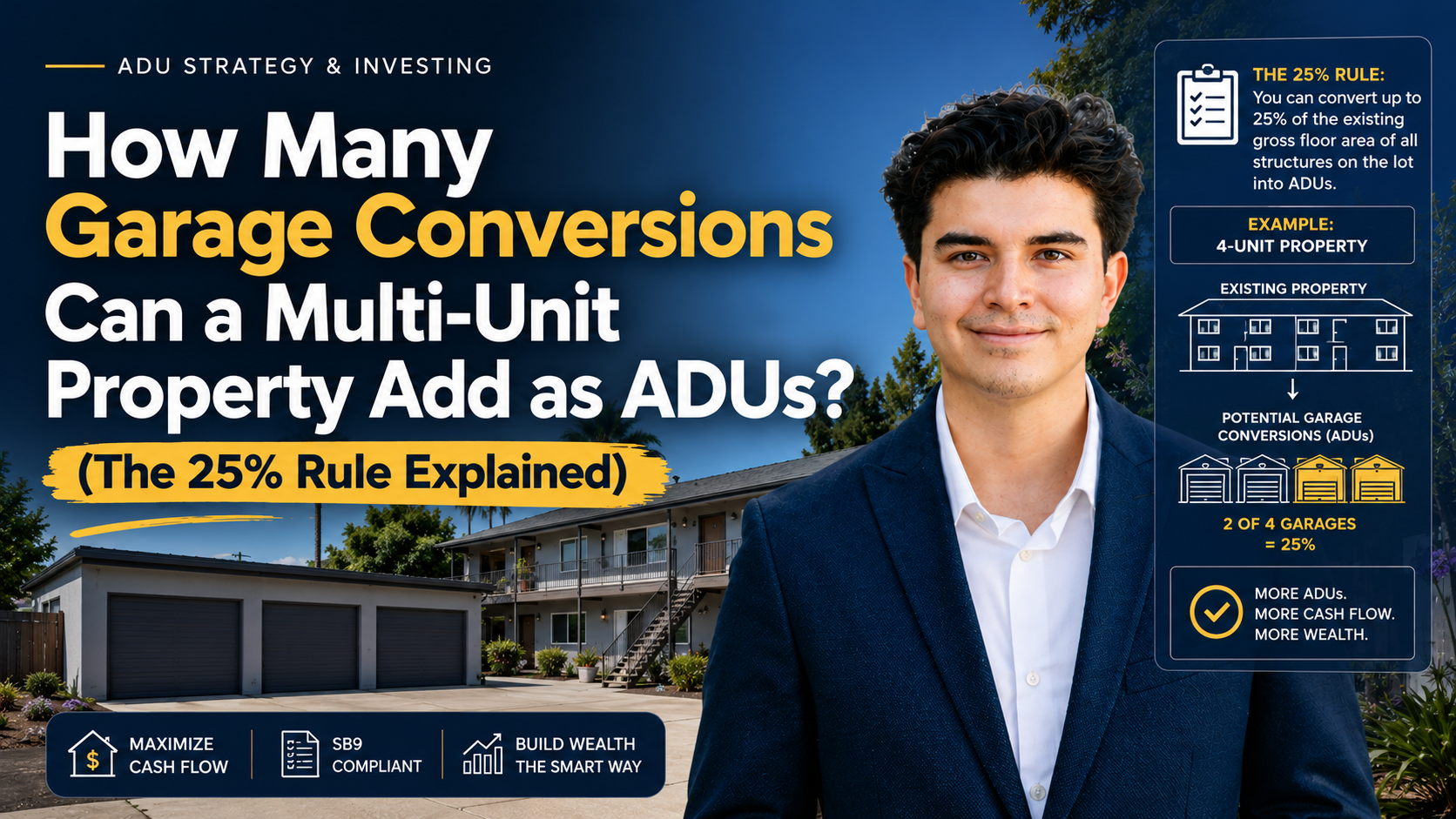
Most buyers shopping for duplexes, triplexes, and fourplexes in Orange County and LA County are underwriting what they see — the units that are already there, the rents those units collect, and the price per door. That's standard practice.
But there's a category of multi-unit property where the real deal isn't in the existing rent roll. It's in the garage out back. Or the storage room on the ground floor. Or the carport nobody uses.
California law gives multi-unit properties a specific right — guaranteed by state statute — to convert non-livable space into a full ADU. For any building with four or fewer units, that's a minimum of one conversion ADU, no matter what the city says. For larger buildings, it scales at 25% of existing units.
When a property is listed and priced as a fourplex but has a detached garage that qualifies for conversion, you're not looking at a fourplex. You're looking at a fiveplex that the current owner hasn't built yet — and that the market hasn't priced in.
That gap is where buyers win.
Why This Right Transfers to You at Closing
This isn't a perk the current owner earned. It's a property right attached to the land and the structure — and it conveys with the deed.
California Government Code § 65852.2(e)(1)(C) is the statute that creates this right. It reads:
"A local agency shall allow at least one accessory dwelling unit within an existing multifamily dwelling and shall allow up to 25 percent of the existing multifamily dwelling units."
The spaces that qualify for conversion include, but are not limited to:
Garages
Carports
Storage rooms
Boiler rooms
Attics
Basements
Passageways
The word "shall" in that statute is doing a lot of work. No city in California can legally block a qualifying conversion on a multi-unit property. The local jurisdiction controls the permit process, but it cannot say no to a conversion that meets HCD's ADU standards. That right is yours the day escrow closes.
The Math: How Many Conversions Does the Property You're Looking At Actually Support?
The formula: 25% of existing units, minimum 1, rounded down.
Because 25% of any number below 4 produces a fraction, properties with 4 or fewer units all share the same floor — one guaranteed garage conversion ADU. The number doesn't increase until the building reaches 8 units.
When you're touring a duplex, a triplex, or a fourplex — and you spot a garage, a carport, or a storage structure on the lot — you're looking at a potential additional unit that state law says you're entitled to build. The question isn't whether you can. The question is whether the garage is large enough, structurally sound enough, and worth the conversion cost relative to what you're paying for the property.
What to Look for When You're Touring
Not every garage on a multi-unit property is a conversion candidate worth underwriting. Here's how to assess quickly when you're walking a property:
Size. A standard two-car garage runs roughly 400–500 square feet — enough for a legitimate studio or one-bedroom ADU. A one-car garage at 200 square feet gets tight and may have ceiling height issues. Bigger is obviously better. Measure or ask the listing agent for dimensions.
Detached vs. attached. A detached garage that sits separately from the main structure gives you cleaner separation, easier permitting, and a more rentable ADU (separate entrance, no shared walls with existing tenants). An attached garage or a ground-floor parking bay works too, but the conversion is more complex.
Ceiling height. California's residential building code requires a minimum 7-foot ceiling in habitable space. Some garages — especially older ones — sit lower. If the garage slab is at grade and the ceiling is 7'6" or above, you're probably in good shape. If it's 6'8", you're looking at a more expensive conversion involving raising the roofline or slab work.
Condition of the structure. A garage that's been neglected for 20 years is a different project than one that's solid and weather-tight. You're not buying the garage as-is — you're buying the right to convert it — but the condition affects your conversion budget.
Current use. Is anyone using the garage? Is it leased to a tenant? Is it full of the owner's belongings? A garage that's been sitting empty is easier to move on. One that's occupied or leased out means you'll need to think through timing and tenant management before conversion starts.
How to Underwrite the Opportunity
When you spot a qualifying garage on a multi-unit listing, here's the framework for figuring out whether it changes your offer:
Step 1: Estimate the conversion cost. Garage conversions in OC and LA County typically run $80,000–$150,000 depending on size, finish level, and scope of work. Get a rough estimate before making an offer if you can, or build a contingency range into your analysis.
Step 2: Estimate the ADU's market rent. What would a one-bedroom unit in that submarket rent for? In Anaheim, Garden Grove, or Long Beach, a 400–500 square foot one-bedroom ADU currently commands $1,600–$2,200/month depending on quality and location. Run it conservatively.
Step 3: Calculate the value you're adding. Apply a cap rate consistent with that submarket. If the ADU generates $2,000/month ($24,000/year) and properties in the area trade at a 5% cap rate, that ADU represents $480,000 in added stabilized value — minus your conversion cost. A $120,000 conversion that creates $480,000 in value is a compelling trade.
Step 4: Price the deal accordingly. If the market hasn't priced in the ADU potential, you have room to pay slightly more than competing buyers while still underwriting a better deal. The seller sees their fourplex. You see a fiveplex. That's the advantage.
Real-World Scenarios to Run Through
Anaheim Duplex, Detached Two-Car Garage
A duplex in Anaheim is listed at $750,000. The listing mentions a two-car detached garage on the rear of the lot — currently unused, accessed from the alley. The existing two units are rented at $1,800 and $2,000/month.
Under state law, you have the right to convert that garage into one ADU. A 450 square foot studio or one-bedroom conversion in Anaheim rents for roughly $1,700–$1,900/month. At $1,800/month, that's $21,600 in additional annual income. At a 5.5% cap rate, you've added roughly $393,000 in property value for a conversion cost of $100,000–$130,000.
The duplex isn't priced as a triplex. But with the garage, that's effectively what you're buying. If you're already thinking about what that looks like at resale, the guide to preparing a multi-unit Anaheim property for sale shows how ADU-added properties are positioned when they hit the market.
Garden Grove Triplex With Ground-Floor Parking Bay
A triplex in Garden Grove has an attached ground-floor parking bay that sits below one of the units. It's been used for tenant parking, but the tenants all park on the street. The listing price reflects three units.
You're entitled to convert that parking bay into one ADU. If the bay is 500 square feet with a high enough ceiling, you're looking at a one-bedroom unit that rents for $1,700–$1,900/month in Garden Grove. Your triplex becomes a de facto fourplex, and your GRM improves materially. Garden Grove has some of the strongest comp data for multi-unit ADU properties in OC right now — buyers who understand that are competing differently. For more on how multi-unit investing works in LA County, including how to frame ADU rights in your purchase analysis, that post breaks down the full picture.
Long Beach 12-Unit Building With Parking Structure
A 12-unit apartment building in Long Beach has an attached parking structure with individual tenant stalls. Under the 25% rule, you're entitled to convert up to three of those stalls into ADUs after closing.
Three additional units at $1,800–$2,000/month each is $5,400–$6,000/month in new gross income — $64,800–$72,000/year. At a 5.25% cap rate, that's $1.2M–$1.37M in additional stabilized value from a conversion project that might cost $350,000–$450,000 total. Long Beach is one of the strongest multi-unit markets in LA County for this play right now. The Long Beach ADU seller's guide covers what buyers in that market are looking for — useful context when you're modeling the eventual exit.
This Is Separate From the Detached ADU Rights You Also Get
The garage conversion pathway (the 25%/minimum-1 rule) is specifically about converting existing non-livable space that's already on the property. It's a distinct right from the rules that allow adding brand-new detached ADUs to a multifamily lot.
Under SB 1211 (effective January 2025), multi-unit owners can also add new detached ADUs — up to the same count as existing units for buildings with 7 or fewer units, capped at 8 for larger buildings. That's a completely separate tally.
If you're buying an 8-unit building with garage space to convert, you could be looking at:
2 garage conversion ADUs (25% of 8 units under § 65852.2)
Plus additional detached ADUs on the lot under SB 1211
These pathways stack. Garage conversion rights don't consume your detached ADU rights, and vice versa. When you're underwriting a larger multi-unit purchase, it's worth modeling both paths independently before you decide where to start.
Due Diligence Checklist for Garage Conversion Potential
Before you close on a property where a garage conversion is part of your thesis, verify these during escrow:
Confirm the garage qualifies. The structure needs to be part of the existing multifamily property — attached or on the same legal parcel. A detached garage on a separate APN is a different situation.
Check for any existing permits or violations. Request the property's permit history from the city. An unpermitted conversion or open violations on the garage complicate your plans. If you spot an issue, the post on unpermitted ADUs and AB 2533 covers your options as a buyer walking into that situation.
Review tenant leases. If a tenant has a lease that includes a parking space tied to the garage, you'll need to account for that in your conversion timeline.
Get a contractor walkthrough during inspection. You don't need a full bid in escrow, but a rough estimate from an ADU-experienced contractor gives you the data to model your return accurately.
Understand the city's processing timeline. The city can't deny the permit, but it controls how long it takes. Anaheim and Garden Grove tend to be straightforward. Factor processing time into your cash flow projections post-close.
Replacement parking. In most OC and LA County markets, you don't need to replace the parking eliminated by conversion — the state waived that requirement for properties near transit, which covers virtually every urban lot in these counties. Confirm with the local building department as a formality.
The Bottom Line for Buyers
When you're shopping multi-unit properties in OC and LA County, every garage, carport, and storage structure on the lot is a line item in your analysis — not an afterthought.
California law guarantees that any multi-unit property you buy comes with the right to convert at least one of those spaces into a full ADU. For properties with 4 or fewer units, that minimum is always 1. For larger buildings, it scales at 25%.
The sellers who listed those properties often don't know this. The agents marketing them often don't either. The buyers who do understand it are entering the same deals with a completely different investment thesis — and a materially better return.
A fourplex with a convertible garage isn't a fourplex at the price of a fourplex. It's a value-add fiveplex, and the best time to underwrite it that way is before you write the offer.
Dylan Serna is an ADU specialist agent serving buyers and investors in Orange County and Los Angeles County. If you're looking at multi-unit properties and want to know which ones have real garage conversion potential — and how to price that into your offer — reach out before you make a move.
California's Multi-Unit ADU Rule: Two Detached, Plus More Attached — What Investors Need to Know

You found a duplex, triplex, or small apartment building with a big backyard and a few unused storage rooms. Your agent says it has "ADU potential." But how much potential — exactly?
This is the question buyers almost never get a straight answer to, and it costs them. Understanding California's multi-unit ADU rules before you make an offer can change how you underwrite a deal, what you're willing to pay, and how you structure your exit years down the road.
Here's the actual rule: California state law allows you to add up to two new detached ADUs on a multi-unit lot, while additional ADUs can also be built attached to or converted from within the existing primary dwelling. These are two separate opportunities, and they run at the same time. Most buyers — and many agents — only know about one of them.
The Two-Track System Every Buyer Should Understand
When you purchase a multi-family property in California, state ADU law gives you two distinct paths for adding units:
Track 1 — Up to Two New Detached ADUs
On any lot with a multi-unit dwelling, California allows you to build up to two brand-new detached ADUs. These are standalone structures separate from the main building — a backyard cottage, a converted detached garage, a new accessory building. The state caps this track at two, and cities cannot reduce that number below what state law permits.
The phrase "proposed primary dwelling" matters here: if the main building is new construction as part of your purchase or redevelopment plan, those two detached slots apply to that new structure. If the main building is existing, they apply to it as-is.
Track 2 — Attached ADUs Converted from Existing Non-Livable Space
This is the one buyers consistently overlook. Separate from the two detached slots, California also lets you convert existing non-habitable space inside the multi-family structure into additional ADUs. Storage rooms, boiler rooms, laundry rooms, attic space, passageways — any area that isn't currently a livable unit is eligible.
The number of units you can add through this track is capped at 25% of the property's existing unit count, with a minimum of one. So if you're buying a fourplex, you can convert interior space to add one attached ADU on top of the two detached units you could build outside. A 12-unit building could add three interior ADUs through conversion.
Critically, Track 2 units don't count against your Track 1 limit. Both tracks run independently.
Running the Numbers Before You Make an Offer
This is where the two-track framework becomes a real underwriting tool. When you're evaluating a multi-unit investment property in Los Angeles or Orange County, walk through this before you finalize your offer price:
Existing unit count → determines your Track 2 ceiling (25%, min. 1)
Available detached space (backyard, side yard, detached garage) → determines Track 1 feasibility
Unconverted non-livable interior space → determines Track 2 feasibility
A triplex with an undeveloped backyard and a large storage room could legally support:
2 new detached ADUs (Track 1)
1 attached ADU from interior conversion (Track 2: 25% of 3 = 0.75, rounded up to 1)
That's three additional units on a property that many buyers would pass on assuming it was already built out. In markets like Garden Grove, Anaheim, and Long Beach — where rental demand is strong and ADU permitting has become more predictable — those three units can represent hundreds of thousands of dollars in additional value that isn't reflected in the listing price.
What Cities Can and Can't Restrict
Before you get into contract, it's worth understanding what your target city can and cannot do with these rules.
Cities have authority over how ADUs are built — setbacks, height limits, materials, design standards, parking requirements in some cases. What they cannot do is prohibit the types of ADUs the state expressly permits. If a city's local ordinance is more restrictive than state law on multi-unit ADUs, state law controls.
The best buyer-side resource for confirming this is the 2026 California ADU Handbook, published by the California Department of Housing and Community Development. It's a plain-language breakdown of exactly what cities can regulate, what they can't, and what rights you have as a property owner. You can download it directly:
Download the 2026 California ADU Handbook (English PDF)
If a seller, listing agent, or city planner tells you something doesn't pencil under local rules, the handbook gives you the state baseline to check that against. Buyers who know the rules close better deals than buyers who take someone else's word for it.
Due Diligence Questions to Ask During Escrow
Once you're in contract, these are the questions that determine whether your ADU math actually holds up:
1. Have any ADU permits already been pulled on this property? If a previous owner already added one detached ADU, you may only have one Track 1 slot remaining. Check the permit history with the city building department — don't rely on the seller's disclosure alone.
2. What is the exact existing unit count? The Track 2 ceiling is 25% of current units. Confirm the permitted unit count, not just what's physically on the property. Unpermitted units don't count toward your ceiling.
3. What square footage and configuration is the non-livable interior space? Not all storage rooms convert cleanly into habitable ADUs. Have an architect or contractor walk the property during your inspection period to assess what's actually viable.
4. What are the city's setback and height requirements for detached ADUs? Track 1 feasibility depends on whether your available yard space meets the city's minimum setbacks. A narrow side yard or an oddly shaped lot can reduce what's actually buildable.
5. Does the property have any existing unpermitted units? If so, those need to be addressed before or alongside your ADU plans. AB 2533 created a legalization pathway for unpermitted ADUs that's worth understanding before you close. What you do with those units affects your basis, your permit timeline, and your financing.
For a deeper look at what documentation to request during escrow on any property with existing ADUs, this guide walks through the full checklist.
How This Changes What You Should Pay
If you're buying a multi-unit property with unused ADU slots, those slots have real value — but only if you buy them at the right basis. A property priced as a turnkey fourplex that actually has capacity for three additional ADUs is a different investment than the seller may be representing.
The way to capture that value is to underwrite the ADU buildout into your offer model before you go into contract, not after. Run a conservative rent projection on the additional units, estimate construction cost per unit, and back into a maximum purchase price that makes the full project work. That number is your ceiling — and it's often lower than the asking price on properties being sold on current NOI alone.
In competitive markets like Anaheim, Long Beach, and Costa Mesa, understanding ADU runway before your competitors do is one of the few genuine edges a buyer can have. If you're buying a multi-unit portfolio or thinking about how individual properties are packaged and valued, that analysis gets more layered — but the two-track framework still applies parcel by parcel.
The Bottom Line for Buyers
California's multi-unit ADU law gives buyers more runway than most listings communicate. Two detached ADUs from the proposed primary dwelling, plus additional attached units converted from existing non-livable space inside the structure — these aren't theoretical. They're permitted by state law, enforceable against restrictive local ordinances, and directly underwritable into a purchase model.
If you're looking at a multi-unit property in Orange County or LA County and want a clear read on how many ADU slots are available, what they're realistically worth, and how to structure your offer around them, reach out to Dylan Serna. This is the analysis that separates investors who buy well from those who leave value behind.
Ready to Start your Investment Search?
Text or call to schedule a multi-unit Consult Call with Dylan Serna at (714) 860-2868
Sources: California HCD ADU Policy & Research | 2026 HCD ADU Handbook | Full English PDF
How Many ADUs Can You Add to a Multi-Unit Lot? The One-Per-Unit Rule Explained
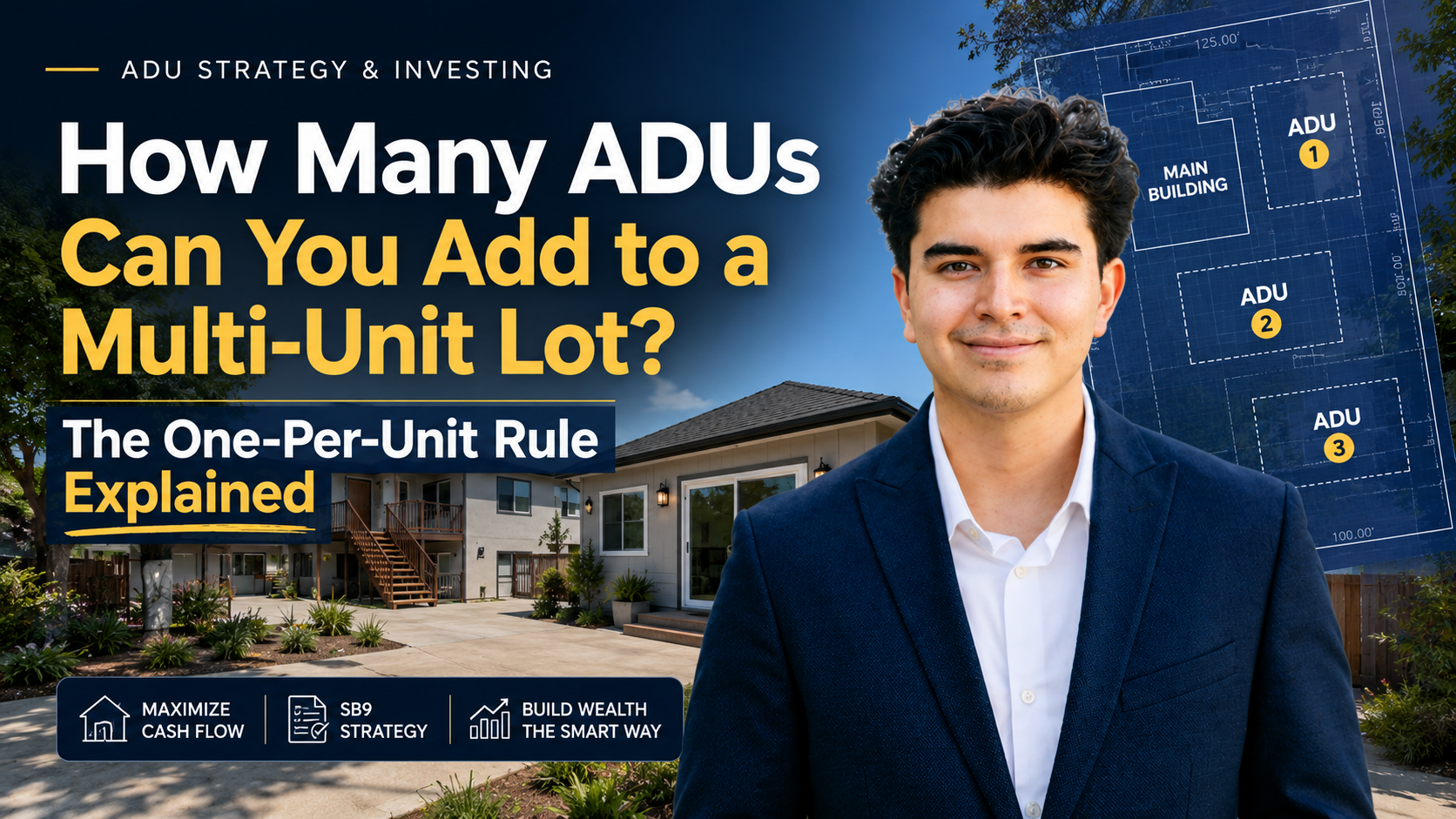
Most investors underwrite the rent roll. The smart ones underwrite the ADU potential first.
If you're shopping for a duplex or triplex in Orange County or LA County and you're not running the ADU math before you make an offer, you're leaving one of the most valuable numbers off the table. Here's the rule you need to know — and the move most buyers miss completely.
The Rule: One ADU Per Existing Unit
California state law is straightforward on this: for every existing unit on a multifamily property, you can add one detached ADU accessory to it. Not one per lot. One per unit.
That single distinction changes how you underwrite multi-family deals.
What It Looks Like Deal by Deal
R-2 lot, duplex — 2 existing units:
You can add 2 ADUs. You're buying a 2-door asset with a clear, legal path to 4 doors. No discretionary approval. No rezoning. Just permits.
R-3 lot, triplex — 3 existing units:
You can add 3 ADUs. A 3-unit property becomes 6 units. If you're looking at a triplex in a market like Garden Grove or Anaheim and the seller has no idea those ADU rights exist, that's a mispriced deal.
The Move Most Investors Miss: The Underbuilt R-3 Lot
This is the one worth hunting for.
An R-3 zoned lot is entitled for a triplex — 3 units. But not every R-3 lot actually has 3 units on it. Sometimes you find an R-3 with only a duplex sitting on it. The previous owner never built out the third unit.
Under the one-per-unit rule, you'd get 2 ADUs with what's there today. But your zoning allows a third unit — and once that third unit exists, you can add an ADU accessory to it.
The play: buy the lot, build out the 3rd unit, then add the ADU that goes with it.
You end up with 3 units + 3 ADUs = 6 doors. All of it legal under state law. You're not creative accounting anything — you're using the entitlements that are already baked into the zoning.
An underbuilt R-3 lot with only 2 units on it is one of the highest-upside finds in the multi-family market right now. Most buyers walk past it because they only see 2 units. You see a 6-door play hiding in the zoning.
How to Spot These Deals When You're Shopping
When you pull up a listing, check three things:
1. What's the zoning? R-2 or R-3 tells you the unit ceiling. That's your ADU multiplier.
2. How many units are actually built? If a lot is zoned R-3 but only has a duplex on it, flag it. That's the gap.
3. What's the lot size? ADUs require setbacks. A tight lot might limit your detached ADU options even if the unit count is right. California's ADU guidelines set the state minimums, but local cities can add their own requirements on top.
Why This Changes Your Offer Price
An R-3 lot with 2 units on the market looks like a duplex to most buyers. If you know it's an underbuilt R-3 with a path to 6 doors, you're underwriting a fundamentally different asset.
The seller is often pricing it like a duplex because that's what they see. You're buying it for what it can become. That spread is where the value-add investor makes money — not in the rent roll the day you close, but in the income the property is entitled to produce once you activate it.
Before you move on a deal like this, confirm the ADU potential with the local planning department. State law under HCD is the floor, but your city's ordinance is what gets your permits approved. One call before an offer saves a lot of assumptions.
Looking for Multi-Family Lots With ADU Potential in OC or LA?
This is exactly what I help investors find. If you're actively looking for a duplex or triplex where the ADU math makes the deal work, let's talk.
📞 Dylan Serna | ADU Specialist Agent
🌐
Buying a Lakewood Property. How can I tell it qualifies for SB9?
Before LA County will approve an SB 9 urban lot split or two-unit development in Lakewood, every applicant must complete a five-page form called the Pre-Existing Site Conditions & Household Income Certification. Most people have never seen it until a planner puts it in front of them. This post walks through every section so you know exactly what you're signing — and what answers could stop your project before it starts.
Why This Form Exists
California's SB 9 law grants qualifying single-family homeowners the right to split their lot or add a second primary unit with ministerial (no-discretion) approval. But the state never intended SB 9 to be a tool for displacing existing renters or erasing affordable housing. So LA County requires this certification to answer two questions: (1) Are there existing or recently demolished units on the site that must be replaced? And (2) were any of those units protected by rent stabilization?
This form is distinct from the ADU process. If you've been exploring Lakewood's ADU potential, understand that SB 9 involves splitting the underlying parcel — a more involved path that carries these additional screening steps.
⚠️ Important: Failing to provide accurate and complete information on this form will delay your review or result in project denial. LA County's Department of Regional Planning can also require you to produce documentation supporting your answers under penalty of perjury.
Section 1 — Identifying Your Property
Section 1 is straightforward: the Assessor's Parcel Number (APN) and the property address or site location. Have your APN from the LA County Assessor's Office ready — planners will cross-reference it against their records to verify what has previously been permitted or demolished on the site.
Section 2 — Pre-Existing Site Conditions
This is the section that actually determines your eligibility. LA County uses a series of yes/no questions to screen for rent-stabilized units, recent tenancy history, and Ellis Act withdrawals. Answer every question carefully — the wrong combination immediately disqualifies your project from SB 9 review.
Questions 2a – 2c: Does replacement even apply to you?
Question 2a: Is your project new construction of a primary building, a change of primary use, a change in the number of principal units, a subdivision, or legalization of an existing unpermitted principal unit?
If No → replacement requirements do not apply. If Yes → continue.
Question 2b: Is your project a single-family demolition/vacation, new ADU construction, conversion to resident ownership in a mobilehome park, or addition of mobilehome spaces?
If Yes → replacement requirements do not apply. If No → continue.
Question 2c: Is your project a lease project subdivision per County Code Section 21.08.090?
If Yes → replacement requirements do not apply.
If all of 2b through 2g come back "No," you can skip directly to Section 4. But most SB 9 lot-split scenarios won't skip that easily — keep reading.
Questions 2d – 2j: The History of the Site
Question 2d: Has the property contained a dwelling unit in the last 10 years (vacant, occupied, or demolished)?
Question 2e: Were any units rented at any time in the last 5 years?
Question 2f: Were any units rented at any time in the last 3 years?
If "Yes" to 2f and "Yes" to 2j → project is NOT eligible for SB 9.
Question 2g: Were any units subject to a recorded affordable-housing covenant (moderate, lower, very low, or extremely low income)?
If "Yes" to 2g and "Yes" to 2j → project is NOT eligible for SB 9. Attach a copy of the covenant.
Question 2h: Were residential units withdrawn from rent or lease under the Ellis Act in the last 15 years?
"Yes" here means your project is NOT eligible for SB 9 — full stop.
Question 2i: Were residential units withdrawn under the Ellis Act in the last 10 years?
Question 2j: Are you proposing to alter or demolish any of the existing units?
🚨 Disqualifying Conditions:
"Yes" to question 2h (Ellis Act withdrawal within 15 years) = your project is not eligible for SB 9.
"Yes" to 2f or 2g, AND "Yes" to 2j (recently rented or covenant-restricted units that you propose to demolish or alter) = also not eligible for SB 9.
These aren't soft screening criteria — they are hard legal bars under California Government Code Section 65852.21.
Questions 2k – 2o: Rent Stabilization Screening
If you answered "Yes" to 2j (proposing to demolish or alter existing units), LA County then runs the rent stabilization screen. These questions determine whether the units are covered by the LA County Rent Stabilization Ordinance.
Question 2k: Were units in a duplex (including owner-occupied), multi-unit development, or accessory dwelling unit with proof of continuous occupancy?
If yes: Were they built in 1995 or later? Units built after 1995 are generally exempt from the RSO.
Question 2l: Was the unit unpermitted?
Question 2m: Were units built in the last 15 years?
Question 2n: Have units been rented since November 20, 2018?
"No" = units have NOT had a tenant since that date. "Yes" = they have.
Question 2o: If condo or SFR: were units owned after January 1, 2020 by an individual, LLC with no corporate member, or family trust?
💡 Reading the Footnotes:
Footnote 3: If you answered "Yes" to 2j, AND "Yes" to any of 2k–2m or 2o, AND "No" to 2n — the project is still eligible for SB 9. Those units are not rent-stabilized.
Footnote 4: If you answered "Yes" to 2k, 2l, or 2m and "No" to 2n, the units are not rent-stabilized — but if they were occupied by lower, very low, or extremely low-income tenants within the last 5 years, replacement is still required.
If you have an unpermitted unit on the property, question 2l is particularly relevant to you. Answering "Yes" there can actually work in your favor for the rent stabilization analysis — unpermitted units are generally outside the RSO — but it doesn't erase the income-replacement question in Section 3.
Section 3 — Income Levels of Households in Rental Units
If replacement requirements do apply to your site, Section 3 is where you document every unit that currently exists — or existed on the site within the last 5 years (10 years if you answered "Yes" to 2d). For each unit, you identify both its income level and its bedroom count.
Income CategoryWhat It MeansReplacement RequirementUnknownTenant income not documentedCounty assumes lower-income by defaultExtremely Low≤30% of Area Median IncomeMust be replaced at same affordability levelVery Low31–50% of AMIMust be replaced at same affordability levelLow(er)51–80% of AMIMust be replaced at same affordability levelModerate81–120% of AMIReplacement typically not required
If some units are unoccupied, you use the income data for the last household in occupancy. For vacated or demolished rental properties, you use the greatest number of units that were occupied by extremely low, very low, or lower-income households — or that were rent-stabilized and rented to moderate or above moderate-income households — during the last five years.
🚨 The Unknown Income Trap: If you can't document what income category a tenant fell into, LA County assumes the worst: under Section 22.119.050.B of the LA County Code, unknown-income units are presumed to have been occupied by extremely low, very low, and/or lower-income households — in proportion to how they exist across all unincorporated county renter households, per HUD's CHAS database. Not knowing can cost you significantly more in replacement obligations than knowing.
Current LA County Affordable Housing Income Limits are published by HUD annually.
Section 4 — Owner / Applicant Certification
The final section is a wet-ink signature under penalty of perjury. By signing, you certify that everything you've provided is true and correct, and you commit to two specific obligations for any occupied units requiring replacement:
1. Relocation benefits — pursuant to the County's Rent Stabilization Ordinance, any tenant in an occupied unit that must be replaced is owed relocation assistance before they can be displaced.
2. Right of first refusal — displaced tenants have the right to return to a comparable replacement unit in the new development at an affordable rent.
These aren't optional. If you're buying a property with existing tenants and planning an SB 9 split, these obligations transfer to you. This is exactly the kind of due diligence item you should be reviewing during escrow — not after close. Our guide on what documents to collect during escrow covers the broader landscape of what to ask for before you commit.
The SB 9 Applicant Acknowledgment Form
Stapled to the back of the certification form in the Lakewood SB 9 memo packet is a separate LA County Regional Planning acknowledgment. This one covers conditions that Regional Planning doesn't verify during its own review — but which can kill your project during other county department reviews:
🏔 Earthquake Fault Zones — Properties within a delineated Alquist-Priolo fault zone don't qualify for SB 9 unless the project complies with applicable seismic protection standards. The County Department of Public Works verifies this during their review — not Regional Planning.
🌊 100-Year Flood Zones — If your property is in a FEMA 100-year flood zone, you need a Letter of Map Revision from FEMA issued to the County, or proof of compliance with minimum flood plain management criteria. Public Works verifies.
🔃 Regulatory Floodways — Properties in a FEMA regulatory floodway need a no-rise certification per Title 44 of the Code of Federal Regulations before they qualify for SB 9.
🚿 Sewer Capacity — If your property uses a private wastewater (septic) system, you must demonstrate it meets all County Public Health requirements. Percolation testing within the last 5 years (or 10 years if recertified) will likely be required. A Grading and Drainage Plan may also be required by Public Works.
⚠️ Critical Note: Regional Planning approval of your SB 9 project does not guarantee approval by other County departments. Regional Planning fees are non-refundable if another department later blocks the project. Know your site's physical constraints before you apply.
What This Means for Lakewood Property Owners
Lakewood is one of the strongest markets in LA County for SB 9 opportunity right now — the older single-family stock, lot sizes, and access to employment corridors make it a natural target. But SB 9 is not a simple process, and this form is one of the most consequential documents in that process.
Before you start an SB 9 application, you need honest answers to: Has this property ever had renters in the last 3–10 years? Has it ever been subject to an Ellis Act withdrawal? Are any units rent-stabilized? Do you know the income level of any former tenants? Are there any geological, flood, or sewer constraints on the parcel?
If you don't know the answers, the county will assume the most protective defaults — and that can mean replacement obligations, or outright disqualification. This is especially true for investors building multi-unit positions in LA County, where a history of rental activity on a site is common.
Lakewood is different from LA City, where ZA Memo 143 layers on additional ADU size flexibility for SB 9 lots. In unincorporated LA County (which governs most of Lakewood), the rules come directly from the state SB 9 statute and the County's own Title 22 implementation. This form is how the county enforces both.
💡 For Sellers Too: If you're thinking about selling your Lakewood home with an ADU or SB 9 potential, disclosure of the site's rental history is a material fact. Buyers with SB 9 ambitions will ask — and a completed Pre-Existing Site Conditions form attached to your listing package is a serious differentiator.
Have questions about your Lakewood property? I specialize in ADU and SB 9 properties across LA and Orange County. If you're trying to figure out whether your site qualifies — or you're buying into a property with existing tenants — let's talk through it before you're committed.
Ready to Start your Investment Journey?
If your looking for a ADU potential Property in the Lakewood area or surrounding Los Angeles County or Orange County area, schedule a free NO-OBLIGATION consult with Dylan Serna through text or call - (714) 860-2868
Selling My Home with an ADU: A Complete Seller's Guide
Selling a home that has an ADU is not the same as selling a standard single-family home. There are more moving parts, more questions from buyers, and — done right — more money on the table. But only if you know what you're working with going in.
This guide walks through the key things every seller needs to think through before listing a property with an accessory dwelling unit in Orange County or LA County.
How Do You Know What Your Home Is Actually Worth?
This is the first question, and it's the one that trips up a lot of sellers. You can't just look at what other homes in your neighborhood sold for and apply that to your property. An ADU adds value — but the way appraisers and the market measure that value is specific.
Properties with ADUs are valued using other local sales that also have ADUs as comparable sales. That's not a preference — it's how appraisers are required to approach it under Fannie Mae appraisal guidelines. A standard single-family comp cannot fully capture the income potential and utility that a second unit adds to your property, so appraisers look for sales that are similarly structured.
In markets like Garden Grove, Anaheim, Costa Mesa, and Long Beach, this usually isn't a problem. There's a reasonable volume of ADU-equipped sales to draw from, and your agent and the appraiser can find suitable comps without much difficulty.
The challenge shows up in thinner markets — cities like Cypress, Buena Park, or Fullerton, where ADU construction picked up later and fewer of those properties have transacted yet. When there are no local ADU comps, the appraisal process gets more complex, and the buyer's lender may push back on the valuation.
What If There Are No Local ADU Comps?
If you're selling in a market where there aren't many — or any — comparable ADU sales, the best thing you can do is work with an agent who specializes in ADU properties. This isn't a situation where a general real estate agent can just look it up.
An ADU-specialist realtor understands how to make the case for value when comps are thin. That might mean pulling from adjacent cities, using income approach methodology, or working proactively with the buyer's appraiser before an issue arises. If the value doesn't get properly supported, deals fall apart in escrow — and that's a much harder position to recover from than getting ahead of it at listing.
Does Your ADU Have a Tenant?
A lot of sellers list their ADU property with a tenant already in place. Whether that's an advantage or a complication depends on a few things.
On the upside, an active lease with a paying tenant is real proof of income — it's not theoretical rental income, it's documented cash flow. For investors buying the property, that's appealing. Buyers who understand ADUs often prefer a property with a tenant already in place because it means day-one income.
The complication is that you cannot simply ask a tenant to leave because you're selling. California tenant protections — including local rent control in many Orange County cities — control how and when tenants can be displaced. You need to understand your obligations before you list, and ideally before you have an offer on the table.
For a full breakdown of what this situation looks like and what your options are, the post on selling an ADU property with an active tenant in Orange County covers this in detail.
Do You Have the Permit Paperwork?
This one is more important than most sellers realize until they're already in escrow.
Buyers purchasing an ADU property — especially if they're financing it — are going to want documentation that the ADU was built with permits and has a valid certificate of occupancy. Their lender will likely require it. Without that paperwork, you're selling what amounts to an unpermitted structure, which changes the risk profile of the deal and can significantly affect what a buyer is willing to pay and whether they can even get financing.
Before you list, gather:
The original ADU permit (building permit for new construction, or conversion permit for garage/room conversions)
Certificate of occupancy (or final inspection sign-off)
Any utility separation records if applicable
Current property tax records reflecting the ADU
If you don't have these documents and aren't sure where to start, a title company can pull some of them, but you may also need to work with your city's building department. The post on what documents you should get during escrow on an already-built ADU property goes deeper on what buyers are going to ask for — and knowing that in advance lets you show up prepared rather than scrambling.
California's HCD ADU guidelines also clarify what constitutes a legally permitted ADU at the state level, which can be useful if your city's records are incomplete or inconsistent.
Do You Need to Find a Replacement Property First?
If you live in the main home — not the ADU — this question needs an honest answer before you list.
Selling and buying simultaneously in today's market is one of the more stressful things you can do. But if you sell first without a plan for where you're going, you may find yourself in a tight spot, especially if the replacement property you want is hard to find or takes longer than expected.
A few options sellers in this situation commonly use:
Sell with a rent-back agreement. You sell the home, close escrow, and then rent it back from the new buyer for a set period — typically 30 to 60 days — while you complete your purchase of the next property. Not all buyers will agree to this, but many will if the price is right.
Buy first, sell second. If you have the equity or resources to carry two properties for a short window, buying before you sell eliminates the timing pressure. Bridge loans exist specifically for this scenario.
Work with your agent to align timelines. A good agent who knows the ADU market can help you structure offer timelines so that your sale and your purchase close within a workable window of each other.
If you're looking for a replacement property that also has ADU potential — or a property where you could add one — knowing what to look for matters. The post on how to search for homes with ADU potential in Orange County is a useful starting point for that search.
Ready to Get These Questions Answered?
Selling a home with an ADU is a different transaction than a standard home sale. The value question, the tenant situation, the permit paperwork, the replacement property timing — each one of these can derail a deal if it's not handled correctly.
If you want to sell your ADU property in Orange County or LA County and want guidance from an agent who specializes in exactly this kind of sale, reach out. The right preparation before you list makes every step after it easier.
Call or Text Dylan Serna at (714) 860 - 2868 to explore what selling your Home with an ADU would look like