Buena Park SB-9 Lot Split: A Plain-English Guide to the City's Urgency Ordinance
You've heard the pitch — buy a single-family home in Buena Park, split the lot under SB-9, build two units on each parcel, and walk away with four income-producing doors where one house used to sit. Investors are already doing exactly that. But the strategy only works if the property you're buying actually qualifies — and a lot of buyers find out too late that the lot they went under contract on doesn't clear the bar.
This is everything you need to vet before you write an offer.
Step 1: Confirm the Zoning
Buena Park's SB-9 Urgency Ordinance only applies to lots in single-family residential zones: RS-6, RS-8, RS-10, or RS-16. Pull the zoning designation from the city's GIS portal or confirm it with the Community Development Department before you go too far. If the property is in any other zone, the SB-9 lot split path is off the table.
Most single-family homes in Buena Park are zoned RS-8 or RS-10, so this usually clears — but verify, not assume.
Step 2: Run the Lot Size Math
Under California Government Code Section 66411.7, Buena Park requires:
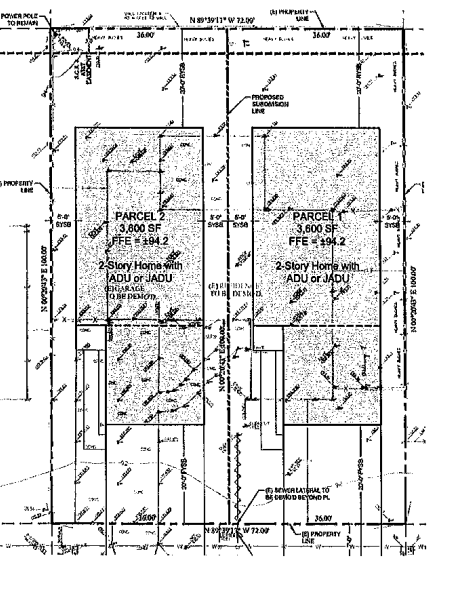
The original lot must be at least 2,400 square feet
Each resulting lot must be at least 1,200 square feet
The split must fall between a 40/60 ratio — you can't create one tiny lot and one large one
In practice, you want a lot that's comfortable above the 2,400 sq ft floor so the resulting parcels each have room to build and still meet the 10-foot minimum frontage requirement on a public right-of-way. If the lot is irregularly shaped or deep and narrow, run the geometry early. Corner lots tend to be the cleanest fit for SB-9 lot splits because they give both resulting parcels natural street access without creative engineering.
Step 3: Check for the Disqualifiers
This is where most buyers skip a step. Buena Park will deny your lot split application — ministerially and without appeal — if any of these conditions exist:
The lot was previously split. If the lot you're buying was itself created by an urban lot split, it cannot be split again. Check the parcel history.
An adjacent lot was already split by the same owner. If the seller (or anyone acting with them) already did a lot split on an adjacent parcel, your target lot is ineligible. This is worth a title and ownership history check.
The property is historic. Any lot designated as a historic property or within a historic district is out. Buena Park doesn't have a large historic footprint, but confirm before you proceed.
The lot has tenant-protected housing. This one is the most common problem for buyers targeting tenant-occupied properties. The lot split is blocked if:
The property has income-restricted or rent-controlled housing
The property was withdrawn from rental under the Ellis Act in the last 15 years
Any dwelling on the lot has been tenant-occupied in the last three years
That last point matters a lot for investment buyers. If the seller has had a tenant in the house within three years, you cannot execute a lot split until that clock clears — unless you're comfortable holding and waiting. The seller must provide a sworn statement on tenant history as part of your application. The city can investigate independently. Don't take this on faith from a seller; verify tenant occupancy history carefully before you close.
Step 4: Understand What You Can Build
Once you've confirmed the lot qualifies for a split, model out the build before you price the deal. Here's what Buena Park allows on each resulting parcel under the two-unit development rules (California Government Code Section 65852.21):
Unit count: A lot created by an urban lot split is capped at two total dwelling units — that includes ADUs and JADUs. You cannot stack a lot-split parcel with additional ADUs on top of the two-unit project. Two units per resulting lot is the ceiling.
Unit size: New primary dwellings built under the ordinance must be between 500 and 800 square feet. This is a hard cap — you cannot build 1,000 sq ft SB-9 units in Buena Park. If an existing home on the lot is already larger than 800 sq ft, it stays at its current size and cannot be expanded. The unit size rules catch a lot of buyers off guard — read that breakdown before you model your rents.
Height: Depends on your resulting lot size:
Lots over 2,000 sq ft → max one story / 16 feet
Lots under 2,000 sq ft → max two stories / 22 feet, with a required 5-foot step-back on any second-story portion
Setbacks: Interior side yard and rear yard minimum 4 feet. Corner lots must provide 10 feet from the side yard abutting a street.
Parking: One off-street space per new unit — waived if the property is within ½ mile of a high-quality transit corridor or Major Transit Stop under Public Resources Code §21064.3.
Demo cap: If the property has had a tenant in the last three years, you can only demolish up to 25% of the existing exterior walls. If the property has been vacant for three years, the cap doesn't apply. This changes your construction cost and design assumptions significantly. Know the full demo rules before you model your rehab budget.
Design standards: Buena Park is not hands-off on design. New units must match the roof pitch and style of the primary dwelling, match window style and trim, and include an accent exterior material covering at least 25% of street-facing elevations. No rooftop decks. No exterior water heaters. No windows with a direct line of sight to adjoining properties. These aren't suggestions — they're objective standards your plans must meet to get approved.
Step 5: Know the Deed Restriction Before You Close
Every two-unit project in Buena Park requires a recorded deed restriction. As the buyer, this deed restriction will run with the land — meaning it binds you and every future owner.
What it prohibits: short-term rentals under 30 days, non-residential use, and separate conveyance of the two units on any single parcel.
What it may require: owner-occupancy in one of the units — but only if the lot is NOT the product of an urban lot split. If you execute the lot split first, then build on a resulting parcel, the owner-occupancy requirement does not attach. For investors who don't plan to live on site, this sequencing matters.
Step 6: Model the Numbers
On a qualifying Buena Park lot, a full SB-9 execution looks like this:
One original parcel → split into two lots
Each lot → up to two units at 500–800 sq ft each
Potential outcome: four rentable units from one purchase
Buena Park's long-term rental market supports this strategy well — rents are consistent, vacancy is low, and you're not competing with the oversupplied condo product that plagues other OC markets. Unlike Costa Mesa or Anaheim, which have more established SB-9 comp data, Buena Park is early enough that acquisition prices haven't fully priced in the density potential yet.
On the financing side, DSCR loans underwritten against the projected rental income are increasingly available for SB-9 projects, which means you may not need W-2 income to qualify — the property qualifies itself.
The Application Process
Once you own the property and it clears all the eligibility checks, here's how the approval flows:
Submit a complete application on Buena Park's approved form with the parcel fee
The city has 30 days to flag any incompleteness
The Public Works Director approves the tentative parcel map ministerially — no hearings, no discretionary review
You have three months to record the final map or the tentative map expires
Before the final map is approved, you must record deed restrictions and utility easements with each public service provider for both resulting lots
Once the final map is recorded, each lot is its own legal parcel — you can develop, sell, or finance them separately
The ministerial approval process under California's SB-9 legislation is intentionally designed to remove discretionary obstacles. In Buena Park, that plays out in practice — if your lot meets the objective standards, the city approves it.
If you're actively looking at Buena Park properties and want a fast read on whether a specific lot clears the SB-9 threshold, reach out. I run these analyses before offers go in.
Dylan Serna is an ADU specialist agent serving Orange County and LA County. Contact dylan@serna-realestate.com
