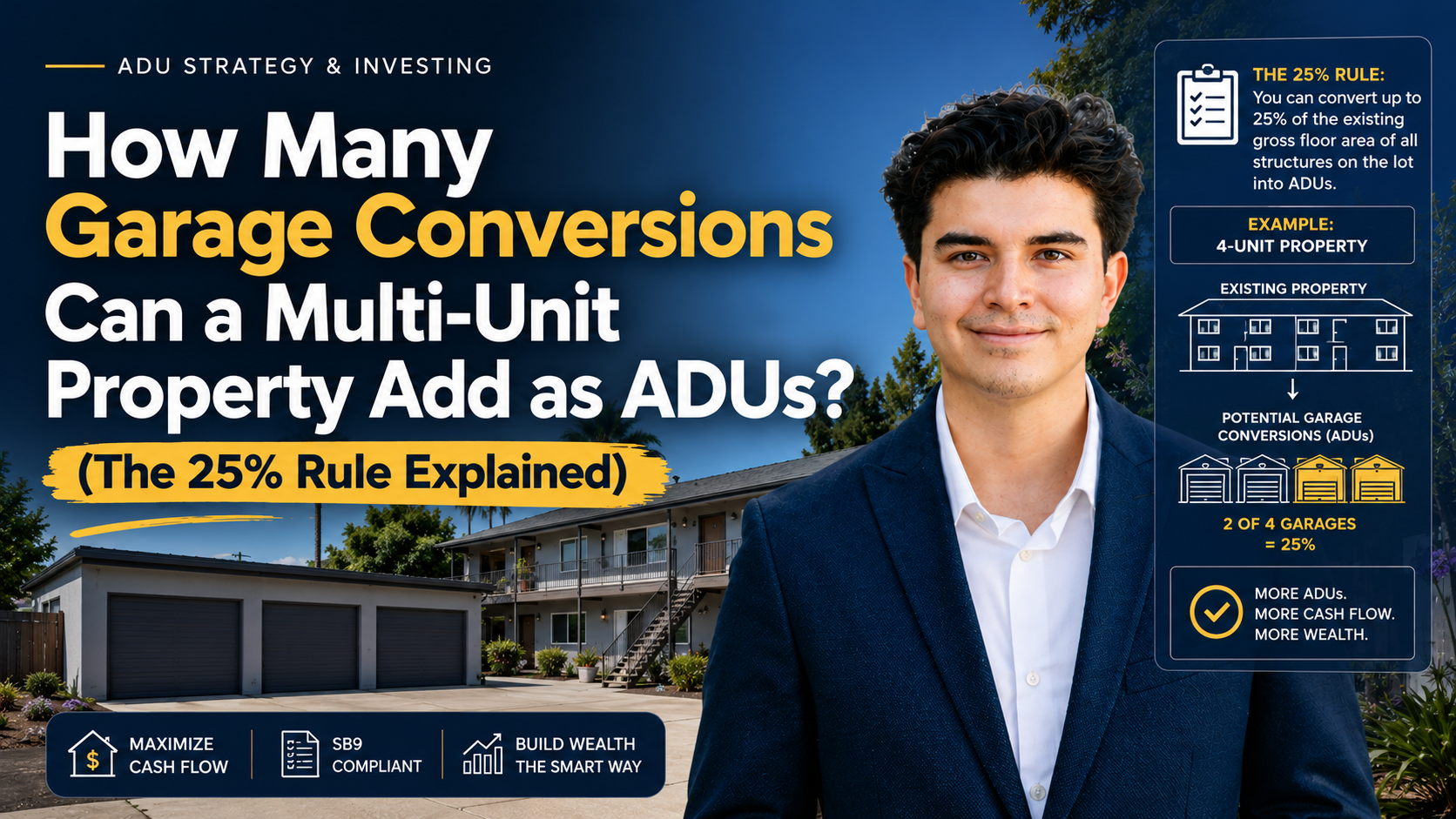
How Many Garage Conversions Can a Multi-Unit Property Add as ADUs? (The 25% Rule Explained)
Most buyers shopping for duplexes, triplexes, and fourplexes in Orange County and LA County are underwriting what they see — the units that are already there, the rents those units collect, and the price per door. That's standard practice.
But there's a category of multi-unit property where the real deal isn't in the existing rent roll. It's in the garage out back. Or the storage room on the ground floor. Or the carport nobody uses.
California law gives multi-unit properties a specific right — guaranteed by state statute — to convert non-livable space into a full ADU. For any building with four or fewer units, that's a minimum of one conversion ADU, no matter what the city says. For larger buildings, it scales at 25% of existing units.
When a property is listed and priced as a fourplex but has a detached garage that qualifies for conversion, you're not looking at a fourplex. You're looking at a fiveplex that the current owner hasn't built yet — and that the market hasn't priced in.
That gap is where buyers win.
Why This Right Transfers to You at Closing
This isn't a perk the current owner earned. It's a property right attached to the land and the structure — and it conveys with the deed.
California Government Code § 65852.2(e)(1)(C) is the statute that creates this right. It reads:
"A local agency shall allow at least one accessory dwelling unit within an existing multifamily dwelling and shall allow up to 25 percent of the existing multifamily dwelling units."
The spaces that qualify for conversion include, but are not limited to:
Garages
Carports
Storage rooms
Boiler rooms
Attics
Basements
Passageways
The word "shall" in that statute is doing a lot of work. No city in California can legally block a qualifying conversion on a multi-unit property. The local jurisdiction controls the permit process, but it cannot say no to a conversion that meets HCD's ADU standards. That right is yours the day escrow closes.
The Math: How Many Conversions Does the Property You're Looking At Actually Support?
The formula: 25% of existing units, minimum 1, rounded down.
Because 25% of any number below 4 produces a fraction, properties with 4 or fewer units all share the same floor — one guaranteed garage conversion ADU. The number doesn't increase until the building reaches 8 units.
When you're touring a duplex, a triplex, or a fourplex — and you spot a garage, a carport, or a storage structure on the lot — you're looking at a potential additional unit that state law says you're entitled to build. The question isn't whether you can. The question is whether the garage is large enough, structurally sound enough, and worth the conversion cost relative to what you're paying for the property.
What to Look for When You're Touring
Not every garage on a multi-unit property is a conversion candidate worth underwriting. Here's how to assess quickly when you're walking a property:
Size. A standard two-car garage runs roughly 400–500 square feet — enough for a legitimate studio or one-bedroom ADU. A one-car garage at 200 square feet gets tight and may have ceiling height issues. Bigger is obviously better. Measure or ask the listing agent for dimensions.
Detached vs. attached. A detached garage that sits separately from the main structure gives you cleaner separation, easier permitting, and a more rentable ADU (separate entrance, no shared walls with existing tenants). An attached garage or a ground-floor parking bay works too, but the conversion is more complex.
Ceiling height. California's residential building code requires a minimum 7-foot ceiling in habitable space. Some garages — especially older ones — sit lower. If the garage slab is at grade and the ceiling is 7'6" or above, you're probably in good shape. If it's 6'8", you're looking at a more expensive conversion involving raising the roofline or slab work.
Condition of the structure. A garage that's been neglected for 20 years is a different project than one that's solid and weather-tight. You're not buying the garage as-is — you're buying the right to convert it — but the condition affects your conversion budget.
Current use. Is anyone using the garage? Is it leased to a tenant? Is it full of the owner's belongings? A garage that's been sitting empty is easier to move on. One that's occupied or leased out means you'll need to think through timing and tenant management before conversion starts.
How to Underwrite the Opportunity
When you spot a qualifying garage on a multi-unit listing, here's the framework for figuring out whether it changes your offer:
Step 1: Estimate the conversion cost. Garage conversions in OC and LA County typically run $80,000–$150,000 depending on size, finish level, and scope of work. Get a rough estimate before making an offer if you can, or build a contingency range into your analysis.
Step 2: Estimate the ADU's market rent. What would a one-bedroom unit in that submarket rent for? In Anaheim, Garden Grove, or Long Beach, a 400–500 square foot one-bedroom ADU currently commands $1,600–$2,200/month depending on quality and location. Run it conservatively.
Step 3: Calculate the value you're adding. Apply a cap rate consistent with that submarket. If the ADU generates $2,000/month ($24,000/year) and properties in the area trade at a 5% cap rate, that ADU represents $480,000 in added stabilized value — minus your conversion cost. A $120,000 conversion that creates $480,000 in value is a compelling trade.
Step 4: Price the deal accordingly. If the market hasn't priced in the ADU potential, you have room to pay slightly more than competing buyers while still underwriting a better deal. The seller sees their fourplex. You see a fiveplex. That's the advantage.
Real-World Scenarios to Run Through
Anaheim Duplex, Detached Two-Car Garage
A duplex in Anaheim is listed at $750,000. The listing mentions a two-car detached garage on the rear of the lot — currently unused, accessed from the alley. The existing two units are rented at $1,800 and $2,000/month.
Under state law, you have the right to convert that garage into one ADU. A 450 square foot studio or one-bedroom conversion in Anaheim rents for roughly $1,700–$1,900/month. At $1,800/month, that's $21,600 in additional annual income. At a 5.5% cap rate, you've added roughly $393,000 in property value for a conversion cost of $100,000–$130,000.
The duplex isn't priced as a triplex. But with the garage, that's effectively what you're buying. If you're already thinking about what that looks like at resale, the guide to preparing a multi-unit Anaheim property for sale shows how ADU-added properties are positioned when they hit the market.
Garden Grove Triplex With Ground-Floor Parking Bay
A triplex in Garden Grove has an attached ground-floor parking bay that sits below one of the units. It's been used for tenant parking, but the tenants all park on the street. The listing price reflects three units.
You're entitled to convert that parking bay into one ADU. If the bay is 500 square feet with a high enough ceiling, you're looking at a one-bedroom unit that rents for $1,700–$1,900/month in Garden Grove. Your triplex becomes a de facto fourplex, and your GRM improves materially. Garden Grove has some of the strongest comp data for multi-unit ADU properties in OC right now — buyers who understand that are competing differently. For more on how multi-unit investing works in LA County, including how to frame ADU rights in your purchase analysis, that post breaks down the full picture.
Long Beach 12-Unit Building With Parking Structure
A 12-unit apartment building in Long Beach has an attached parking structure with individual tenant stalls. Under the 25% rule, you're entitled to convert up to three of those stalls into ADUs after closing.
Three additional units at $1,800–$2,000/month each is $5,400–$6,000/month in new gross income — $64,800–$72,000/year. At a 5.25% cap rate, that's $1.2M–$1.37M in additional stabilized value from a conversion project that might cost $350,000–$450,000 total. Long Beach is one of the strongest multi-unit markets in LA County for this play right now. The Long Beach ADU seller's guide covers what buyers in that market are looking for — useful context when you're modeling the eventual exit.
This Is Separate From the Detached ADU Rights You Also Get
The garage conversion pathway (the 25%/minimum-1 rule) is specifically about converting existing non-livable space that's already on the property. It's a distinct right from the rules that allow adding brand-new detached ADUs to a multifamily lot.
Under SB 1211 (effective January 2025), multi-unit owners can also add new detached ADUs — up to the same count as existing units for buildings with 7 or fewer units, capped at 8 for larger buildings. That's a completely separate tally.
If you're buying an 8-unit building with garage space to convert, you could be looking at:
2 garage conversion ADUs (25% of 8 units under § 65852.2)
Plus additional detached ADUs on the lot under SB 1211
These pathways stack. Garage conversion rights don't consume your detached ADU rights, and vice versa. When you're underwriting a larger multi-unit purchase, it's worth modeling both paths independently before you decide where to start.
Due Diligence Checklist for Garage Conversion Potential
Before you close on a property where a garage conversion is part of your thesis, verify these during escrow:
Confirm the garage qualifies. The structure needs to be part of the existing multifamily property — attached or on the same legal parcel. A detached garage on a separate APN is a different situation.
Check for any existing permits or violations. Request the property's permit history from the city. An unpermitted conversion or open violations on the garage complicate your plans. If you spot an issue, the post on unpermitted ADUs and AB 2533 covers your options as a buyer walking into that situation.
Review tenant leases. If a tenant has a lease that includes a parking space tied to the garage, you'll need to account for that in your conversion timeline.
Get a contractor walkthrough during inspection. You don't need a full bid in escrow, but a rough estimate from an ADU-experienced contractor gives you the data to model your return accurately.
Understand the city's processing timeline. The city can't deny the permit, but it controls how long it takes. Anaheim and Garden Grove tend to be straightforward. Factor processing time into your cash flow projections post-close.
Replacement parking. In most OC and LA County markets, you don't need to replace the parking eliminated by conversion — the state waived that requirement for properties near transit, which covers virtually every urban lot in these counties. Confirm with the local building department as a formality.
The Bottom Line for Buyers
When you're shopping multi-unit properties in OC and LA County, every garage, carport, and storage structure on the lot is a line item in your analysis — not an afterthought.
California law guarantees that any multi-unit property you buy comes with the right to convert at least one of those spaces into a full ADU. For properties with 4 or fewer units, that minimum is always 1. For larger buildings, it scales at 25%.
The sellers who listed those properties often don't know this. The agents marketing them often don't either. The buyers who do understand it are entering the same deals with a completely different investment thesis — and a materially better return.
A fourplex with a convertible garage isn't a fourplex at the price of a fourplex. It's a value-add fiveplex, and the best time to underwrite it that way is before you write the offer.
Dylan Serna is an ADU specialist agent serving buyers and investors in Orange County and Los Angeles County. If you're looking at multi-unit properties and want to know which ones have real garage conversion potential — and how to price that into your offer — reach out before you make a move.
