What Developers Are Actually Building in Costa Mesa Right Now: SB9 Lot Splits, Demolitions, and the Four-Unit Play
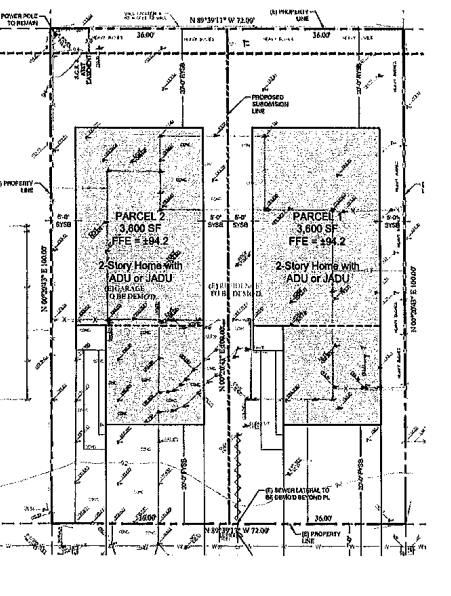
Costa Mesa has quietly become one of the most active infill development markets in Orange County. If you've been paying attention to building permits, demo applications, or even just driving around Mesa Verde and the Westside neighborhoods lately, you've probably noticed what's happening.
Developers are buying older single-family homes — mostly 1950s and 60s ranch-style houses sitting on 6,000 to 7,500 square foot lots — demolishing them, splitting the lot under SB9, and building two new structures on each resulting parcel. Done right, one acquisition becomes four rental units.
Here's exactly what that looks like on the ground — including unit layouts and lot sizes for each parcel.
The Setup: Why Costa Mesa Is the Target
Costa Mesa's R1 zones sit in a sweet spot for this strategy. The lots are large enough to split and still leave buildable parcels on each side. The city has been publishing its SB9 urban lot split decisions publicly, which means the application pathway is established. And the rental market is strong — Costa Mesa has historically tight vacancy and rents that hold up better than adjacent cities.
The other factor: these older ranch homes are often owned by long-time residents or estates, and the underlying land value has long since outpaced whatever the structure is worth. A 1,100 square foot home from 1958 on a 7,200 square foot lot is worth more demolished than renovated. Developers know this, and they're acting on it.
The Demolition Question
Yes, the existing structure gets demolished. Both lots — the front half of the original parcel and the rear — require clearing the original house before new construction begins.
This isn't just a physical necessity. It's part of the underwriting logic. Renovating a 60-year-old house to rental-ready condition in Costa Mesa is expensive, time-consuming, and leaves you with an outdated floorplan. Demolishing and building new gives you a modern structure with current insulation, electrical, plumbing, and — critically — a layout that maximizes every square foot of what you're allowed to build.
One important constraint: under California Government Code § 65852.21, you cannot demolish a unit that has been tenant-occupied within the last three years. Developers targeting this play are specifically acquiring owner-occupied properties or long-vacant homes for exactly this reason.
The Lot Split: What the Numbers Look Like
A typical Costa Mesa SB9 urban lot split on a 7,200 square foot lot produces:
Lot 1 (front parcel): approximately 4,300 sq ft
Lot 2 (rear parcel): approximately 2,900 sq ft
Costa Mesa follows state SB9 law minimums: each resulting parcel must be at least 1,200 square feet and between 40% and 60% of the original lot area. On a 7,200 square foot lot, that means the split must land between 2,880 and 4,320 square feet per parcel. Developers are typically targeting a 60/40 split to give Lot 1 more room to build the primary SFR and ADU.
The same lot-split framework applies in other SB9 markets across OC — but Costa Mesa's combination of lot sizes, rental demand, and established application pathway makes it especially active right now.
Lot 1: New 2-Story SFR + ADU
The front lot gets the more substantial build — the full new-construction single-family residence.
The SFR (Main House)
Stories: 2
Bedrooms / Bathrooms: 3 bed / 2.5 bath
Approximate square footage: 1,500–1,750 sq ft
First floor: Open kitchen, dining, living room, half bath, direct garage access
Second floor: Primary suite with ensuite bath, two additional bedrooms, full hall bath
Parking: Attached 2-car garage
The ADU (Detached, Rear Yard)
Stories: 1
Bedrooms / Bathrooms: 2 bed / 1 bath
Approximate square footage: 800–850 sq ft — at or near the maximum permitted under California ADU law
Layout: Open-concept living/kitchen, two bedrooms on one side, full bath
Entry: Private entrance from alley or side yard, no shared walls with main house
Setbacks: 4-foot rear and side setbacks per the HCD ADU Handbook
Corner lot configurations are the most buildable for this front-lot strategy — independent ADU entry, more rear yard, and better separation from the street. Developers hunting for this play are specifically filtering for them.
Combined income potential on Lot 1: The SFR rents for approximately $4,200–$4,800/month in Costa Mesa's current market. The 2-bed/1-bath ADU at 800+ sq ft realistically rents for $2,200–$2,500/month. That's $6,400–$7,300/month in gross income from a single parcel.
Lot 2: New 2-Story SB9 Primary Unit + ADU
The rear lot is the more compact build, but developers are engineering this parcel carefully to maximize every buildable square foot.
The SB9 Primary Unit
Stories: 2
Bedrooms / Bathrooms: 2 bed / 2 bath
Approximate square footage: 1,200–1,400 sq ft
First floor: Living room, kitchen, dining area, one bedroom with full bath (designed as a flex/guest suite or home office)
Second floor: Primary bedroom with ensuite, walk-in closet, laundry
Parking: 1-car attached garage or tandem driveway parking
Setbacks: 4-foot rear and interior side setbacks per SB9 state standards
The ADU (on the SB9 Parcel)
Stories: 1
Bedrooms / Bathrooms: 1 bed / 1 bath
Approximate square footage: 500–600 sq ft
Layout: Living area with kitchen, one bedroom, full bath
Entry: Private entrance from rear property line or alley
Utilities: Separately metered per Costa Mesa ADU ordinance requirements
Combined income potential on Lot 2: The SB9 primary unit rents for approximately $3,200–$3,600/month. The 1-bed/1-bath ADU rents for approximately $1,700–$2,000/month. That's $4,900–$5,600/month in gross income from the rear lot.
The Full Four-Unit Picture
When you stack both parcels together:
UnitTypeBed/BathEst. Sq FtEst. Monthly RentLot 1 – SFRNew 2-story SFR3 bed / 2.5 bath~1,650 sq ft$4,200–$4,800Lot 1 – ADUDetached ADU2 bed / 1 bath~825 sq ft$2,200–$2,500Lot 2 – SB9 UnitNew 2-story primary2 bed / 2 bath~1,300 sq ft$3,200–$3,600Lot 2 – ADU1-story ADU1 bed / 1 bath~550 sq ft$1,700–$2,000Total~4,325 sq ft$11,300–$12,900/mo
That's roughly $11,000–$13,000/month in gross rent from a single original parcel — before expenses, and before any appreciation on the newly constructed assets. Investors engineering this kind of income stack with SB9 and ADUs are now doing it systematically, not opportunistically.
What This Means for Buyers and Sellers
If you're a buyer and you're seeing new-construction listings in Costa Mesa described as "SFR with ADU" or "new build on split lot" — this is the play that produced them. Before you make an offer, understand how the income from each unit is treated at appraisal. ADU income and SB9 unit income aren't always appraised the same way, and getting that wrong affects your offer price and your financing. Lenders count ADU rental income differently depending on the loan program — knowing which structure gives you the most underwriting flexibility changes the math on what you can actually buy.
If you're a seller sitting on a larger Costa Mesa R1 lot with an older home on it — this is what your land value actually represents right now. The question isn't whether to renovate. It's whether a developer is already looking at your lot. Understanding what a property with ADU potential is actually worth in a market where developers are running this math is a different conversation than a standard CMA.
If you want to understand what your Costa Mesa property is worth in this environment — or if you're an investor evaluating a new-construction ADU play in OC — reach out to Dylan Serna.
Call or text: (714) 860-2868
Dylan Serna is an ADU specialist real estate agent serving buyers and sellers across Orange County and LA County. DRE #02217359
