What You Need to Know Before Going Under Contract on a Full Demo Project in LA County
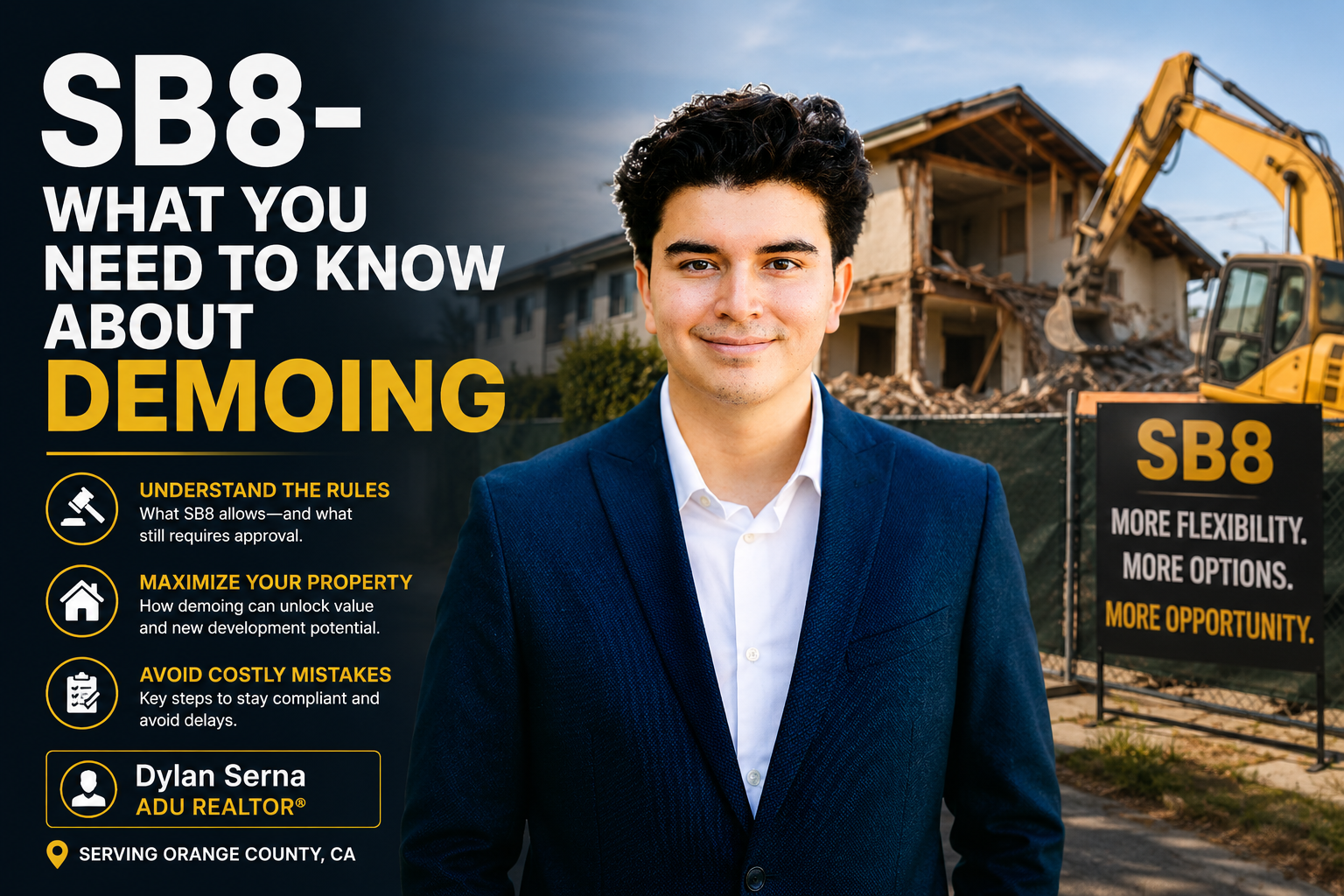
If you're looking at a property in LA County with the intent to tear it down and start fresh — full demolition, new construction, clean slate — there's a law that can stop your project cold if you haven't accounted for it before you're in contract.
SB 8. Most buyers have never heard of it. And most agents don't bring it up until you're already deep in escrow.
Here's what it is, how it applies to full demo projects, where the exemptions are, and one strategic move — parcel separation — that can change how SB 8 affects your deal entirely.
What SB 8 Is
SB 8 is not a new law. It's an extension of an existing one.
In 2019, California passed SB 330, the Housing Crisis Act of 2019. The stated purpose was to protect existing housing stock from being demolished without replacement during a period when California was critically short on housing. Among other things, SB 330 required that when existing residential units are demolished as part of a development project, those units must be replaced — unit for unit — with new housing at the same affordability levels for anyone who was a protected tenant.
SB 330 was originally set to expire in 2025. SB 8, signed in 2021, extended that expiration date to 2030. The underlying rules didn't fundamentally change — the clock just got reset. What that means practically: the replacement and tenant protection requirements that SB 330 established are in full effect through the end of this decade.
How SB 8 Applies to Full Demolition Projects
When you apply for a demolition permit in LA County on a property that has — or has recently had — residential units, SB 8's requirements activate. Here's what that means in practice.
1:1 replacement requirement. Any unit that was occupied by a renter at or below 80% of Area Median Income (AMI) within the past five years must be replaced with a new unit at the same affordability level. If the seller had low-income tenants, you're not just building whatever you want on the cleared site — you're contractually obligated to include replacement units at matching affordability levels in whatever you build. This isn't a fee or a penalty. It's a unit count requirement. You have to build the replacement housing.
Relocation assistance. If tenants currently occupy any of the residential units being demolished, you are required to provide relocation assistance — typically equivalent to several months of rent. This applies whether you purchased the property with tenants in place or they were there when your project timeline started. The tenant doesn't have to be low-income for relocation assistance to kick in; that requirement is broader.
Right of first refusal. Any tenant displaced as a result of the demolition has the right to be offered a unit in the new project at the rent they were paying — or at the restricted affordable rate, whichever is lower. You have to notify them, give them the opportunity, and document the process.
The combined effect: a full demo project on a previously tenanted property in LA County is not a blank slate. It comes with legally mandated costs and obligations attached to what was there before.
Who It Actually Affects — and How Much It Costs
The replacement and relocation requirements add real cost to a demolition project. How much depends on what was on the property before.
A vacant, owner-occupied house that hasn't been rented in years is a fundamentally different situation than a six-unit apartment building with long-term tenants paying below-market rents. The first may have minimal SB 8 exposure. The second has full-weight obligations across every unit.
Before you write any offer on a full-demo project, you need to know: how many residential units currently exist or existed on the property within the last five years; whether any were rented (and at what income levels); whether any current tenants remain; and the current AMI for the relevant LA County submarket, which HCD publishes annually.
Those four answers determine what SB 8 actually costs you — in replacement units, relocation assistance, and project constraints. This is the same framework I walk through in the pre-offer analysis I run on every LA County investment property — SB 8 exposure is one of the first boxes I check.
SB 8 Exemptions: Where They Apply
SB 8's requirements have specific carve-outs. These are the ones that actually matter in the LA County context.
Vacancy of 5+ years. If no tenant has occupied any unit on the property for at least five consecutive years before you submit your demolition permit application, the relocation assistance and right of first refusal requirements do not apply. This is one of the most commonly cited exemptions — and the one sellers and their agents sometimes misrepresent or misunderstand. Five years is the threshold. Three years doesn't count. Document the vacancy history carefully, because you'll be asked to prove it.
Uninhabitable structures. Units that have been declared uninhabitable by a local health or building official are exempt from the replacement and tenant protection requirements. This isn't a self-certification — it requires an official determination from the city or county. Properties in severe disrepair that have been formally red-tagged may qualify.
Owner-occupied without rental history. A property that was owner-occupied — not rented, no tenants in the lookback period — sits in a cleaner position under SB 8. The protections are specifically designed around displaced renters. If there are no renters to displace, the most significant obligations don't attach.
What doesn't exempt you: the fact that the property "looks abandoned," that the seller says it hasn't been rented recently, or that the tenants have already vacated since you opened escrow. SB 8 looks backward. The occupancy history in the five years preceding your application is what determines your exposure.
The Lot Split Strategy: Separating Parcels to Narrow SB 8's Reach
Here's the part most buyers don't know.
SB 8 applies to the parcel where the residential units exist. If a property is made up of multiple parcels — or if you can legally separate a larger lot into distinct parcels before applying for demolition permits — you can potentially isolate SB 8's reach to only the parcel that contained the residential units.
The practical version of this: say you're buying a large lot that has a small existing residential structure on one portion and otherwise undeveloped land adjacent to it. If that property can be split into two legal parcels — one containing the residential structure, one vacant — you can pursue demolition on the parcel with the structure while keeping the adjacent parcel clean of SB 8 obligations.
California's SB 9 created the urban lot split pathway for qualifying single-family parcels. But traditional lot splits and parcel map applications through the city's planning department are available across a broader set of property types. The mechanism matters less than the outcome: if you can legally establish separate parcel identities before the demolition application goes in, the replacement and tenant protection requirements follow the parcel history — not the combined lot.
This isn't a loophole. It's proper project sequencing. The parcel separation has to be legitimate, legally completed, and documented before the demolition permit application. You can't retroactively apply it after you've already triggered SB 8 obligations.
Whether a specific lot qualifies for a parcel split depends on the local jurisdiction's subdivision rules, lot size minimums, and access requirements. In LA County's unincorporated areas, that's the County Planning Department. In the City of Los Angeles, it's the Bureau of Engineering. The LA County 2026 ADU ordinance updates have also expanded flexibility around how parcels can be developed — worth reviewing if you're working in unincorporated county territory. And for City of LA parcels specifically, ZA Memorandum No. 143 creates additional pathways for density that may interact with your overall project strategy.
Corner lot configurations — which already offer natural lot separation advantages for ADU and SB 9 projects — can also make the parcel split geometry cleaner. Two street frontages make it easier to establish independent access to both resulting parcels without creating easement dependencies.
What to Do Before You Write the Offer
Full demo projects in LA County require more pre-offer due diligence than a standard acquisition. Here's what to verify before you're in contract.
Pull the permit history. The LA County Building & Safety portal and the City of Los Angeles's LADBS portal (for city parcels) will show you what was permitted on the site, whether there were residential units, and any code enforcement actions. This is public record.
Get the occupancy history in writing. Ask the seller — via your agent, in writing — for a declaration of the occupancy status for each residential unit for the past five years. If they can't produce that, factor the uncertainty into your offer.
Identify the parcel configuration. Is this a single APN or multiple? If it's a large lot with a single APN, understand whether a parcel split is viable before you're committed to the deal. That analysis happens before the contract, not after.
Talk to a land use attorney. SB 8 is fact-specific. The exemptions and obligations depend on precise facts about the property's history, and those facts need to be reviewed by someone who knows California housing law — not just your contractor or your agent.
Model the replacement cost. If SB 8 applies and you're required to replace affordable units, those replacement units need to go into your pro forma as a real cost. Don't close on a deal where you've assumed the requirement away.
If you're buying multi-unit properties in LA County with the intent to add density, the SB 8 analysis is especially important — the more units that existed on the property, the greater the potential replacement obligation.
The Bottom Line
Full demolition projects in LA County can absolutely pencil — and for the right investor, they're the path to building exactly what the market needs on the right site. But SB 8 is a real constraint that doesn't show up in the listing description.
Know it before you write the offer. Model it into your costs. And if the lot configuration allows for a parcel split that narrows the law's reach, that's a strategic conversation to have with your team before you're in escrow — not after you're already committed.
If you're evaluating a demo project in LA County and want to understand how SB 8 affects that specific deal — what it costs, whether the exemptions apply, and what the parcel options look like — reach out before you're in contract. That's where the analysis actually matters.
Ready to Start?
Call or text Dylan Serna for an LA Investor Call at (714) 860-2868
Dylan Serna | ADU Specialist | DRE #02217359 Call or text: (714) 860-2868 | adurealtor.net | Book a Strategy Session
