Why Savvy Multi-unit Investors Are Targeting New Construction in Los Angeles City
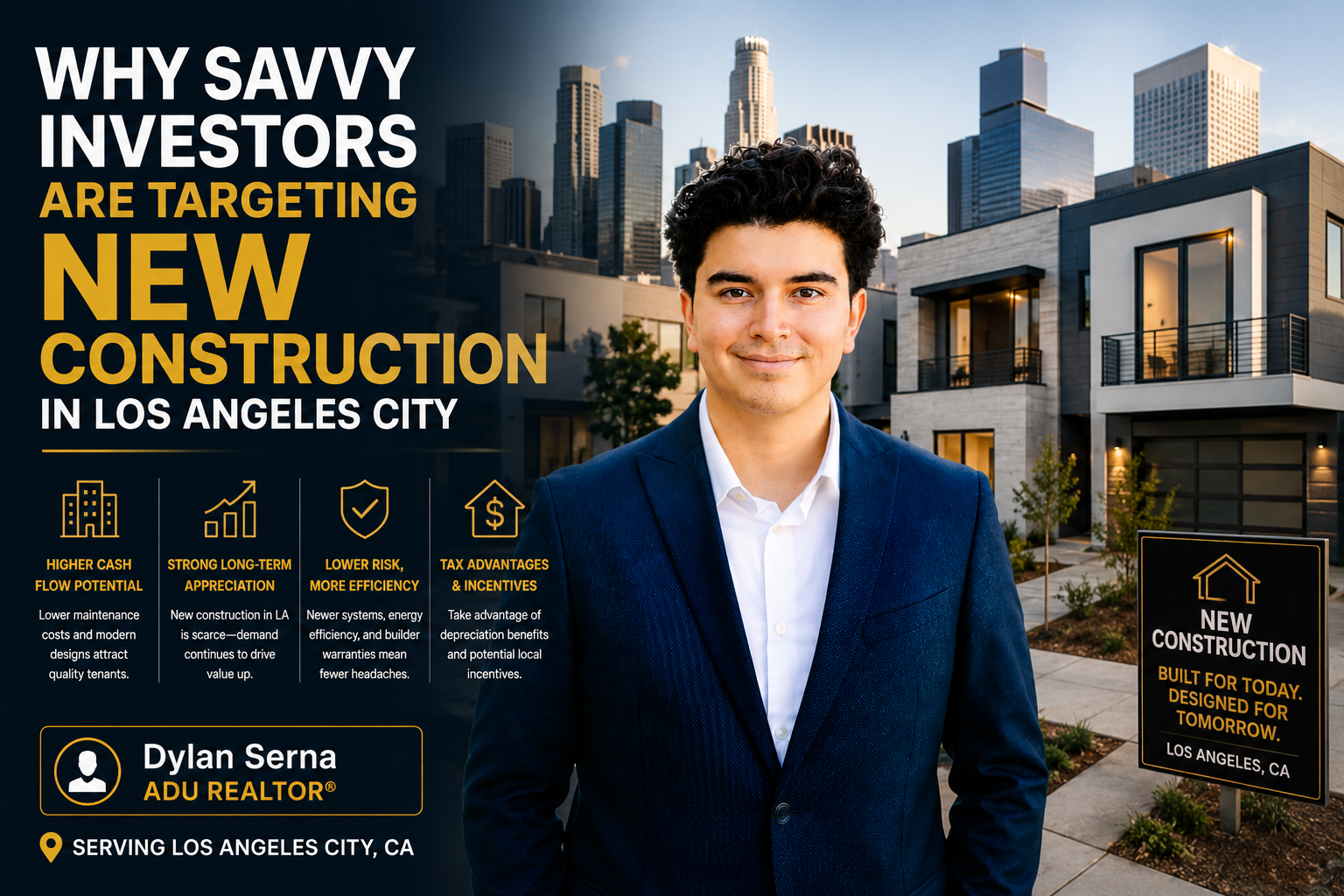
If you're looking to buy investment property in Los Angeles, there's one filter that changes everything: the year it was built.
Buildings constructed after October 1, 1978 are exempt from the City of Los Angeles Rent Stabilization Ordinance (RSO) — the city's strict rent control law. And if you narrow it down to new construction built within the last 15 years, you're not just getting a modern asset. You're buying into a completely different set of landlord rules.
Here's why that matters — and how to actually find these deals.
What the RSO Controls (And Why New Builds Escape It)
The RSO covers approximately 624,000 units across 118,000 properties in LA city. Under the RSO, landlords face annual rent increase caps set by the city, strict grounds required to evict a tenant, mandatory relocation assistance payments for no-fault evictions, and annual registration fees and compliance requirements.
According to the Los Angeles Housing Department, properties built after October 1, 1978 are generally exempt from the RSO. That means buildings from 2011, 2015, 2020, 2024 — virtually any new construction — falls completely outside rent control.
When a unit turns over in a new build, you set the new rent at whatever the market supports. No caps. No city-mandated allowable increase percentages. Just the rate a qualified tenant agrees to pay.
LA Is Actively Incentivizing New Development
Here's the part that surprises a lot of buyers: Los Angeles isn't just allowing new construction — it's pushing it.
The city has implemented density bonuses, streamlined permitting, and ADU ordinance amendments specifically designed to bring new units to market. The policy logic is straightforward — LA has a massive housing shortage, and aging rent-controlled stock isn't solving it. New development gets the green light.
New construction investment properties also benefit from modern systems that reduce maintenance costs, current building codes (seismic, electrical, energy efficiency), and higher achievable rents that reflect the quality of the unit.
If you want to maximize a new-build lot even further, ZA Memorandum No. 143 allows you to place up to four units on a single-family lot in the City of Los Angeles with no lot split required — a powerful tool to stack returns on new construction parcels.
The Tenant Turnover Advantage
This is where new construction gets especially attractive for investors who want to actively manage their portfolio.
On an RSO-covered property, a long-term tenant paying below-market rent can stay indefinitely unless they violate their lease or you're willing to pay relocation assistance. Moving tenants out on your timeline — to renovate, raise rent, or reposition the asset — is expensive and slow.
On a non-RSO property, the equation shifts in your favor. Rents can be taken to market between tenancies. When a lease expires, you have far more flexibility in how you re-let the unit. You're not constrained by the city's allowable increase schedule every 12 months.
That flexibility compounds over time, and it's one of the core reasons investors are increasingly targeting LA County multi-unit properties built outside the RSO window rather than chasing older multifamily stock.
One Builder Worth Knowing: Ocean Development
Not all new construction is easy to find on the open market. A lot of the best inventory sits in developer pipelines before it ever hits the MLS.
Ocean Development, Inc. is one builder actively producing new residential units in South Los Angeles. They carry a mix of completed and upcoming properties — including 4- and 5-bedroom duplexes purpose-built for investors. Their sister company, Ocean Properties, manages over 2,000 units across South LA, which means they understand the operator side of the equation, not just the build side.
If you're targeting new construction in South LA, checking what's in their pipeline — both the on-market listings and upcoming inventory — can give you a real edge before a property hits the open market.
A Few Things to Know Before You Buy
New construction isn't automatically free of all restrictions. A few nuances worth knowing:
The Just Cause Ordinance (JCO) applies to most post-1978 rentals in LA city. This means you still need a defined legal reason to evict — but you remain free to set rent at market rate, which is the real lever. Units built to replace demolished RSO buildings after July 15, 2007 may also still fall under the RSO depending on the circumstances, so you want to verify that before going under contract.
Always confirm RSO status using the city's ZIMAS tool — enter the address, click the Housing tab, and it tells you exactly where the property stands.
If you're also evaluating teardown plays or demo projects in LA as a path to new construction, there's a full breakdown of what to know before going under contract on a demolition project worth reading first. And if you're still in the early stages of evaluating any investment in LA, here's what I personally check before recommending any property.
The Bottom Line
If you're buying investment property in Los Angeles city, the age of the building is one of the highest-leverage filters you can apply. New construction from the last 15 years keeps you out of rent control, delivers a modern asset with lower ongoing costs, and positions you to capture market-rate rent when units turn over — without the city setting a ceiling on what you can charge.
LA is building more, not less. The inventory exists. You just need to know where to look and which builders are active.
Ready to find the right new construction investment in Los Angeles?
Book a call with Dylan — I work specifically with investors looking for non-RSO properties in LA that cash flow from day one. Whether you're looking at active MLS listings or upcoming developer inventory like what Ocean Development has in the pipeline, I'll help you find what fits your strategy.
