What Fullerton ADU Rents Actually Look Like in 2026 — And How Buyers Are Using Them to Qualify

If you're looking at homes in Fullerton right now and you keep landing on properties with an ADU — or properties where you could add one — there's a question you should be asking your lender before you do anything else:
Can that rental income help me qualify?
The answer, as of 2026, is yes. But the details matter. This post is for the buyer who's running the math on a Fullerton home with an ADU and trying to figure out whether the projected rent is real — and whether the bank will actually count it.
What ADU Rents Are Actually Doing in Fullerton Right Now
Let's start with the numbers, because a lot of buyers are working with guesses instead of data.
Fullerton is sitting in an interesting position in the Orange County ADU market. It's not one of the heavy-comp cities — Garden Grove and Anaheim have more volume and better appraisal data — but that doesn't mean the rents aren't real. They are.
Here's what permitted ADUs are actually renting for in Fullerton in 2026:
1-bed/1-bath ADU (500–650 sq ft): $1,900–$2,200/month
1-bed/1-bath ADU (700–800 sq ft, well-finished): $2,200–$2,400/month
2-bed/1-bath ADU (at or near 800 sq ft max): $2,300–$2,600/month
Junior ADU / studio garage conversion: $1,600–$1,900/month
For context, the overall Fullerton rental market has average 1-bedroom apartments at approximately $2,176/month and studios around $1,900/month. Fullerton's multi-unit market has been tight on inventory all year, which is keeping ADU rents firm. Permitted ADUs consistently pull toward the top of the 1-bedroom range because they offer a private entrance, yard access, and more square footage than a comparable apartment.
The key word is permitted. An unpermitted unit doesn't give you the same income reliability, and more importantly, a lender won't count unpermitted income the way they'll count rent from a legal ADU. If you're buying a property where the ADU hasn't been through the city, that's a different conversation — and a more complicated one.
How Fannie Mae's Updated Rules Changed the Math for Buyers
This is where it gets important.
As of March 2026, Fannie Mae updated its underwriting guidelines through Desktop Underwriter version 12.1 to explicitly allow ADU rental income to count toward a borrower's qualifying income. This isn't new in theory — lenders have been counting existing ADU rent for a while — but the update made the rules cleaner and expanded when projected income (from an ADU that isn't yet rented or doesn't yet exist) can be used.
Here's what the current framework looks like:
What's eligible: The subject property must be a one-unit principal residence. This is for purchase transactions and limited cash-out refinances only. The buyer has to be buying the home as their primary residence — not as a straight investment property.
How much counts: Lenders can use 75% of the fair market rent for the ADU toward your qualifying income. So if the ADU is projected to rent for $2,200/month, $1,650/month goes toward your income stack.
The 30% cap: ADU income cannot exceed 30% of your total qualifying income. If your W-2 income is $8,000/month and the ADU adds $1,650, your total qualifying income would be $9,650 — but the ADU portion ($1,650) is 17% of that total, which is well within the cap. Where this bites is when a buyer has lower W-2 income and is leaning heavily on the ADU to qualify. If the math only works because of the ADU, you might hit that ceiling.
Documentation for projected income: You'll need a market rent analysis from an appraiser — specifically a Form 1007 (Single-Unit Residential Appraisal) or Form 1025 (Small Residential Income Property Appraisal) showing what the ADU would rent for at market. Your lender orders this as part of the appraisal process.
The full breakdown of exactly how lenders count ADU rental income — including the difference between existing leases versus projected rents, and which loan programs are most flexible — is worth reading before you sit down with a lender.
The Math: What This Looks Like on a Real Fullerton Purchase
Let me run through a realistic scenario.
You're looking at a Fullerton SFR with a detached ADU in the backyard. The home is priced at $850,000. The ADU is permitted, approximately 700 square feet, 1-bed/1-bath. You're putting 10% down.
Purchase details:
Purchase price: $850,000
Down payment (10%): $85,000
Loan amount: $765,000
Rate (30-year fixed, approximate August 2026): ~6.75%
Monthly P&I: ~$4,961
Property taxes (~1.15%): ~$814
Insurance: ~$175
Total PITI: ~$5,950/month
Now you add the ADU.
Projected ADU rent: $2,200/month
75% used by lender: $1,650/month added to qualifying income
If your household income is $12,000/month ($144K/year), that ADU adds $1,650 to your qualifying picture — bringing your effective qualifying income to $13,650/month. At a standard 43% DTI threshold, that means you can carry up to $5,870/month in total debt service. With the ADU income in the stack, a $5,950 PITI becomes workable instead of a stretch.
And from a cash flow standpoint: $5,950 PITI minus $2,200 actual monthly rent = $3,750 effective monthly cost to own an 850K home in Fullerton with a backyard rental unit.
That math is why buyers are specifically searching for ADU properties right now — not as investment plays, but as affordability tools.
What Fullerton's ADU Rules Mean for Your Property Search
If you're buying a property with the intention of adding an ADU (rather than purchasing one with an existing unit), you need to understand what Fullerton actually allows before you fall in love with a floor plan.
California state law through HCD sets the baseline minimums, and Fullerton's local ordinance (Municipal Code 15.17.100, updated effective January 1, 2026) largely follows the state framework:
Maximum ADU size: 800 square feet for a detached unit
Minimum ADU size: 150 square feet
Setbacks: 4 feet from rear and interior side property lines (state standard)
Height: Up to 16 feet for a detached ADU; up to 25 feet if attached to the primary home
Parking: No more than one space per bedroom required for the ADU
Owner occupancy: Not currently required for most configurations following the 2026 update
The 800 square foot cap is your income ceiling for a new ADU in Fullerton. A well-finished 800 sq ft 2-bed/1-bath in a good neighborhood is a $2,400–$2,600/month unit. That's meaningful income, and it's income that — with the right loan program — you can start counting before the first tenant ever moves in.
If you're looking at an existing property with a garage that could convert to a Junior ADU, the HCD ADU Handbook is the definitive reference for what each unit type requires and what the permitting pathway looks like.
The Due Diligence Questions That Actually Matter
Before you write an offer on any Fullerton property where ADU income is part of your buying thesis, here's what you need to verify:
Is the ADU permitted? This is not a detail. An unpermitted ADU cannot be counted in your qualifying income, cannot be legally advertised as rental space, and creates disclosure and liability issues when you eventually sell. Pull the permit history through the City of Fullerton Planning Division before you're in escrow, not during it.
What does a market rent analysis actually show? The number your agent tells you and the number an appraiser puts on a 1007 form can be different. Know what the appraisal will support — not what the seller is claiming the ADU "could rent for."
What's the condition of the unit? A permitted ADU that needs $30,000 in work to be rentable changes the income timeline. Build that into your offer price.
How does this affect your appraisal? How a home with an ADU is valued when you sell is a function of comps, not just income — and Fullerton has thinner ADU comp data than Anaheim or Garden Grove. Understanding how the appraiser will approach the income method versus the sales comparison method matters for your purchase price and your financing.
Before writing any offer on an OC or LA income property, this is the checklist I walk every buyer through. It applies just as much to a single-family home with one ADU as it does to a multi-unit.
Why This Strategy Works Particularly Well in Fullerton
Fullerton is a market where the underlying home prices are real — you're not in bargain territory — but the ADU potential is strong because of lot sizes, strong renter demand from CSU Fullerton and the surrounding employment base, and relatively permissive new state rules that the city has adopted.
The income-to-price ratio on a Fullerton SFR with a permitted ADU compares favorably to what you'd see in coastal cities, where purchase prices are higher but ADU rents don't scale proportionally. An $850K home in Fullerton with a $2,200/month ADU is a different affordability picture than a $1.3M home in Costa Mesa with a $2,400/month ADU — even though the ADU rents are close.
This is exactly the kind of analysis worth doing with a spreadsheet before you decide which market to focus on. The ADU income doesn't change dramatically between cities. The purchase price does.
How to Find the Right Property
Not every Fullerton property advertised as having an ADU actually has a permitted one. And not every property with ADU potential is priced to reflect it correctly.
If you're a buyer specifically targeting this strategy — using projected or existing ADU rent to help qualify or offset your payment — the search needs to be structured around ADU potential from the start, not treated as a bonus feature to discover mid-escrow.
A customized ADU property search built around your specific income targets and qualification needs is a different tool than the standard Zillow filter. You're looking for the right lot size, the right setbacks, the right existing structure — or already-permitted units — in neighborhoods where ADU demand is strong.
If you want to run the numbers on a specific property you're looking at in Fullerton — whether it's a home with an existing ADU or a lot where you're thinking about building one — call or text me directly.
I'll tell you what the unit would realistically rent for, how a lender is likely to count it, and what the full purchase picture looks like before you spend a dollar on inspections.
Dylan Serna | The ADU Realtor 📞 (714) 860-2868 adurealtor.net | Free ADU Buyer Guide
Dylan Serna is an ADU specialist real estate agent serving buyers and sellers across Orange County and LA County. DRE #02217359
What Your Stanton ADU Will Actually Rent For: A Buyer's Real-World Income Projections by Bedroom and Square Footage
If you're buying a property in Stanton specifically to build an ADU, the number you need before you write an offer isn't the construction cost — it's the rent. Everything else in your underwriting flows from that one figure. Get it wrong and you've overpaid for the land, miscalculated your carrying costs, and built a project that doesn't pencil the way you modeled it.
Two ADUs just rented in Stanton. Both are newly built. Both closed in summer 2026. The data is fresh, and it gives buyers something most North OC markets can't offer: actual closed comps at two different size points.
Here's what the market is actually telling you.
The Closed Comps
Comp 1: 8171 Orangewood Ave, Stanton 90680
Bedrooms / Baths: 2 bed / 2 bath
Square footage: 800 sq ft
Lease closed: $2,750/month (June 2026)
Price per sq ft: $3.44/month
Unit description: Brand new ADU, central air and heat, quartz counters, tile floors, washer/dryer hookups, 1 common wall, assigned parking
Comp 2: 7684 Ruthann Ave, Stanton 90680
Bedrooms / Baths: 3 bed / 2 bath
Square footage: 1,000 sq ft
Lease closed: $3,500/month (July 2026)
Price per sq ft: $3.50/month
Unit description: Newly built 2026 ADU on a corner lot with no common walls, separate utilities, private fenced yard, stainless appliances including refrigerator, solar owned outright, laundry room, central air and heat
Both units are move-in ready new construction. Neither renter is paying for finishes from 1985. That matters for the comp applicability — if you're building new, these two leases are your closest benchmarks in this zip code.
What the Numbers Say About Rent Per Square Foot
What's striking here isn't just the rent amounts — it's how consistent the per-square-foot figure is across two different bedroom counts.
SizeBedroomsClosed RentRent/Sq Ft800 sq ft2 bed / 2 bath$2,750/mo$3.441,000 sq ft3 bed / 2 bath$3,500/mo$3.50
Two data points. Six cents apart per square foot. The market is pricing new-construction ADU square footage in Stanton at roughly $3.44–$3.50 per square foot per month.
That's a real number you can work with.
Projected Rents by Size: What to Model Before You Buy
Using the $3.44–$3.50/sq ft range from closed comps, here's how to project income based on what you're planning to build:
ADU SizeBedroom CountProjected Monthly Rent500 sq ft1 bed / 1 bath (JADU range)~$1,720–$1,750600 sq ft1 bed / 1 bath~$2,064–$2,100700 sq ft1–2 bed~$2,408–$2,450800 sq ft2 bed / 2 bath~$2,750 (closed comp)900 sq ft2–3 bed~$3,096–$3,1501,000 sq ft3 bed / 2 bath~$3,500 (closed comp)
The bolded rows are real closed transactions, not projections. Everything else is a straight extrapolation from the same per-square-foot range.
A few things to keep in mind when you're using this table:
Bedroom count at smaller sizes matters. A 600 sq ft 1-bed will command a premium over a cramped studio of the same size. Renters in Stanton are looking for livable space — separate bedroom, not just a partition.
Layout and finish level affect where you land in the range. The Ruthann comp closed at full ask ($3,500) and had amenities working in its favor: corner lot privacy, refrigerator included, laundry room, solar. If your build hits those marks, you're modeling toward the top of the range. A more basic finish on a tighter lot — you're at the bottom.
These comps reflect summer 2026 demand. Stanton sits in Orange County without local rent control. Under California ADU law, ADUs are exempt from many local restrictions, and Stanton doesn't have a rent stabilization ordinance — which means your rental income can grow with the market year over year without a cap compressing your returns.
How a Buyer Should Use This Data
If you're underwriting a purchase in Stanton with the intention of building an ADU, here's the order of operations:
Start with the rent, not the construction cost. A lot of buyers run the build number first and then cross their fingers that the rent will justify it. Do it backwards. Lock in what the market will pay — from data like this — and then work backward to what you can spend on construction and land to hit your target return.
Model for the ADU you can actually build on the lot. California ADU law allows detached ADUs up to 1,200 sq ft in most configurations, but what you can build on a specific lot depends on setbacks, lot coverage, and existing structure size. Stanton's Planning Division administers the local ADU chapter (§ 20.400.330) under the City of Stanton's planning regulations — confirming buildable square footage before you're in contract isn't optional.
Understand how the rent counts for your financing. If you're buying a property where the ADU is already built and rented, lenders can use that income to help you qualify. If you're buying with the intent to build, the math is different — and more nuanced than most buyers expect. How lenders count ADU rental income at underwriting depends on the loan program, whether the unit is existing or projected, and whether you can document a lease. Knowing this before you make an offer determines how much house you can actually buy.
Don't ignore the resale picture. You're building this to generate income now, but the ADU also changes what the property is worth when you eventually sell. A permitted, rented ADU with documented income affects how buyers underwrite your property and which buyer pool you're marketing to. How an ADU is valued at resale in Orange County is its own topic — but it should be in your model from day one.
Why Stanton Is Worth Looking At
Stanton doesn't get talked about the way Garden Grove or Anaheim does — but that's part of what makes it interesting. Properties are still priced below some of the more established North OC markets, and the rental demand is real. These two comps didn't sit. The Orangewood unit went in 21 days. The Ruthann unit took 46 days — that's one that originally listed at $3,800 and needed a price reduction before it found its tenant, which is worth noting if you're a 3-bed builder: the market tops out around $3,500 for a 1,000 sq ft unit in this area right now.
Neighboring Buena Park gets a lot of attention from investors for similar reasons — below-market entry prices, no rent control, strong long-term demand, and the same Orange County employment base driving rental demand. Stanton has comparable fundamentals and is worth stacking against the Buena Park numbers when you're evaluating where to buy.
Both Stanton comps fall under the Garden Grove Unified School District — a factor that affects your tenant pool and demand characteristics more than most investors think.
Before You Make an Offer
If you're approaching Stanton as an ADU investment play, the pre-offer checklist matters. Lot dimensions and zoning, existing structure square footage, setback constraints, permit history on any existing structures — these aren't items you discover in escrow. They're items you verify before you write the number.
And if the property already has an ADU on it — built before you arrived — there are specific questions around permit status, legal non-conforming conditions, and rental history that can affect your financing options and future plans in ways a standard inspection won't surface.
If you want to run the numbers on a specific Stanton property — what the ADU will rent for, what you can afford to build, and how the deal pencils at current prices — reach out directly.
Call or text Dylan Serna at (714) 860-2868. I specialize in ADU investment plays across Orange County and can walk you through exactly what the income picture looks like before you commit to anything.
Dylan Serna is an ADU specialist real estate agent serving buyers and sellers across Orange County and LA County. DRE #02217359
The 90802 Multi-Unit Market Just Flipped — Here's What the July 2026 Numbers Are Telling Investors
If you've been watching the multi-unit market in Downtown Long Beach, something shifted this summer — and the July 2026 RPR data for zip code 90802 makes it impossible to ignore.
The multifamily/multiplex segment in 90802 is now officially a buyer's market. Not trending toward one — officially there.
Here's what the numbers show, and what it actually means if you're an investor looking at this pocket of Long Beach.
What the Data Says
Months of Inventory: 6.75 (up 20.54% month over month)
Six-plus months of inventory is the textbook definition of a buyer's market. And a 20% jump in a single month means this didn't creep up gradually — supply hit the market fast. Sellers who listed in the spring are still sitting. New sellers are coming on while buyers are being selective.
Median Days on Market: 41 (up 51.85% month over month)
That number is the one that should get your attention. Properties are taking more than 50% longer to sell than they were just a month ago. When days on market jump that sharply, it tells you buyer demand hasn't kept pace with supply. Sellers who priced aggressively are getting passed over.
Sold to List Price %: 92.3% (down 5% month over month)
On average, multi-unit buyers in 90802 are negotiating properties to 7.7% under list. On a $1.4M property, that's roughly $108,000 in negotiated discount. If you've been waiting for a market where you can actually get a price concession on a Long Beach multi-unit, this is that market.
Median Sold Price: $1,385,000 (down 5.46% month over month)
Multi-units in this zip closed at a median of $1.385M in July. That's down from last month. It's not a crash — but it is meaningful downward movement in a market that spent years going the other direction.
What's Happening in 90802 Specifically
The 90802 zip covers Downtown Long Beach — Alamitos Beach, the area around the Pike, Cambodia Town, the waterfront corridor along Shoreline Drive. It's one of the densest rental demand zones in all of LA County. Walkability scores are high. Transit access is strong. The tenant pool for this area is deep.
That's what makes this moment interesting for investors. You have a zip code with structurally strong rental demand — and a multi-unit segment where sellers are negotiating.
The broader Long Beach multi-unit market is showing similar buyer-friendly dynamics across other zip codes, but 90802 is where the inventory spike is most pronounced.
The ADU Angle: Why This Market Makes Sense for the Right Buyer
Here's the strategy that makes sense in a market like this: buy the multi-unit at a negotiated discount, then add an ADU to force appreciation and increase cash flow.
90802 properties — especially corner lots and properties with underutilized rear yards — are strong ADU candidates. Long Beach permits ADUs under state law and has been relatively smooth to work with on the permitting side. And Long Beach ADU rents in 2026 are holding up well, with closed comps showing solid numbers in the Downtown corridor.
The combination looks like this:
Buy a multi-unit now while sellers are accepting 7-8% under list
Add an ADU to a property that already cash flows
Collect rent on the ADU, which increases your gross rental income and improves your debt service coverage ratio
Investors doing this in LA County right now are specifically targeting the buy-negotiate-add-ADU sequence. 90802 is a textbook market for it.
How to Finance It
If you're using a DSCR loan on a multi-unit, the rental income from the existing units plus a projected ADU rent can improve your coverage ratio significantly. DSCR loans for ADU investment properties in California work on projected income, not your personal W-2 — which is why so many investors who own multiple properties prefer them for this kind of deal.
If you need to compare your options before committing to a loan structure, this breakdown of DSCR loans, HELOCs, and construction loans for multi-unit ADU projects walks through all three side by side.
Fannie Mae's guidelines for ADU income in mortgage qualification also allow lenders to count ADU rental income toward qualifying — something worth knowing before you assume you won't qualify on a higher-priced property.
What to Watch Out For Before You Go Under Contract
A buyer's market doesn't mean every deal is a good deal. A few things I'd check hard on any 90802 multi-unit right now:
Why has it been sitting? If a property has been on market for 41+ days — which is now the median — find out whether it's price, condition, or a tenant issue. Days on market at or above the median doesn't automatically mean you have leverage. It might mean there's a problem the seller hasn't disclosed.
Tenant situation. A lot of Downtown Long Beach rentals have long-term tenants with protections under California's AB 1482 just cause eviction law. Know before you close what it takes to make a unit available if your ADU plan depends on relocating a tenant.
Unpermitted work. Some of the older multi-unit stock in 90802 has ADU-like structures that were built without permits. How unpermitted ADUs get treated at appraisal is something every buyer needs to understand before they factor it into their offer price.
For a more complete picture of what I check on every investment property before writing an offer, here's my full pre-offer checklist for OC and LA multi-units.
The Bottom Line
90802 in July 2026 is giving investors a window that hasn't existed in this market for a while: real negotiating leverage on multi-unit properties in one of Long Beach's strongest rental demand zip codes.
6.75 months of inventory. 41 days on market. Sellers accepting 7.7% under list. Those numbers don't last forever — once rates shift or inventory pulls back, this window closes.
If you're evaluating a multi-unit in Downtown Long Beach right now and want to talk through the numbers, reach out. I work specifically with investors buying and selling ADU properties in Long Beach and LA County, and I can help you figure out whether a specific property pencils.
Data source: Realtors Property Resource (RPR), July 2026. Multifamily/Multiplex property type, 90802 zip code. Data is deemed reliable but not guaranteed.
What a Real SB9 Lot Split in East Side Costa Mesa Actually Looks Like:
If you've been following what developers are building in Costa Mesa right now, you already know the broad strokes — older ranch homes getting demolished, lots getting split under SB9, two new structures going up on each parcel. But most of what gets written about this strategy stays abstract. Numbers get rounded. Layouts get generalized.
This post isn't that. This is a real, city-approved SB9 urban lot split in East Side Costa Mesa with the actual lot dimensions, the actual split, and the actual square footage of both homes that got built. The City of Costa Mesa approved this project in June 2023 under PM-23-02 (Tentative Parcel Map 2023-111). Here's exactly what it looks like.
The Lot: 6,489 Square Feet on 22nd Street
The original parcel sits in the R1 (Single-Family Residential) zone, deep in East Side Costa Mesa near the Newport Beach border. It's a low-density residential neighborhood — R1 in every direction, north, south, east, and west across 22nd Street.
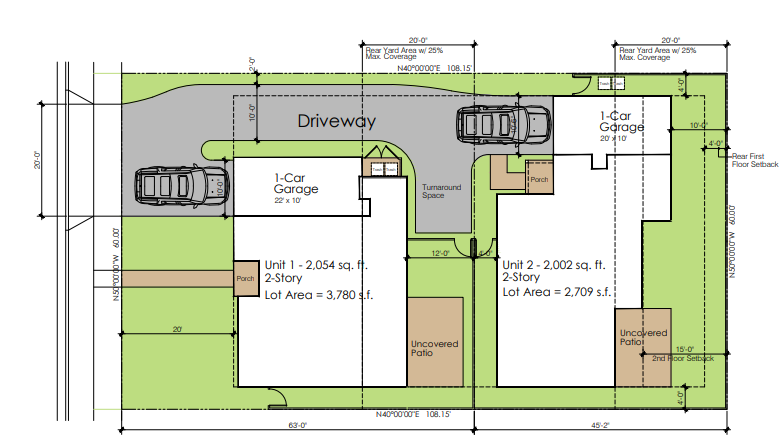
The lot came in at 6,489 square feet total, measuring 60 feet wide by 108 feet, 2 inches deep. Sitting on it was an existing 800-square-foot single-family home with a detached two-car garage — both proposed for demolition to make way for the new build.
One thing worth noting: this is not a corner lot. It's a straight rectangular mid-block parcel with a single street face on 22nd Street. Corner lots do offer real advantages for SB9 in Orange County — more flexible access points, better separation between units, easier rear lot ingress — but this project demonstrates that a standard rectangular lot can execute the strategy cleanly too. The rear parcel (Parcel 2) gets its street access via a 12-foot-wide access easement running over Parcel 1, with both driveways connecting to 22nd Street.
The Split: 3,780 and 2,709 Square Feet
Under California SB9 law, a lot split must produce two parcels where neither is smaller than 40% of the original lot area and neither drops below 1,200 square feet. On a 6,489-square-foot lot, that math produces a required minimum of roughly 2,596 square feet for the smaller lot.
This project split 58/42:
Parcel 1 (front lot): 3,780 square feet
60 feet wide x 63 feet deep
58% of the original lot area
Direct street frontage on 22nd Street (50-foot frontage)
Parcel 2 (rear lot): 2,709 square feet
60 feet wide x 45 feet, 2 inches deep
42% of the original lot area
Access via 12-foot easement over Parcel 1
Both parcels cleared the state's minimums — and both cleared Costa Mesa's own SB9 requirements as set out in Urgency Ordinance 2021-21, which the city adopted in December 2021 to comply with state law while maintaining local design standards.
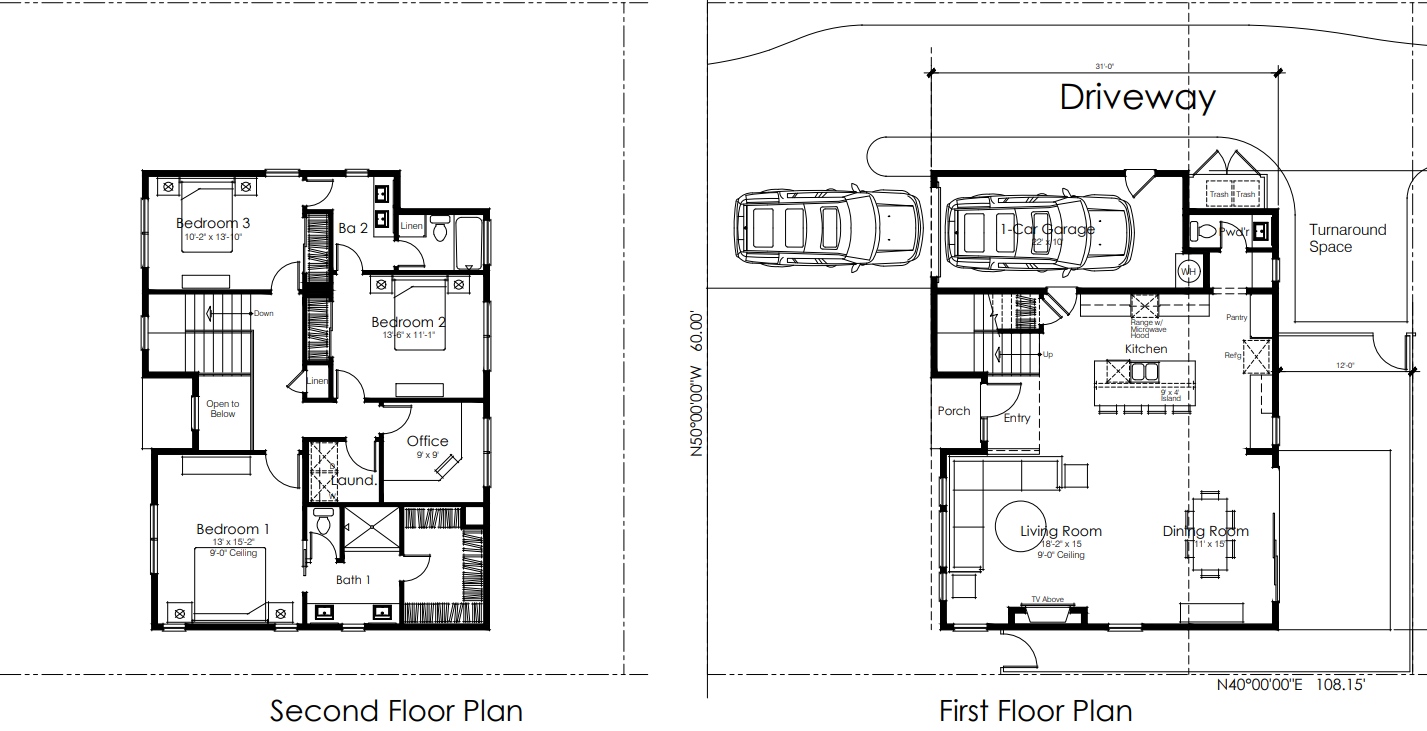
Parcel 1: A 2,054 Square Foot Two-Story Home
The front lot gets the larger of the two homes — a two-story, single-family residence with a 1-car attached garage.
Floor area breakdown:
First floor: 958 sq ft
Second floor: 1,096 sq ft
Total living area: 2,054 sq ft
1-car garage: 244 sq ft (22 ft x 10 ft)
Porch: 28 sq ft
Layout: The first floor runs an open kitchen with island, dining room, and living room with 9-foot ceilings — plus a powder room and entry porch. The second floor holds the primary bedroom suite, two additional bedrooms, a second full bathroom, and an office. Total: 3 bedrooms, 2.5 bathrooms.
Site data:
Building footprint: 1,230 sq ft (33% of lot)
Driveway: 1,025 sq ft (27%)
Open space: 1,525 sq ft (40% — exactly at minimum)
Building height: 2 stories / 27 feet
The design uses horizontal panel siding with a stone base facing 22nd Street, shuttered windows, and gabled rooflines with variation in pitch — all consistent with Costa Mesa's Residential Design Guidelines, which the city applies even to ministerially approved SB9 projects.
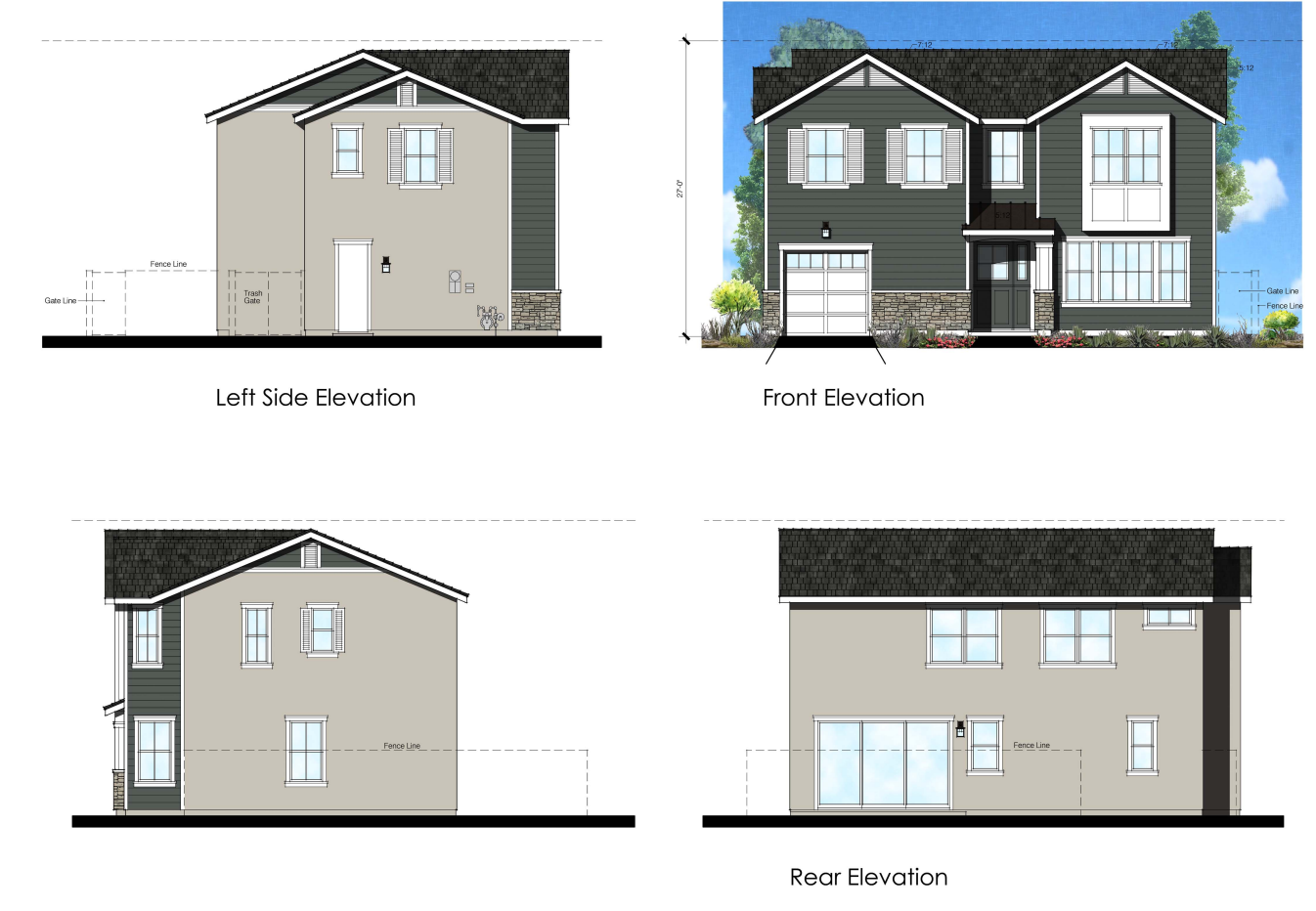
Parcel 2: A 2,002 Square Foot Two-Story Home
The rear lot isn't a throwaway. At 2,002 square feet of living area, this is a full two-story home — not a compact infill unit.
Floor area breakdown:
First floor: 991 sq ft
Second floor: 1,011 sq ft
Total living area: 2,002 sq ft
1-car garage: 227 sq ft (20 ft x 10 ft)
Porch: 31 sq ft
Layout: The first floor holds a living room with 9-foot ceilings, dining room, full kitchen, an office, powder room, and porch. The second floor has three bedrooms — including a primary suite — plus two full baths and a laundry area. Total: 3 bedrooms, 2 bathrooms.
Site data:
Building footprint: 1,249 sq ft (46% of lot)
Driveway: 150 sq ft (6%)
Open space: 1,310 sq ft (48% — well above minimum)
Building height: 2 stories / 27 feet
The rear home uses shingled siding on the street-facing elevation with enhanced trim and shutters. A hedge is proposed at the rear property line to provide privacy separation from the neighboring property on Costa Bella Court. Window placement was carefully considered — second-story windows on Parcel 2 are offset at 35 feet from the neighboring two-story home to eliminate direct sightlines.
Why This Lot Worked Without Being a Corner
The 22nd Street project shows that the SB9 lot split strategy doesn't require a corner lot to pencil. What it does require is enough raw depth. At 108 feet, this lot had the depth to produce a rear parcel over 2,700 square feet after the front home's footprint and driveways consumed their share. A lot that's only 80 or 85 feet deep would have produced a rear parcel that barely clears state minimums — significantly limiting what you can build on Parcel 2.
The access easement solution — running a 12-foot driveway strip along the side of Parcel 1 to give Parcel 2 its own 22nd Street connection — is the standard workaround on non-corner rectangular lots. It works, but it consumes square footage that a corner lot gives you for free.
This is the same dynamic playing out across Costa Mesa's R1 neighborhoods and in SB9 markets throughout OC. Lot depth matters as much as total square footage. A 6,000 sq ft corner lot with 100+ feet of depth is a different opportunity than a 6,000 sq ft flag lot at 75 feet deep.
What the City Approved — and Why It Went Through Ministerially
This application moved through Costa Mesa's planning process without a public hearing or discretionary review. Under Government Code Section 66411.7 and Costa Mesa Municipal Code Section 13-265.5, an SB9 urban lot split is ministerially approved if it meets the required criteria. The city reviewed this project and approved it based on:
R1 zoning ✓
Located within the urbanized area ✓
Split producing two parcels, each between 40–60% of the original ✓
Both parcels above 1,200 sq ft ✓
No tenant occupancy in the last three years ✓
No rent control, no Ellis Act history, no deed restrictions ✓
No more than two units per parcel ✓
The project is also exempt from CEQA under Section 15268 (Ministerial Projects), which further streamlines the timeline. The approval letter came from the City's Director of Economic and Development Services — no commission vote, no appeal window. When an SB9 lot split is structured correctly, the approval process is administrative, not political.
If you're evaluating a potential demo-and-rebuild project and want to understand what disqualifies a property from this path — particularly around tenant history and the Criterion 6 rental occupancy rules — that's the single most important due diligence question to answer before you're in contract.
What Two New Homes on This Lot Actually Represent
Together, these two parcels produce approximately 4,056 square feet of total living area across two brand-new, two-story, three-bedroom homes on what was previously a single 800-square-foot rental cottage. Both homes have private garages, covered porches, open-concept first floors, and full second-story bedroom suites.
In East Side Costa Mesa — where proximity to Newport Beach, access to top schools, and limited new supply have kept demand consistently elevated — new construction of this caliber on two independently owned parcels represents real value creation, not just a paper exercise.
What these homes are worth once built — and how that value is captured at appraisal and sale — is a separate conversation. But the physical blueprint is here: a 6,489-square-foot mid-block lot in a sought-after R1 neighborhood, split cleanly into two parcels, each supporting a market-rate two-story SFR.
That's what an SB9 lot split in East Side Costa Mesa actually looks like.
Thinking about buying a Costa Mesa property to do an SB9 lot split? The starting point is understanding your lot dimensions, depth, and rental history — not just the zoning.
Call or text Dylan Serna at (714) 860-2868 to run the lot analysis together.
Dylan Serna is an ADU specialist real estate agent serving buyers and sellers across Orange County and LA County. DRE #02217359
How Many ADUs Can You Add to a Multi-Unit Property in Orange County and LA?
If you own a duplex, triplex, or any other multi-unit property in Orange County or Los Angeles County, you've probably heard that state law lets you add ADUs. What most owners get wrong is thinking the number of ADUs they can add is tied to their zoning — it's not. It's tied to how many units are actually on the property right now.
Here's the rule: the number of ADUs you can add equals the number of existing dwelling units on the lot.
The Simple Version
California's ADU law, as codified under Government Code Section 65852.2, allows owners of multifamily residential properties to add ADUs based on their existing unit count. The HCD ADU Handbook (updated March 2026) confirms this framework — existing units drive the math, not what the zoning could allow.
Two units on the property? You can add two ADUs. Three units? Three ADUs. It scales with what's already there.
The Example That Trips People Up
Here's where I see buyers and investors get confused — and sometimes overpay for a property based on a mistaken assumption.
Take an R-3 zoned lot. R-3 means the zoning allows up to three units. But if the owner only built two units on it, there are two existing dwelling units. Under state law, that property qualifies for two ADUs — not three.
The zoning capacity doesn't matter for this calculation. What's built matters.
So if you're buying a property and a seller or their agent is telling you "it's zoned R-3 so you can add three ADUs," that's likely wrong. Pull the records, confirm how many units are actually on the lot, and run the math from there.
This is exactly the kind of thing I walk through when verifying a property's ADU eligibility before close of escrow in Los Angeles County. You'd be surprised how often the listing doesn't match what's permitted.
Breaking It Down by Property Type
Duplex (2 existing units) You can add 2 ADUs. This is one of the cleanest scenarios — a standard duplex in Garden Grove, Anaheim, or Long Beach with a usable rear yard can often accommodate two detached ADUs, dramatically increasing the income the property produces.
Triplex (3 existing units) You can add 3 ADUs. These are the properties investors in LA County are actively hunting right now — a triplex with ADU potential is essentially two income properties in one.
Fourplex (4 existing units) You can add 4 ADUs. At this scale, financing becomes a different conversation — DSCR loans and construction loan products start making a lot more sense than a standard HELOC.
R-3 lot with only 2 units built Even though the zoning supports three units, you're capped at 2 ADUs. The third unit that was never built doesn't count. If you want to capture that third unit, you'd need to build it out as a standard permitted unit first — and then you'd potentially qualify for a third ADU on top of that.
Why This Matters When You're Buying
When you're underwriting a multi-unit acquisition, getting the ADU count right isn't a minor detail — it changes the entire return profile of the deal.
A buyer who assumes an R-3 lot with 2 units can support 3 ADUs is modeling income that doesn't exist under current law. That mispricing can mean overpaying by $50,000–$100,000+ depending on the market.
The same applies when you're evaluating whether to buy an investment property in Orange County or LA. The ADU count isn't a bonus you calculate later — it's a core part of the acquisition thesis.
This is also worth keeping in mind if you're exploring more aggressive unit strategies. LA City's ZA Memorandum No. 143, for example, allows up to 4 units on a single-family lot with no lot split — a completely different pathway that has its own rules and unit count logic. Worth knowing they're separate lanes.
The LA County Angle
LA County updated its ADU ordinance in 2026, and while the core rule — existing units drive ADU count — remained intact, some of the setback, height, and permitting nuances shifted. If you're looking at a multi-unit property specifically in the unincorporated county area, it's worth reviewing what changed in the 2026 LA County ADU ordinance amendment before you finalize any assumptions.
Bottom Line
The formula is straightforward once you know it: count the existing units, that's your ADU allowance. Don't let zoning capacity inflate that number — it doesn't under current California law.
If you're analyzing a multi-unit property in Orange County or LA and want to know exactly what's possible on a specific lot, reach out. This is the kind of homework I do before every deal.
Ready to Start Investing?
If you are looking for similar help with buying a multi unit property, schedule our investor consult with Dylan Serna through text or call at (714) 860-2868
Buena Park SB-9 Lot Split: A Plain-English Guide to the City's Urgency Ordinance
You've heard the pitch — buy a single-family home in Buena Park, split the lot under SB-9, build two units on each parcel, and walk away with four income-producing doors where one house used to sit. Investors are already doing exactly that. But the strategy only works if the property you're buying actually qualifies — and a lot of buyers find out too late that the lot they went under contract on doesn't clear the bar.
This is everything you need to vet before you write an offer.
Step 1: Confirm the Zoning
Buena Park's SB-9 Urgency Ordinance only applies to lots in single-family residential zones: RS-6, RS-8, RS-10, or RS-16. Pull the zoning designation from the city's GIS portal or confirm it with the Community Development Department before you go too far. If the property is in any other zone, the SB-9 lot split path is off the table.
Most single-family homes in Buena Park are zoned RS-8 or RS-10, so this usually clears — but verify, not assume.
Step 2: Run the Lot Size Math
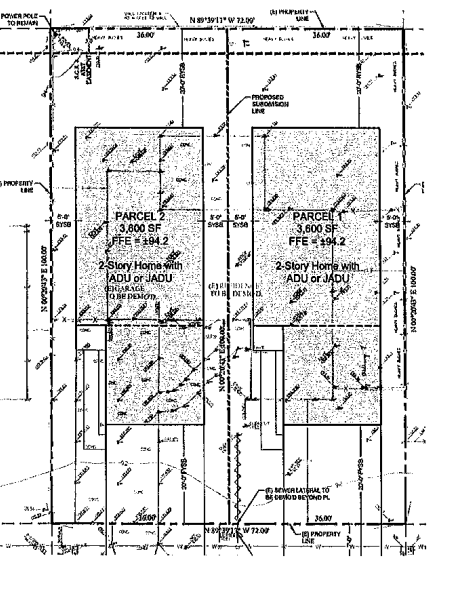
Under California Government Code Section 66411.7, Buena Park requires:
The original lot must be at least 2,400 square feet
Each resulting lot must be at least 1,200 square feet
The split must fall between a 40/60 ratio — you can't create one tiny lot and one large one
In practice, you want a lot that's comfortable above the 2,400 sq ft floor so the resulting parcels each have room to build and still meet the 10-foot minimum frontage requirement on a public right-of-way. If the lot is irregularly shaped or deep and narrow, run the geometry early. Corner lots tend to be the cleanest fit for SB-9 lot splits because they give both resulting parcels natural street access without creative engineering.
Step 3: Check for the Disqualifiers
This is where most buyers skip a step. Buena Park will deny your lot split application — ministerially and without appeal — if any of these conditions exist:
The lot was previously split. If the lot you're buying was itself created by an urban lot split, it cannot be split again. Check the parcel history.
An adjacent lot was already split by the same owner. If the seller (or anyone acting with them) already did a lot split on an adjacent parcel, your target lot is ineligible. This is worth a title and ownership history check.
The property is historic. Any lot designated as a historic property or within a historic district is out. Buena Park doesn't have a large historic footprint, but confirm before you proceed.
The lot has tenant-protected housing. This one is the most common problem for buyers targeting tenant-occupied properties. The lot split is blocked if:
The property has income-restricted or rent-controlled housing
The property was withdrawn from rental under the Ellis Act in the last 15 years
Any dwelling on the lot has been tenant-occupied in the last three years
That last point matters a lot for investment buyers. If the seller has had a tenant in the house within three years, you cannot execute a lot split until that clock clears — unless you're comfortable holding and waiting. The seller must provide a sworn statement on tenant history as part of your application. The city can investigate independently. Don't take this on faith from a seller; verify tenant occupancy history carefully before you close.
Step 4: Understand What You Can Build
Once you've confirmed the lot qualifies for a split, model out the build before you price the deal. Here's what Buena Park allows on each resulting parcel under the two-unit development rules (California Government Code Section 65852.21):
Unit count: A lot created by an urban lot split is capped at two total dwelling units — that includes ADUs and JADUs. You cannot stack a lot-split parcel with additional ADUs on top of the two-unit project. Two units per resulting lot is the ceiling.
Unit size: New primary dwellings built under the ordinance must be between 500 and 800 square feet. This is a hard cap — you cannot build 1,000 sq ft SB-9 units in Buena Park. If an existing home on the lot is already larger than 800 sq ft, it stays at its current size and cannot be expanded. The unit size rules catch a lot of buyers off guard — read that breakdown before you model your rents.
Height: Depends on your resulting lot size:
Lots over 2,000 sq ft → max one story / 16 feet
Lots under 2,000 sq ft → max two stories / 22 feet, with a required 5-foot step-back on any second-story portion
Setbacks: Interior side yard and rear yard minimum 4 feet. Corner lots must provide 10 feet from the side yard abutting a street.
Parking: One off-street space per new unit — waived if the property is within ½ mile of a high-quality transit corridor or Major Transit Stop under Public Resources Code §21064.3.
Demo cap: If the property has had a tenant in the last three years, you can only demolish up to 25% of the existing exterior walls. If the property has been vacant for three years, the cap doesn't apply. This changes your construction cost and design assumptions significantly. Know the full demo rules before you model your rehab budget.
Design standards: Buena Park is not hands-off on design. New units must match the roof pitch and style of the primary dwelling, match window style and trim, and include an accent exterior material covering at least 25% of street-facing elevations. No rooftop decks. No exterior water heaters. No windows with a direct line of sight to adjoining properties. These aren't suggestions — they're objective standards your plans must meet to get approved.
Step 5: Know the Deed Restriction Before You Close
Every two-unit project in Buena Park requires a recorded deed restriction. As the buyer, this deed restriction will run with the land — meaning it binds you and every future owner.
What it prohibits: short-term rentals under 30 days, non-residential use, and separate conveyance of the two units on any single parcel.
What it may require: owner-occupancy in one of the units — but only if the lot is NOT the product of an urban lot split. If you execute the lot split first, then build on a resulting parcel, the owner-occupancy requirement does not attach. For investors who don't plan to live on site, this sequencing matters.
Step 6: Model the Numbers
On a qualifying Buena Park lot, a full SB-9 execution looks like this:
One original parcel → split into two lots
Each lot → up to two units at 500–800 sq ft each
Potential outcome: four rentable units from one purchase
Buena Park's long-term rental market supports this strategy well — rents are consistent, vacancy is low, and you're not competing with the oversupplied condo product that plagues other OC markets. Unlike Costa Mesa or Anaheim, which have more established SB-9 comp data, Buena Park is early enough that acquisition prices haven't fully priced in the density potential yet.
On the financing side, DSCR loans underwritten against the projected rental income are increasingly available for SB-9 projects, which means you may not need W-2 income to qualify — the property qualifies itself.
The Application Process
Once you own the property and it clears all the eligibility checks, here's how the approval flows:
Submit a complete application on Buena Park's approved form with the parcel fee
The city has 30 days to flag any incompleteness
The Public Works Director approves the tentative parcel map ministerially — no hearings, no discretionary review
You have three months to record the final map or the tentative map expires
Before the final map is approved, you must record deed restrictions and utility easements with each public service provider for both resulting lots
Once the final map is recorded, each lot is its own legal parcel — you can develop, sell, or finance them separately
The ministerial approval process under California's SB-9 legislation is intentionally designed to remove discretionary obstacles. In Buena Park, that plays out in practice — if your lot meets the objective standards, the city approves it.
If you're actively looking at Buena Park properties and want a fast read on whether a specific lot clears the SB-9 threshold, reach out. I run these analyses before offers go in.
Dylan Serna is an ADU specialist agent serving Orange County and LA County. Contact dylan@serna-realestate.com
Selling in Santa Ana With a Problem Tenant: What Your Options Actually Are
The number one reason Santa Ana landlords say they can't sell is a problem tenant.
Not the market. Not pricing. Not timing. A tenant.
Maybe they're behind on rent. Maybe they've stopped communicating. Maybe you've been managing around the situation for months, telling yourself you'll deal with it later — except later keeps getting pushed out, and meanwhile the property isn't working for you the way it should.
Here's the thing: a problem tenant is not a reason you can't sell. It's a situation with real options, each with a different timeline, cost, and outcome. The one you choose depends on how much time you have, how bad the situation actually is, and whether you want top dollar or a fast exit.
Let's go through all three.
Option 1: Work It Out With the Tenant First
If your tenant is behind on rent, the first conversation is simple: can they catch up?
This sounds obvious, but a lot of landlords skip it. They assume the situation is further gone than it is, or they've let the relationship deteriorate to the point where nobody's picking up the phone. But before any legal process, a direct conversation about a repayment plan is always worth having.
A tenant who's two or three months behind and willing to get current is a very different situation from a tenant who's six months behind and not responding. In the first case, you may be able to get the rent roll cleaned up, document current payments, and list the property with a tenant who's actually performing — which is exactly what investor buyers want to see.
Buyers who purchase income properties in Orange County are underwriting the rent roll. A tenant who's current and month-to-month isn't a liability — it's documented income from day one. Getting your tenant current before you sell is worth real money at closing.
If the conversation doesn't go anywhere, you move to Option 2.
Option 2: Start the Notice to Vacate Process
If the tenant won't engage, won't catch up, or the situation has gone past a point where working it out is realistic, you serve notice.
Under Santa Ana's Rent Stabilization and Just Cause Eviction Ordinance, landlords can only terminate a tenancy for specific "at-fault" or "no-fault" reasons once a tenant has occupied the unit for 30 days. Non-payment of rent is the most common at-fault ground — it allows you to serve a 3-day notice to pay or quit, which is the first formal step in the process.
If the tenant doesn't respond to the notice or doesn't pay, you file an unlawful detainer in court.
Here's what you need to know about that process: plan for up to a year. In the best case — tenant doesn't contest, court calendar is clear — an uncontested eviction can move in 4–8 weeks. But contested cases in Orange County courts, particularly under Santa Ana's local protections, can stretch significantly longer. If the tenant has an attorney, files responses, or requests a jury trial, you're looking at many months. Factor in the time before you even file — notices, cure periods, documentation — and a realistic landlord timeline from "this isn't working" to "keys in hand" is often 9–12 months.
That's not a scare tactic. That's what the process actually looks like for a lot of landlords, and going in with eyes open changes how you think about your options.
There's also the cost side: attorney fees, court costs, lost rent during the process, and in no-fault terminations, Santa Ana requires relocation assistance equal to three months' rent paid to the tenant. If you're pursuing a no-fault termination — owner move-in, withdrawal from the rental market, substantial remodel — that line item is non-negotiable.
If you don't have a year, or if the carrying cost of the process doesn't pencil out, Option 3 is almost always the right call.
Option 3: Sell As-Is With the Tenant in Place
This is the option most landlords don't know exists — and it's often the cleanest exit.
There is an active pool of cash investors who buy tenant-occupied properties in Santa Ana as-is. They are not buying despite the tenant situation. They are buying because they are experienced landlords and operators who know how to handle it — through negotiation, cash-for-keys, or simply continuing the tenancy on their own terms once they take title.
The transaction closes faster than a traditional sale (often 2–3 weeks), there's no need to evict before listing, no repairs, no staging, no open houses with a tenant who doesn't want strangers walking through the unit. You sell, you get paid, and the tenant situation becomes the buyer's problem — which is exactly what they're equipped and motivated to solve.
Selling a tenant-occupied property in this market isn't unusual — it's actually the norm for income properties in Orange County. The question is just whether you're selling on the MLS to a wide buyer pool or selling directly to an investor who specializes in these situations.
I have a direct pool of investors who buy Santa Ana properties as-is, with tenants in place, for cash. No contingencies, no financing fallout, no drawn-out escrow. If you're in a situation where you need to move and the tenant situation is what's been holding you back, this path exists and it moves fast.
Call or text me directly at (714) 860-2868 to schedule a no-obligation consult. We'll talk through the situation, I'll tell you what the property is likely worth in an as-is sale versus a traditional sale, and you can decide which path makes the most sense for you.
How to Think About Which Option Fits Your Situation
If the tenant is behind but still communicating: Start with Option 1. A repayment agreement, documented and signed, is worth trying before anything else. If they follow through, you've got a cleaner property to sell. If they don't, you've got documentation that strengthens your position in Option 2.
If the situation is hostile or communication has completely broken down: Skip Option 1 and go straight to legal advice. The formal notice process needs to be done correctly — a procedural mistake can reset your timeline entirely.
If time is your biggest constraint: Option 3. The as-is investor sale is specifically built for situations where going through a 9–12 month eviction process isn't viable. The tradeoff is that you'll net less than a fully cleaned-up retail sale — but you need to weigh that against carrying costs, lost rent, legal fees, and the months of stress between now and a traditional close.
If you're worried about leaving money on the table: Run the math on both. I can tell you what your property is likely worth on the open market fully vacant vs. what a cash investor offer looks like as-is. The gap is often smaller than landlords expect — especially in a market where Santa Ana properties are trading at and above list price and investor appetite for income properties remains strong.
And if the property has an ADU, the valuation picture is more nuanced than it looks on the surface — additional income units affect how buyers underwrite the deal, which affects the price ceiling in ways a standard CMA won't capture.
One More Thing Worth Saying
A lot of Santa Ana landlords are sitting on properties where the tenant situation is really just the final straw. The deeper story is that the rent cap has been quietly compressing returns for years, the income isn't growing the way it should, and the problem tenant is the thing that finally made the math undeniable.
If that resonates, the question isn't just "how do I deal with this tenant" — it's "is this the right time to exit this investment entirely?" Those are connected questions, and they're worth thinking through together before you decide which path to take.
If you want to think through any of this, I'm easy to reach. No pressure, no pitch — just a straight conversation about your situation and what the options actually look like.
Text or call Dylan Serna at (714) 860-2868 to schedule a consult.
What Developers Are Actually Building in Costa Mesa Right Now: SB9 Lot Splits, Demolitions, and the Four-Unit Play
Costa Mesa has quietly become one of the most active infill development markets in Orange County. If you've been paying attention to building permits, demo applications, or even just driving around Mesa Verde and the Westside neighborhoods lately, you've probably noticed what's happening.
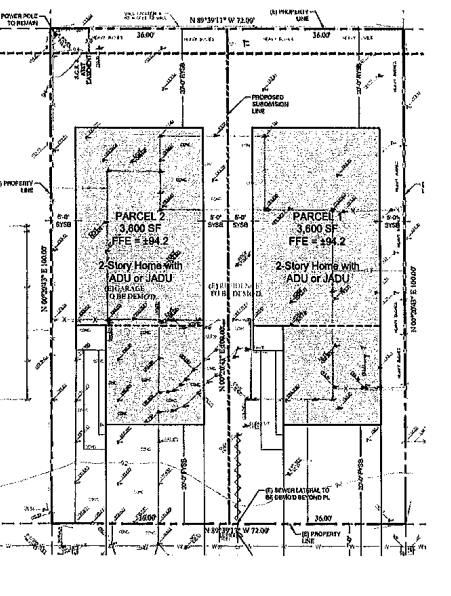
Developers are buying older single-family homes — mostly 1950s and 60s ranch-style houses sitting on 6,000 to 7,500 square foot lots — demolishing them, splitting the lot under SB9, and building two new structures on each resulting parcel. Done right, one acquisition becomes four rental units.
Here's exactly what that looks like on the ground — including unit layouts and lot sizes for each parcel.
The Setup: Why Costa Mesa Is the Target
Costa Mesa's R1 zones sit in a sweet spot for this strategy. The lots are large enough to split and still leave buildable parcels on each side. The city has been publishing its SB9 urban lot split decisions publicly, which means the application pathway is established. And the rental market is strong — Costa Mesa has historically tight vacancy and rents that hold up better than adjacent cities.
The other factor: these older ranch homes are often owned by long-time residents or estates, and the underlying land value has long since outpaced whatever the structure is worth. A 1,100 square foot home from 1958 on a 7,200 square foot lot is worth more demolished than renovated. Developers know this, and they're acting on it.
The Demolition Question
Yes, the existing structure gets demolished. Both lots — the front half of the original parcel and the rear — require clearing the original house before new construction begins.
This isn't just a physical necessity. It's part of the underwriting logic. Renovating a 60-year-old house to rental-ready condition in Costa Mesa is expensive, time-consuming, and leaves you with an outdated floorplan. Demolishing and building new gives you a modern structure with current insulation, electrical, plumbing, and — critically — a layout that maximizes every square foot of what you're allowed to build.
One important constraint: under California Government Code § 65852.21, you cannot demolish a unit that has been tenant-occupied within the last three years. Developers targeting this play are specifically acquiring owner-occupied properties or long-vacant homes for exactly this reason.
The Lot Split: What the Numbers Look Like
A typical Costa Mesa SB9 urban lot split on a 7,200 square foot lot produces:
Lot 1 (front parcel): approximately 4,300 sq ft
Lot 2 (rear parcel): approximately 2,900 sq ft
Costa Mesa follows state SB9 law minimums: each resulting parcel must be at least 1,200 square feet and between 40% and 60% of the original lot area. On a 7,200 square foot lot, that means the split must land between 2,880 and 4,320 square feet per parcel. Developers are typically targeting a 60/40 split to give Lot 1 more room to build the primary SFR and ADU.
The same lot-split framework applies in other SB9 markets across OC — but Costa Mesa's combination of lot sizes, rental demand, and established application pathway makes it especially active right now.
Lot 1: New 2-Story SFR + ADU
The front lot gets the more substantial build — the full new-construction single-family residence.
The SFR (Main House)
Stories: 2
Bedrooms / Bathrooms: 3 bed / 2.5 bath
Approximate square footage: 1,500–1,750 sq ft
First floor: Open kitchen, dining, living room, half bath, direct garage access
Second floor: Primary suite with ensuite bath, two additional bedrooms, full hall bath
Parking: Attached 2-car garage
The ADU (Detached, Rear Yard)
Stories: 1
Bedrooms / Bathrooms: 2 bed / 1 bath
Approximate square footage: 800–850 sq ft — at or near the maximum permitted under California ADU law
Layout: Open-concept living/kitchen, two bedrooms on one side, full bath
Entry: Private entrance from alley or side yard, no shared walls with main house
Setbacks: 4-foot rear and side setbacks per the HCD ADU Handbook
Corner lot configurations are the most buildable for this front-lot strategy — independent ADU entry, more rear yard, and better separation from the street. Developers hunting for this play are specifically filtering for them.
Combined income potential on Lot 1: The SFR rents for approximately $4,200–$4,800/month in Costa Mesa's current market. The 2-bed/1-bath ADU at 800+ sq ft realistically rents for $2,200–$2,500/month. That's $6,400–$7,300/month in gross income from a single parcel.
Lot 2: New 2-Story SB9 Primary Unit + ADU
The rear lot is the more compact build, but developers are engineering this parcel carefully to maximize every buildable square foot.
The SB9 Primary Unit
Stories: 2
Bedrooms / Bathrooms: 2 bed / 2 bath
Approximate square footage: 1,200–1,400 sq ft
First floor: Living room, kitchen, dining area, one bedroom with full bath (designed as a flex/guest suite or home office)
Second floor: Primary bedroom with ensuite, walk-in closet, laundry
Parking: 1-car attached garage or tandem driveway parking
Setbacks: 4-foot rear and interior side setbacks per SB9 state standards
The ADU (on the SB9 Parcel)
Stories: 1
Bedrooms / Bathrooms: 1 bed / 1 bath
Approximate square footage: 500–600 sq ft
Layout: Living area with kitchen, one bedroom, full bath
Entry: Private entrance from rear property line or alley
Utilities: Separately metered per Costa Mesa ADU ordinance requirements
Combined income potential on Lot 2: The SB9 primary unit rents for approximately $3,200–$3,600/month. The 1-bed/1-bath ADU rents for approximately $1,700–$2,000/month. That's $4,900–$5,600/month in gross income from the rear lot.
The Full Four-Unit Picture
When you stack both parcels together:
UnitTypeBed/BathEst. Sq FtEst. Monthly RentLot 1 – SFRNew 2-story SFR3 bed / 2.5 bath~1,650 sq ft$4,200–$4,800Lot 1 – ADUDetached ADU2 bed / 1 bath~825 sq ft$2,200–$2,500Lot 2 – SB9 UnitNew 2-story primary2 bed / 2 bath~1,300 sq ft$3,200–$3,600Lot 2 – ADU1-story ADU1 bed / 1 bath~550 sq ft$1,700–$2,000Total~4,325 sq ft$11,300–$12,900/mo
That's roughly $11,000–$13,000/month in gross rent from a single original parcel — before expenses, and before any appreciation on the newly constructed assets. Investors engineering this kind of income stack with SB9 and ADUs are now doing it systematically, not opportunistically.
What This Means for Buyers and Sellers
If you're a buyer and you're seeing new-construction listings in Costa Mesa described as "SFR with ADU" or "new build on split lot" — this is the play that produced them. Before you make an offer, understand how the income from each unit is treated at appraisal. ADU income and SB9 unit income aren't always appraised the same way, and getting that wrong affects your offer price and your financing. Lenders count ADU rental income differently depending on the loan program — knowing which structure gives you the most underwriting flexibility changes the math on what you can actually buy.
If you're a seller sitting on a larger Costa Mesa R1 lot with an older home on it — this is what your land value actually represents right now. The question isn't whether to renovate. It's whether a developer is already looking at your lot. Understanding what a property with ADU potential is actually worth in a market where developers are running this math is a different conversation than a standard CMA.
If you want to understand what your Costa Mesa property is worth in this environment — or if you're an investor evaluating a new-construction ADU play in OC — reach out to Dylan Serna.
Call or text: (714) 860-2868
Dylan Serna is an ADU specialist real estate agent serving buyers and sellers across Orange County and LA County. DRE #02217359
What to Know Before Doing a Complete Full Demo for an SB9 + ADU Project in Orange County

You found the lot. An aging single-family home sitting on 7,000 square feet in a solid R1 neighborhood — Costa Mesa, Anaheim, Garden Grove, somewhere in OC. The plan is clean: demolish the existing structure, do an SB9 urban lot split, and build two brand-new SFRs — each with an ADU or JADU — on the two resulting parcels. You've run the income math. You know what the finished product is worth.
And then the city sends back the application.
One line stops everything: "The proposed lot split would not require demolition or alteration of any housing that is subject to a recorded covenant, ordinance, or law that restricts rents... a parcel on which an owner has exercised rights under Government Code Section 7060 et seq. to withdraw accommodations from rent or lease within 15 years before the date of the application, or housing that has been occupied by a tenant in the last three years."
This is Criterion 6 under Government Code Section 66411.7, and it's where a lot of SB9 demo projects quietly die. Not because of lot size or setbacks — but because of the property's rental history.
Here's what it actually means, and how to check before you're already in contract.
The Four Disqualifiers That Live Under Criterion 6
When your SB9 project requires demolishing an existing residential unit — and virtually every demo-and-rebuild project does — the city has to verify that the unit being torn down doesn't fall into one of these four categories:
1. Rent-restricted by covenant, ordinance, or law
If the unit carries a deed restriction tied to an affordable housing program — think Low Income Housing Tax Credit compliance, inclusionary housing covenants, or any recorded agreement that caps rents to a percentage of Area Median Income — the demolition is off the table. These covenants typically survive ownership changes and are recorded on title. A preliminary title report will surface them.
2. Subject to local rent or price control
In cities with rent stabilization or rent control ordinances, units that fall under that protection cannot be demolished for an SB9 project. Santa Ana is a live example — the rent control cap there is already reshaping how investors look at existing rental stock. If the unit you're planning to demolish is covered by a rent ordinance, you don't have a path forward on SB9.
3. Government Code Section 7060 — the Ellis Act restriction
This is the one that catches people off guard.
Government Code Section 7060, commonly known as the Ellis Act, gives landlords the right to exit the rental market entirely — to withdraw their property from residential rental use. When an owner exercises Ellis Act rights, tenants are formally displaced, the property comes off the rental market, and specific tenant protections and relocation obligations kick in.
But here's the problem for SB9: if the owner of that property ever exercised Ellis Act rights within the 15 years prior to the SB9 application, the parcel is disqualified. It doesn't matter that the property has since sat vacant, changed ownership, or been owner-occupied. The clock runs from the date the Ellis Act rights were exercised — and it runs 15 years.
So if someone went through the Ellis Act process in 2015 and you're submitting an SB9 application in 2026, you're still inside that window.
This comes up more than people expect on older rental properties in OC and LA. An owner who wanted to move into the property, or who was tired of being a landlord, might have formally withdrawn the unit from the rental market years ago. If you're acquiring a property that was previously a rental — or one that has any history of tenant displacement — you need to research whether Ellis Act rights were ever invoked.
How do you check? County recorder's office. Ellis Act withdrawals are supposed to be recorded, and a title search combined with a direct inquiry to the city's housing department should surface any history. For LA County properties specifically, the LA Housing Department maintains records. In OC, your city's planning or housing department is the starting point.
4. Tenant-occupied within the last three years
Even if the unit has never been subject to rent control and no Ellis Act history exists, the property still fails Criterion 6 if it was occupied by a tenant at any point in the three years preceding the SB9 application.
This is the most common disqualifier in practice — and for a full demo project, it's the one with the harshest practical consequence. When you're proposing to demolish the existing structure entirely, the city is looking at the unit being destroyed, not just the land. If that unit housed a tenant within the past three years, the demolition cannot proceed under SB9, period. There's no waiver, no hardship exception, and no workaround at the planning level.
It doesn't matter that the tenant is long gone. It doesn't matter that the lease expired naturally. It doesn't matter that the seller gave proper notice and the tenant moved out voluntarily six months ago. If anyone was renting that unit within the three-year window before you file, the SB9 demolition path is closed.
This is what makes full demo SB9 projects fundamentally different from lot splits that preserve the existing structure. When you're tearing the house down, you need clean owner-occupancy history — not just an empty property.
The Dogwood Street approval in Costa Mesa is the clearest real-world example of how cities apply this: the application passed in part because the owner had occupied the property themselves since 2019, meaning no tenant occupancy within the relevant three-year window. The city confirmed it explicitly in the staff analysis. That's the bar.
Why This Is Such a Problem for the Demo-and-Rebuild Strategy
The typical SB9 demo + ADU play is built on finding undervalued, older housing stock — the kind of 1950s and 60s ranch homes that have traded hands multiple times, often with tenants in place. These are exactly the properties that are most likely to have tenant history, rent control exposure, or a landlord somewhere in the chain who went through the Ellis Act.
Investors engineering multi-unit stacks in LA County with SB9 and ADUs know this well. The deal sourcing is harder than it looks because the best candidates for the demo-and-rebuild play — the right lot size, the right location — are often rental properties. And rental properties have rental history.
The three-year tenant occupancy rule in particular creates a genuine holding period problem. If you acquire a tenant-occupied property today with the intention of eventually demolishing it for SB9, you can't just wait for the lease to expire and then submit. You have to wait three years from the last date of tenant occupancy before the SB9 demolition path is available.
That's a long hold on a property that isn't generating the income you ultimately projected from the development.
What to Look for Before You Write the Offer
If you're serious about the demo-and-rebuild SB9 strategy, here's the diligence sequence that matters:
Tenant history: Ask directly. When did the last tenant vacate? Get it in writing, either as a seller disclosure or through lease documentation and utility records. A property that's been owner-occupied since 2021 or earlier clears the three-year window. Anything more recent and you're waiting, or the path is closed.
Rent restriction covenants: Pull a preliminary title report before you're in contract. Affordable housing deed restrictions will appear. If anything on title references income limits, affordability covenants, or government programs, flag it immediately.
Local rent control status: Check whether your target city has a rent ordinance and whether single-family homes are covered. Most California rent control ordinances — including those in LA County — exempt single-family homes and condos from rent stabilization, but that exemption isn't universal. AB 1482 covers many multi-family units but specifically exempts most single-family homes sold to owner-occupants with proper notice. Know your city's rules before you assume the unit is exempt.
Ellis Act history: This one requires more legwork. Check with the city housing department and county recorder. In LA County especially, Ellis Act evictions are tracked because of the tenant relocation obligations they trigger. An older property with any history of formal tenant displacement is worth verifying.
The Owner-Occupant Path Forward
For properties that don't yet clear the three-year window, there's only one legitimate path: owner-occupy the property yourself during the holding period, wait out the clock, and then apply.
That's exactly what works — and the real SB9 + ADU case study that actually penciled in Buena Park required patience that most buyers underestimate. The holding period is the cost of entry on certain properties. Whether that math still works depends on your carry costs, your cost of capital, and what the finished product is worth when you finally build.
If the property clears all four criteria under Criterion 6, you're in genuinely good shape. The demolition itself isn't what's hard — it's that specific rental history checkpoint that filters out most of the candidates most investors are looking at.
One More Note on the Lot Split Itself
Even if Criterion 6 doesn't block you, the demolition still triggers a specific sequencing requirement under the California Housing Crisis Act: the city cannot issue a demolition permit until replacement unit plans have been submitted and reviewed. And the final parcel map won't be recorded until the existing residence has actually been demolished.
So the timeline is: lot split approval → replacement unit plans submitted → demolition permit issued → demo completed → final map recorded → building permits issued. That's a long runway. Corner lots and deep rectangular lots that give you flexibility on how you configure the new construction make a real difference here because you're optimizing the finished product across a timeline that spans 18 to 24 months from contract to building permit.
If you're evaluating a property right now and you're not sure whether it clears the Criterion 6 threshold — tenant history, rent control status, Ellis Act exposure — that's worth sorting out before you're in escrow. The lot size and zoning you can verify on your own. The rental history requires actual diligence.
Ready to Run the Numbers on a Demo + ADU Project?
If you're looking at a property in Orange County and want to know whether it actually qualifies for a full demo SB9 + ADU play — and what the finished project would be worth — text or call Dylan Serna directly to schedule an investor call. We'll go through the property together, check the rental history, and figure out whether the timeline works for what you're trying to build.
Dylan Serna | The ADU Realtor 📞 Text or call: (714) 860-2868
AB 2533: I Have an Unpermitted Unit in Santa Ana and I Plan to Sell — Should I Legalize It?
If you have an unpermitted unit in Santa Ana and you're getting ready to sell, you've probably stumbled across AB 2533 — California's amnesty law that lets property owners legalize unpermitted ADUs built before January 1, 2020. And now you're wondering: should I use it before I list?
Here's an honest answer.
The Real Fear
You're not really asking about AB 2533. What you're worried about is whether you can even sell with an unpermitted unit — whether the city is going to flag you, whether buyers are going to walk, or whether the whole thing is going to blow up in escrow.
That's a fair concern. But it doesn't mean legalization is the right move before a sale. Let me explain why.
Your Actual Options
Option 1: Legalize it with AB 2533.
On paper, AB 2533 sounds like the clean solution. Local agencies can't deny your permit application outright — they have to give you a path to compliance. But in practice, legalizing an unpermitted unit into a fully permitted ADU typically costs $100,000 or more by the time you've covered structural work, electrical, plumbing, inspections, and contractor fees. It also takes six months or longer, which means you're delaying your sale, carrying the property, and spending six figures on a unit that was already generating income.
For most Santa Ana sellers who want to move their property this year, that math doesn't work. The City of Santa Ana's ADU permit process has gotten more streamlined, but streamlined doesn't mean cheap or fast when there's existing unpermitted work to bring up to code.
Option 2: Sell it the right way — with the right agent.
Here's what I'd actually do.
Pair with an agent who knows how to handle an unpermitted unit. The strategy isn't to hide it — that's a legal problem — it's to disclose it correctly without torpedoing your listing before the right buyers even see it.
Here's how that works in practice:
Keep it out of the public-facing description. The MLS listing description that feeds Zillow, Redfin, and every other consumer site doesn't need to mention the unpermitted unit. You're not misrepresenting — you're simply not advertising something that will cause uninformed buyers to pass before they understand the full picture.
Disclose in the private agent remarks. The agent-to-agent remarks field in the MLS is visible to buyer's agents but doesn't syndicate to consumer portals. That's where you note the unpermitted unit — so any agent representing a buyer sees it before showing the property, and you've already started the disclosure process.
Disclose it in writing in your seller disclosures. This is non-negotiable. California law requires sellers to disclose known unpermitted work on the Transfer Disclosure Statement, regardless of whether you did the work yourself. Your agent will make sure this is documented properly in your disclosures package so you're covered.
And as a buyer reading this: understanding what you're taking on when you purchase a property with an existing ADU situation is just as important as how the seller handles it.
What Loan Types Work
Not every buyer can purchase a property with an unpermitted unit — and that's actually fine, because not every buyer is the right buyer for this sale.
FHA and VA loans are going to be a problem. Those loan programs require the appraiser to flag unpermitted square footage, and the lender may require it to be corrected as a condition of the loan. That's a deal-killer.
Conventional loan offers and cash offers are your best bet. Conventional financing gives appraisers and underwriters more flexibility in how they handle non-permitted space. Cash buyers bypass the appraisal entirely. Either way, you're targeting a buyer pool that can actually close — and how an unpermitted unit gets treated at appraisal is something you need to understand before you're in escrow, not during it.
If you're curious what your property is worth in Santa Ana's current market — with or without the unpermitted unit factored in — the Santa Ana ADU market has been active this summer and there's real comp data to work with. Pricing a property with income units correctly is a different exercise than a standard CMA, and getting that number wrong — in either direction — costs you.
The Bottom Line
You can sell your Santa Ana property with an unpermitted unit. The key is disclosing it correctly, targeting the right buyer pool, and working with an agent who knows how to position it rather than one who's going to panic or over-correct.
If you want to talk through your specific situation — what the unit looks like, what your timeline is, and what your options actually are — reach out to Dylan Serna to schedule a consult. This is exactly the kind of deal that looks complicated from the outside and is very manageable with the right guidance.
Schedule consult through text or call - (714) 860 - 2868
How to Evaluate a Multi-Unit Property in Long Beach as a New Investor: Income, Tenants, and What Actually Determines Value
If you're a new investor looking at multi-unit properties in Long Beach, the first question isn't "what's the list price?" It's "what does the income look like — and what can I actually do with it?"
This guide walks through a real example at the $825K price point, explains how LA County tenant protection laws shape your options, shows you exactly how to calculate cap rate, and explains why this type of deal might make more sense as an owner-occupied purchase than a straight investment buy.
Start With the Income — But Read It Carefully
Before anything else, you need to understand the difference between current income and potential income. Those two numbers are often very different on a Long Beach multi-unit, and the gap between them is where most new investors get into trouble.
Let's use a real scenario. You're looking at a duplex in Long Beach priced at $825,000. Here's the income picture:
Unit 1 (2-bed): Currently rented at $1,600/month. The tenant has been there 5 years and is on a lease.
Unit 2 (3-bed/2-bath): Vacant. Current market rent is $3,200/month.
On paper, the gross monthly income potential is $4,800 — or $57,600 annually. But here's the problem: you can only count the vacant unit at market rate from day one. The occupied unit is a different story entirely.
What LA County Tenant Protections Actually Mean for Your Deal
Because this property is in Long Beach — which falls under LA County jurisdiction — you're operating under one of the tightest tenant protection frameworks in California.
Long Beach has its own Just Cause for Termination of Tenancies Ordinance (Chapter 8.99 of the Long Beach Municipal Code), which applies to tenants who have continuously occupied a unit for 12 months or more. Your 2-bed tenant has been there for five years. You cannot move them out without a legally recognized reason — period. A change of ownership doesn't void this protection. The lease runs with the property, and just cause requirements apply regardless of who the new owner is.
This is one of the key dynamics buyers need to understand when acquiring a tenant-occupied multi-unit in LA County. The due diligence you do on the tenants before you close is just as important as the physical inspection of the building.
What Happens When the Lease Ends?
Once the lease expires, you have options — but they're not unlimited.
You can update the rent. However, because Long Beach does not have its own separate rent control ordinance, you're governed by California's AB 1482 (Tenant Protection Act), which caps annual rent increases at 5% plus the regional Consumer Price Index, up to a maximum of 10%. For 2026, the AB 1482 allowable increase for the LA-Long Beach-Anaheim region is 8.7%, effective August 1, 2026 through July 31, 2027.
What does that mean in practice? On a $1,600/month unit:
$1,600 × 1.087 = $1,739/month — that's your maximum post-lease rent increase in year one.
That's still well below the $2,200–$2,400+ that a vacant 2-bed would command at current Long Beach market rents. The point: even after the lease ends, you're not jumping straight to market. You're stepping up incrementally under the AB 1482 cap — each year, one increase at a time.
This is why comparing occupied and vacant multi-unit properties requires a completely different framework than standard price-per-unit analysis. The income isn't just a number — it's a trajectory with legal guardrails around it.
The Cap Rate Calculation at $825K
Here's the income math on this property as it sits today — with the 2-bed occupied and the 3-bed rented at market:
MonthlyAnnualUnit 1 (2-bed, leased)$1,600$19,200Unit 2 (3-bed/2-bath, vacant → market)$3,200$38,400Gross Income$4,800$57,600Expenses (~35%: taxes, insurance, maintenance, vacancy)—($20,160)Net Operating Income (NOI)—$37,440
Cap Rate = NOI ÷ Purchase Price $37,440 ÷ $825,000 = 4.54%
The average cap rate for multi-unit properties in Long Beach right now is approximately 5.5%. At 4.54%, this property is coming in below market — which means at face value, it doesn't pencil for a pure investment buyer running income-only math.
But that's not the whole story.
Why This Might Make Sense as an Owner-Occupied Deal
Here's where the math shifts.
If you're buying as an owner-occupant — meaning you intend to live in one of the units — you have a tool that a pure investor buyer doesn't: owner move-in as just cause.
Under California AB 1482 and Long Beach's just cause ordinance, owner move-in is one of the recognized "no-fault" reasons a landlord can terminate a tenancy. This means you could, after taking ownership, serve the 2-bed tenant with a notice to vacate so you (or a qualifying family member) can move in.
Once that unit comes back vacant, you can rent it at full market rate — with no AB 1482 cap applicable to a new tenancy. That shifts the income picture significantly, and moves the cap rate closer to where it needs to be.
One important warning: Don't try to execute this during escrow. The minimum escrow timeline on most multi-unit transactions is 60 days, and attempting to serve an owner move-in notice while you're still in contract creates serious complications — legally and practically. The tenant's attorney has 60 days of leverage before you even own the building. Do this post-close. Take ownership, confirm your timeline with a landlord-tenant attorney, and then proceed with the notice process properly.
How to Think About This Deal by Buyer Type
Pure investor: At 4.54%, you're below the 5.5% market cap. You're banking on rent growth over time and on the below-market 2-bed income eventually stepping up toward market under AB 1482 annual increases. That's a patient play, and it depends on your cost of capital. If you're financing this with leverage, the debt service math is tight at current rates. Comparing DSCR vs. conventional loan structures before you write an offer matters here — your loan product affects the underwriting threshold.
Owner-occupied investor: The math is more interesting. You get the 3-bed/2-bath at market ($3,200/month), which alone covers a significant portion of your mortgage. You live in the 2-bed, execute the owner move-in notice post-close, and eventually rent it at market. The long-term income stabilization is much faster, and you have a direct path to closing the gap between current cap rate and market cap rate.
If you want to understand how this type of deal performs in the broader Long Beach multi-unit market right now, the current buyer-favorable dynamics in the multi-unit segment give you more negotiating room than you'd have had 18 months ago. Use it.
Before You Write an Offer
Whether you're approaching this as a pure investor or owner-occupant, the income analysis is just the starting point. A thorough pre-offer review on any LA County multi-unit should cover permit status on every unit, utility metering setup, lease documentation, and confirmation that the income figures the seller is marketing are actually supported by the paperwork.
Long Beach has some of the strongest cash-flow potential in LA County for investors who know how to read the income picture — but you have to understand what you're buying, not just what you're hoping it becomes.
Ready to run the numbers on a Long Beach multi-unit you're looking at?
Call or text Dylan Serna at (714) 860-2868 — I'll walk through the income, the tenant situation, and whether the deal makes sense at the ask before you spend a dollar on inspections.
Dylan Serna is an ADU and multi-unit specialist serving buyers and sellers across Orange County and LA County.
How a Parent's Gift + a Garage Conversion Made a $1.1M Huntington Beach Home Actually Affordable
There's a conversation I've been having more often lately with parents in Orange County — and it goes something like this:
"My daughter and her fiancé want to buy a home. They're early in their careers, they don't have the down payment yet, and if we're being real, they can't qualify for what they'd actually need in a coastal city. But I have equity. I want to help. What does that actually look like?"
This post is the full answer to that question — using a real case study from a client I'm working with right now.
The Setup: A Father Helping His Daughter Get Into Huntington Beach
Here's the situation:
His daughter and her fiancé want to buy in Huntington Beach. They're both working, saving, and building their careers — but coastal OC is a different financial environment than most people are prepared for. A decent SFR in HB right now runs $1.1M on the low end. At today's rates, financing the whole thing would mean a mortgage payment that simply outpaces their combined income.
So Dad stepped in. His plan: contribute a meaningful portion of the down payment as a gift, build a Junior ADU on the property to generate rental income, and let that income offset enough of the monthly payment that the kids can actually carry the house.
We ran the math together. The numbers worked. Here's exactly how.
The Numbers: A $1.1M Huntington Beach SFR with 60% Down
The property: Single-family residence in Huntington Beach, priced at $1,100,000.
The down payment: 60% — $660,000 contributed by the father as a gift toward his daughter's purchase.
The loan: $440,000 at today's rate of approximately 6.75% on a 30-year fixed. (Freddie Mac's weekly survey puts the 30-year fixed at 6.69% as of early August 2026 — rates have been in this range all summer.)
Here's the full PITI breakdown:
MonthlyPrincipal & Interest$2,854Property Taxes (~1.15%)$1,054Homeowner's Insurance$504Total PITI$4,412
Then Dad covers the JADU build — converting the attached garage into a permitted studio unit. Cost: approximately $65,000–$80,000 for a basic garage conversion in Orange County (demo, insulation, drywall, kitchenette, bathroom, egress, permits). That unit goes on the rental market at $1,800/month — a conservative figure for a permitted studio in coastal HB.
Net effective payment after JADU income:
$4,412 − $1,800 = $2,612/month
For a home in Huntington Beach. With the beach 10 minutes away.
That $1,800 in monthly rent covers 41% of the total PITI. In a market where most people are stretching to qualify for a $4,000+ payment with nothing offsetting it, this structure changes the math entirely.
Why a JADU — Not a Full ADU
A lot of people hear "convert the garage" and assume that means building a full detached ADU. It doesn't have to. In this case, we're talking about a Junior ADU (JADU) — and that distinction matters.
Under Huntington Beach's ADU ordinance and California state law, a JADU:
Is contained entirely within the existing SFR footprint (an attached garage qualifies)
Is capped at 500 square feet
Requires a separate entrance and basic kitchen facilities
Does not require a separate utility meter (lower cost to build)
Can be permitted on any single-family lot zoned R-1 in HB
This makes the garage conversion route faster and cheaper than building a detached unit. You're working with existing walls and a roof already in place — no foundation, no framing from scratch. Permits for a JADU conversion in Huntington Beach are reviewed ministerially, which means no discretionary hearings and no neighbor approval required.
The California HCD ADU Handbook (2026) is the definitive reference for what each unit type requires. If you're evaluating whether an existing garage qualifies, that's your baseline. For anyone curious about what building a JADU actually triggers in terms of Title 24 energy requirements — here's a post that breaks that down specifically for JADUs.
How the Father's Contribution is Structured
In this case study, the father is contributing in two stages:
Stage 1 — The down payment gift. The $660,000 goes toward the purchase. This is a gift, not a loan — which matters for the lender. Conventional financing requires a gift letter documenting that no repayment is expected. The daughter and her fiancé are on title and on the loan.
Stage 2 — The JADU build. After close, the father funds the garage conversion separately — budgeted at $70,000. He's essentially making a second investment in the property, but this one pays itself back through the rental income his daughter collects.
What makes this structure smart: the father isn't just giving money. He's building an asset that generates a return inside a property his family owns. The JADU becomes a permanent feature of the home — one that affects how the property is valued when they eventually sell and one that lenders now count as qualifying income in a growing number of scenarios.
Does the Rental Income Count Toward Qualification?
This is the question I get almost every time I walk a buyer through this structure.
The short answer is: it depends on the loan program — but Fannie Mae's updated ADU income guidelines have made this more borrower-friendly in recent years. Under certain conventional programs, projected ADU rental income can be used to offset the subject property's mortgage payment during underwriting, even before the unit is built or rented.
The key word is "projected." You'll need a market rent analysis from an appraiser, and the program specifics vary by lender. But for a family where the JADU income is real, documented, and the unit is already permitted? This can meaningfully move the needle on what the daughter and her fiancé can qualify for on their own. Here's a full breakdown of exactly how lenders count ADU rental income — it's more nuanced than most people expect.
Why This Works Especially Well in Huntington Beach
Huntington Beach is a coastal city with a tight rental market and consistent demand for small, quality units. A permitted studio JADU near the beach — with its own entrance and basic amenities — is genuinely easy to rent. The $1,800/month estimate is conservative; comparable permitted studios in HB have been renting for $1,750–$2,100 depending on the block and condition.
What this also means: if the daughter and her fiancé eventually want to move — whether it's for a growing family, a job change, or something else — the JADU income continues. A future buyer of the property will see documented rental income and a permitted unit, which affects value at appraisal and narrows the buyer pool in the right direction.
The difference between Huntington Beach and inland cities is that you're also buying into a market with real appreciation history and limited new supply. The 60% down position means the family has meaningful equity from day one — they're not overleveraged, and the JADU keeps the monthly exposure manageable throughout.
The Bottom Line
Here's what this structure achieves in a single deal:
A coastal Huntington Beach SFR, purchased at $1.1M
A $2,612/month net effective payment — 41% offset by JADU income
A permitted, income-generating unit built from an existing garage for ~$70K
A parent who invested two tranches of capital (down payment + build) into a family-owned asset — and got a real return on the second one
A daughter and her fiancé who are homeowners in a market most people write off entirely
That's not a stretch or a financial engineering trick. It's a deliberate structure built around real numbers, a real rental market, and a real understanding of what a JADU makes possible in Orange County.
If you're a parent thinking through something similar — or a buyer wondering whether a JADU makes sense on the property you're looking at — let's run the numbers for your specific situation.
Dylan Serna | ADU Specialist | DRE #02217359 Call or text: (714) 860-2868 | adurealtor.net | Free ADU Buyer Guide
Buena Park SB-9: The Unit Size Rules That Most Property Owners Get Wrong
If you own a single-family home in Buena Park and you're thinking about using SB-9 to add a second unit or split your lot, the first question you need to answer isn't "can I do it?" — it's "how big can I actually build?"
Buena Park's SB-9 urgency ordinance has strict unit size limits, and they're more restrictive than most property owners expect. Get this wrong upfront and you're either over-building (which gets flagged at plan check) or under-building (leaving rentable square footage on the table). Here's exactly what the ordinance says.
What SB-9 Actually Allows in Buena Park
Under California's SB-9 law (Government Code § 65852.21), cities must allow up to two primary dwelling units on a single-family lot in most residential zones. Buena Park adopted its implementing ordinance effective January 1, 2022.
There are two separate SB-9 pathways: a two-unit project (adding a second primary dwelling to an existing lot) and an urban lot split (dividing the lot into two parcels). The unit size rules apply to both, but they work differently — and confusing them is the most common mistake I see.
The Unit Size Cap: 500 to 800 Square Feet
This is the number that matters most.
Under Buena Park's ordinance, every new primary dwelling unit built through an SB-9 two-unit project must be between 500 and 800 square feet. Not 850. Not 499. The ordinance is explicit: total floor area must be "less than or equal to 800 and more than 500 square feet."
That's a tight band. For context, 800 square feet is roughly the size of a well-configured two-bedroom apartment — workable for a rental unit, but not a sprawling second home.
What About Your Existing House?
The size cap applies only to the new unit added through SB-9. Your existing home is treated differently depending on its current size:
If your existing home is larger than 800 sq ft: It stays as-is. You cannot expand it as part of the two-unit project — the ordinance freezes it at its current lawful floor area.
If your existing home is smaller than 800 sq ft: You can expand it up to 800 sq ft as part of the project, or afterward.
This matters for income planning. If you own a 1,400 sq ft home and you're adding an 800 sq ft SB-9 unit behind it, you're working with roughly 2,200 sq ft of total residential space on one lot. The income potential stacks up, but the SB-9 unit itself is the ceiling — you can't negotiate the city up to 900 sq ft. The ordinance doesn't leave room for discretion.
Urban Lot Splits: The Lot Size Minimums
If you're pursuing an urban lot split instead of (or in addition to) a two-unit project, the relevant size rules shift from units to land.
Buena Park requires:
The original lot must be at least 2,400 square feet to qualify for a split
Each resulting lot must be at least 1,200 square feet
Each resulting lot must be between 40% and 60% of the original lot area — so you can't split unevenly
That 40/60 rule is the one that catches people off-guard. If your lot is 6,000 sq ft, you can end up with a 2,400 sq ft lot and a 3,600 sq ft lot. That's legal. But you can't create a 1,200 sq ft sliver and keep a 4,800 sq ft remainder — the split has to land within that 40/60 band.
On a lot created through an urban lot split, no more than two dwelling units of any kind are allowed — that includes primary units, ADUs, and JADUs. The ordinance is clear that "unit" means any dwelling unit. So if you split and build two primary units, you're at your maximum. There's no room to add an ADU on top.
On a non-split lot, the math is different: you can have a two-unit SB-9 project plus any ADU or JADU that state law requires Buena Park to allow under its ADU ordinance. That's potentially three or four units on one lot, depending on the configuration. Investors are actively engineering these multi-unit setups in LA County with SB-9 and ADUs — the same logic applies in Buena Park.
Height and Lot Coverage: The Other Limits That Constrain Size
The 800 sq ft cap isn't the only constraint on how much you can build. Two additional rules shape the physical footprint:
Height:
On lots larger than 2,000 sq ft: new SB-9 primary units are capped at one story or 16 feet
On lots smaller than 2,000 sq ft: new units can go up to two stories or 22 feet, but any portion above one story must step back five additional feet from the ground floor — and no balcony or second-story projection can intrude on that step-back
Lot Coverage:
Maximum building coverage is 40% of net lot area across all single-family zones
The ordinance carves out one protection: the 40% cap won't be enforced if it would prevent you from fitting two primary units at 800 sq ft each
In practice, the height cap is what usually bites on smaller lots. A single-story 800 sq ft footprint is a viable build. But if your lot is compact and you were hoping to stack square footage vertically, the 16-foot limit on larger lots shuts that down.
The Four-Foot Setback Rule
New SB-9 units must maintain a four-foot interior side yard and rear yard setback from the property line. On corner lots, a 10-foot setback from the side yard abutting a street is required.
These setbacks exist alongside whatever setbacks the underlying zone imposes — so if your RS-8 zone has larger rear yard requirements, those apply unless the four-foot SB-9 setback gives you more flexibility. Existing structures that are legally established are exempt: you don't need to bring a legal nonconforming garage into compliance just because you're adding an SB-9 unit nearby.
One Parking Space Per Unit (With a Transit Exception)
Each new primary dwelling must have at least one off-street parking space. The exception: if the dwelling is located within half a mile of a high-quality transit corridor, a major transit stop, or a car-share vehicle location as defined under the Public Resources Code, the parking requirement is waived.
Buena Park is served by several OCTA bus routes. Whether any of those corridors qualify as "high-quality transit" under the specific statutory definition is a site-specific question — check with the city before assuming the waiver applies.
What You Can't Do Under Buena Park's SB-9 Ordinance
A few hard stops worth knowing before you plan:
No short-term rentals. Buena Park requires a deed restriction that expressly prohibits any rental for less than 30 days. If you're thinking about Airbnb income to make the numbers work, it won't work here — the restriction runs with the land.
No condos or separate conveyance. Primary dwelling units on the same lot cannot be sold separately. No condominium airspace divisions, no common interest developments. If you're hoping to build-and-sell individual units, SB-9 in Buena Park doesn't support that exit.
Owner occupancy required (on non-split lots). If the lot is not created by an urban lot split, the deed restriction requires the individual property owner to occupy one of the dwellings as their primary residence.
No LLCs or corporations. Only natural persons (or qualifying community land trusts and nonprofits) can apply. An LLC-owned property is not eligible.
Buena Park vs. Comparable Markets
Buena Park is one of those North OC cities where ADU and SB-9 comp data is thin compared to markets like Garden Grove or Anaheim — which means there's less price discovery on what an 800 sq ft SB-9 unit actually adds to a sale or appraisal. That's not a dealbreaker, but it's something to understand when you're projecting value.
The 800 sq ft cap also means the income upside per unit is more limited than what you'd get from a full-size permitted ADU. The 3 SoCal property benefits that stack into $68,000/year show the math on income stacking — but SB-9 units in a city with strict size limits are going to come in at the lower end of that range unless the lot configuration allows for ADU stacking on top.
Before you commit to the SB-9 path in Buena Park, it's worth verifying the property is ADU-eligible and understanding how the unit will be treated at appraisal — because how a home with an additional unit gets valued when you sell depends heavily on comparable income data that's still sparse in this market.
The Practical Takeaway
If you're planning an SB-9 project in Buena Park, here's what to anchor on:
The new unit is capped at 800 sq ft and floored at 500 sq ft. On most lots, it'll be one story and 16 feet tall. You get a four-foot setback from the rear and interior side property lines. You need one parking space unless you're near qualifying transit. And a deed restriction will prohibit short-term rentals and require owner occupancy on non-split lots.
California HCD's ADU Handbook is worth reading alongside the local ordinance — state law sets the floor, and Buena Park's rules layer on top. Where state and local rules conflict, state law generally prevails, but the city's specific standards (like the 500–800 sq ft band) apply to the extent they're within the state-authorized range.
If you own a single-family lot in Buena Park and want to understand what's actually buildable on your specific parcel, I'm happy to walk through it. The lot size, current home footprint, zone designation, and proximity to transit are the four variables that determine what SB-9 actually allows you to do here.
Dylan Serna is an ADU specialist real estate agent serving buyers and sellers across Orange County and LA County. Questions about SB-9 eligibility or ADU value in Buena Park? Reach out directly.
SB 9 in Anaheim: Max Unit Sizes, Lot Split Rules, and What Single-Family Owners Need to Know
If you own a single-family home in Anaheim and you've heard about SB 9 but haven't dug into what it actually allows — or doesn't — this is the post for you.
Senate Bill 9 became effective January 1, 2022. It requires cities to allow two residential units on single-family zoned lots by right, and to ministerially approve the subdivision of one single-family lot into two separate parcels. Anaheim adopted its own implementing ordinance to comply with state law, and in several cases added requirements that are more restrictive than what SB 9 requires at the state level.
There are two separate paths under SB 9, and they work differently. Understanding which one you're pursuing — and what size and design rules apply to each — is where most homeowners get confused.
Path 1: Two-Unit Development (No Lot Split)
Under Anaheim's Two-Unit Development code, a property owner in a single-family zone can build or convert a second unit on their existing lot without subdividing it. Both units stay on one parcel.
Maximum unit size: 800 square feet. This is the floor that state law requires cities to allow, and Anaheim chose to make it the ceiling as well. SB 9 doesn't set a maximum — it only requires that cities permit at least 800 square feet. Anaheim's ordinance locks the maximum at that same number, so you cannot build a Two-Unit Development unit larger than 800 square feet under this pathway.
Minimum unit size: 400 square feet. The state law doesn't specify a floor, so Anaheim set one — roughly the size of a two-car garage — to ensure new units are actually livable rather than token square footage.
Here's what that looks like in practice: you can have two units on your lot, each between 400 and 800 square feet. That's the box you're working in.
Height
For attached Two-Unit Development — meaning the second unit is physically connected to the primary dwelling — the height limit of your underlying zone applies. Anaheim didn't add a separate cap here because an attached unit visually reads as an addition to the main house, so it's subject to the same rules.
For detached Two-Unit Development, the maximum height is 16 feet or the height of the main dwelling unit, whichever is greater. That said, the Planning and Building Director has discretion to allow additional height up to the zone's limit if you can demonstrate it's necessary to actually achieve the 800 square foot minimum. In other words, if your lot configuration makes it impossible to hit 800 square feet at 16 feet, you can make that case.
Setbacks
Front: Whatever the underlying zone requires
Side: 4 feet
Rear: 4 feet
The four-foot side and rear setbacks mirror what SB 9 mandates as a maximum restriction. Front setbacks defer to your zone's existing standards so that the street scene stays consistent.
Separation Between Units
If you're building two detached structures, they must maintain a 10-foot separation between them. This is Anaheim's added requirement — state law doesn't specify a distance, only that separation can't be the sole reason a project is denied.
Parking
One parking space is required per unit. The exemption: if your property is within a half-mile of a high-quality transit corridor or major transit stop, or within a half-mile of a car share vehicle, additional parking cannot be required.
Other Requirements
Each unit must have independent exterior access — they can't share a single entrance
The new unit may be separately metered for gas, electricity, communications, water, and sewer; for new construction, Anaheim Utilities may require a direct connection
Design standards mirror the single-family zone — the new unit has to meet the same articulation requirements as any single-family home in the city
No maximum lot coverage requirement applies to Two-Unit Developments — Anaheim eliminated it to streamline approvals
Path 2: Urban Lot Split
The Urban Lot Split is a different animal. Here, you're not just adding a second unit — you're actually subdividing one single-family parcel into two separate lots, each of which can then have up to two units on it. Done fully, a single-family lot could theoretically produce four units total. California recently completed its first ADU sale as a separate, independently titled home, which gives some sense of where the Urban Lot Split pathway is headed long-term.
Anaheim's implementing code for Urban Lot Splits is more restrictive in several ways.
Minimum lot size after the split: Each new parcel must be at least 1,200 square feet or 40% of the original lot size, whichever is greater. This is the state law floor, and Anaheim adopted it without modification.
Lot frontage: Every new lot created by an Urban Lot Split must have frontage directly onto a public or private street. Alleys don't count. This is a city-added requirement — state law defers the frontage question to municipalities.
Lot width: Each lot must be at least 25 feet wide abutting the street. Again, this is Anaheim's own standard — SB 9 doesn't specify a minimum width.
Owner occupancy: You must have occupied the property as your primary residence for at least three years before an Urban Lot Split application will be approved. This is required by state law and Anaheim enforces it.
Rental term minimum: Any rental on an Urban Lot Split parcel — or on a Two-Unit Development — must be for a period greater than 30 days. Short-term rentals are not permitted under either SB 9 pathway.
Utility service: Each lot created by an Urban Lot Split must have its own separate utility service — it can't share a connection with the adjacent parcel.
Properties That Don't Qualify
Not every Anaheim single-family lot is eligible for SB 9. State law excludes the following outright:
Properties developed with affordable housing
Properties that were tenant-occupied within the last 3 years (this applies even if the tenant has since moved — if someone was renting the unit within that window, SB 9 does not apply; understanding how tenant history affects your options is critical before you list or develop)
Properties where a rental was terminated within the last 15 years (i.e., an Ellis Act eviction)
Hazard waste sites
Sites subject to the Natural Community Conservation Planning Act
Properties under a conservation easement
Properties in a historic district
There are also conditional exclusions — properties in these zones may be prohibited unless specific criteria are met:
Very High Fire Hazard Severity Zone
Earthquake Fault Zone
Special Flood Hazard Zone
Regulatory Floodway
And Anaheim added one more category: sewer-deficient areas. Properties on parcels with known sewer deficiencies are already prohibited from ADU and JADU development in Anaheim, and the city intends to apply the same map when evaluating SB 9 applications. If the building official determines that a development would create a specific, adverse impact on public health — and sewer capacity is the city's primary concern here — the project can be denied.
What This Actually Means for Anaheim Owners
The Two-Unit Development pathway is the more accessible of the two. You don't need to subdivide, you don't need three years of owner-occupancy, and you can move on plan check fees rather than a separate application process. The 800 square foot cap is tight, but it's workable — especially for detached units in larger backyards.
The Urban Lot Split unlocks more density potential, but it comes with owner-occupancy requirements, lot dimension constraints, and the separate utility connection requirement that adds cost. It's a longer-horizon play, and the three-year clock means you can't buy a property and immediately pursue the split.
For investors looking at Anaheim, the Two-Unit Development pathway is worth understanding before you make an offer on a larger single-family lot. The income potential from a permitted second unit — even at 800 square feet — is real, and what that income does to your property's valuation when it's time to sell is something most buyers aren't pricing in yet. It also matters for how you finance it: lenders count ADU rental income differently depending on the loan type, and knowing which program gives you the most purchasing power changes the math on whether this pencils.
If you want to see how SB 9-eligible lots are currently moving in Anaheim and what buyers are actually paying, the Anaheim ADU market data for August 2026 has the active listings and recent closings worth tracking.
Dylan Serna is an ADU specialist real estate agent serving buyers and sellers across Orange County and LA County. Questions about SB 9 eligibility on a specific Anaheim property? Reach out here.
You Found an OC Property With ADU Potential — But It Has a Pool. Here's What You Need to Know
You finally found it. A home in Orange County with the lot size, the setbacks, the zoning — everything that checks out for an ADU. There's just one thing: it has a pool.
If you're buying this purely as a rental investment, that pool deserves a serious conversation before you close escrow. Because what looks like a lifestyle feature to an owner-occupant can become a liability on a rental — and it may be eating the exact square footage you need to build.
Why a Pool Is a Problem on a Pure Rental
When you're living in a home, a pool makes sense. You use it, you maintain it, it adds to your quality of life.
When you're a landlord, it's a different story entirely.
Start with the ongoing costs. A pool service comes every week — typically $150 to $250 a month in Orange County, sometimes more depending on the size and condition. That's $1,800 to $3,000 a year before anything breaks. And things do break. Pumps, heaters, filters, timers — pool equipment fails, and repairs can run anywhere from a few hundred to several thousand dollars depending on what goes out.
Then there's liability. A pool on a rental is an attractive nuisance under California law, which means additional insurance exposure and often higher landlord insurance premiums. If you don't have an umbrella policy already, you'll need one.
Add it all up — pool service, maintenance, repairs, insurance — and you're looking at a recurring expense that chips directly into your rental net operating income every single year. If you're evaluating this as a rental investment, these are exactly the line items that can quietly kill cash flow.
The Bigger Problem: The Pool Is Sitting on Your ADU Lot
Here's what really matters for ADU investors: a pool typically takes up a massive chunk of the rear yard.
In Orange County, most cities require your ADU to maintain specific setbacks — usually 4 feet from the side and rear property lines under California's statewide ADU law. The HCD ADU Handbook lays out exactly what cities can and can't restrict, which is useful when you're evaluating how a pool-filled footprint affects what you can build. But beyond setbacks, your lot coverage limits and available buildable area matter just as much. If a 400 to 600 square foot pool is sitting in the back yard, that's often the exact footprint where a detached ADU would go.
This is the real calculation you need to run before you fall in love with the property. The pool isn't just an expense — it's occupying your investment. If the whole reason you liked this property is its ADU potential, and the pool is blocking it, you have a decision to make. Corner lots and deep rectangular lots are the best configurations for detached ADUs precisely because they preserve rear yard space — a pool on those properties hurts the most.
Some buyers walk. Others negotiate. But a third option — one that more investors are considering — is filling it.
Filling the Pool: What It Costs and What You Need to Know
Pool fills in Orange County and across Southern California typically run $20,000 to $50,000. That range is wide on purpose — quotes vary significantly depending on the size of the pool, the fill method, how much demolition is involved, and which contractor you hire.
You'll want at least three quotes. Don't go with the cheapest one without understanding exactly what you're getting, because how a pool gets filled matters enormously.
There are two primary approaches:
Partial demolition (the budget route): The contractor breaks up the top layer of the pool shell, punches drain holes in the bottom to allow water to percolate, and fills the void with the broken concrete and imported soil. This is faster and cheaper — and it's also where problems happen.
Full demolition (the right way for most situations): The entire pool shell is removed or properly broken down, the area is filled with engineered fill and compacted in lifts, and the surface is graded. This is more expensive but leaves you with land that's actually stable and buildable.
Here's why it matters: if a pool is not filled and sealed correctly, you can end up with water infiltration issues underground. Improper drainage can cause soil settlement, which leads to cracked hardscape, foundation movement, and in serious cases, structural problems on adjacent structures. On a property where you plan to build an ADU over or near that footprint, this is not something to cut corners on.
Before you hire anyone, make sure the contractor pulls the required permits with your city's building department. Most Orange County cities require permits for pool demolition and fill — it ensures inspections happen and protects you when it comes time to sell or build. This matters more than most buyers realize: an unpermitted modification to the property can surface during appraisal and create problems you didn't see coming.
How to Factor This Into Your Offer
If you're serious about the property and the pool is the main obstacle, the fill cost should be part of your purchase negotiation. If comparable filled lots in the area are priced lower, or if you can demonstrate the cost of the work required, you have a real basis to negotiate the price down $20,000 to $50,000 from what the seller is asking.
You can also use your due diligence period to get contractor quotes lined up so you have real numbers, not estimates, before you decide to move forward or walk. Make sure your purchase contract is structured to give you enough time to do this — what you include in the contract before you open escrow on an occupied OC property matters more than most buyers realize.
And once it's done? You've turned a liability — weekly pool service, equipment repairs, insurance exposure, and a blocked ADU footprint — into usable land that can generate long-term rental income for the next 30 years. ADU rental income can also be used to help you qualify for the mortgage, which changes the financing math significantly for buyers who are on the edge of approval.
If you're still in the property search phase and haven't found the right lot yet, you're not alone — a lot of buyers in OC have been searching for a year or more. Properties with genuine ADU potential are scarce, which is exactly why it's worth thinking carefully about a pool rather than dismissing a property outright.
The Bottom Line
A pool on a rental isn't automatically a dealbreaker — but it needs to be treated as a cost center, not a selling point. If it's blocking the rear yard you need for a detached ADU, filling it is often the right move, and it can pencil out very well when you factor in what the ADU will generate in annual rent.
Just make sure it gets done right. Get multiple bids, pull permits, and hire a contractor who knows what proper compaction and drainage looks like. A $30,000 fill done correctly is a smart investment. A $15,000 fill done wrong can cost you far more in repairs and legal exposure down the road.
If you want to talk through the numbers on a specific property — whether the pool fill makes sense, what an ADU would rent for after, and how it affects your overall return — reach out. That's exactly the kind of analysis I do before my clients make an offer.
Dylan Serna is an ADU specialist serving Orange County and LA County. For questions about ADU investment properties, reach out at adurealtor.net.
Buena Park Is One of the Best Long-Term Rental Markets in OC Right Now — Here's Why (And What the Numbers Actually Say)
If you're looking for a long-term rental investment that still pencils below a million dollars in Orange County, Buena Park belongs at the top of your list.
It's not the flashiest market. It doesn't have the name recognition of Anaheim or the investor buzz of Garden Grove. But Buena Park has something those markets are slowly losing: sub-$1M single-family homes with strong renter demand, rock-solid freeway access, and a surprising amount of lot flexibility for investors who want to build future ADU income into their thesis.
Here's the full picture — including a real underwriting breakdown on what a $910,000 Buena Park purchase actually looks like on paper.
The Freeway Thesis
Buena Park sits at the intersection of the 5 and the 91. That's not a minor geographical detail — it's the reason renters keep showing up here.
A tenant in Buena Park can commute north to LA County on the 5, east toward Riverside on the 91, or south to Irvine and the employment centers of central OC without ever dealing with surface streets for the long haul. For working households — the core of the long-term rental market — that kind of freeway optionality is worth real money in rent.
This is the same logic that's driven renter demand in Anaheim and Garden Grove, but Buena Park prices haven't fully caught up yet. That gap is the opportunity.
What Rents Are Doing Here
The average 3-bedroom, 2-bath single-family home in Buena Park is renting for around $3,900 per month as of mid-2026. That's for a well-maintained SFR — not a new build, not a luxury flip. Standard landlord-ready homes in decent neighborhoods are clearing that number with minimal vacancy.
That's a strong rent-to-price ratio for an OC market where properties are still trading below $1 million. In markets like Costa Mesa or Santa Ana, you're often paying comparable prices for the same home but dealing with rent control caps that compress your returns year over year. Santa Ana's 3% rent control cap is a real constraint that Buena Park investors don't have to navigate.
The renter base here is stable. You're not chasing entertainment-district turnover or short-term demand — you're renting to working families with steady employment and genuine roots in the community. That translates to lower vacancy, longer average tenancy, and less management overhead.
The Lot Strategy: Why Corner Lots and RV Access Are the Play
This is where Buena Park gets interesting for investors who are thinking 3–5 years ahead.
A lot of single-family homes in Buena Park sit on lots that are ADU-eligible today — and unlike tighter, denser markets where every lot has been subdivided down to the minimum, Buena Park still has an unusual number of corner lots and homes with RV access. Those two features matter a lot when you're underwriting for future ADU potential.
Corner lots often come with wider frontage and more flexibility on setbacks, which means more buildable area for a detached ADU in the rear yard. They also tend to give you independent entry options for a future unit — which makes the ADU feel like a separate residence rather than an afterthought tacked onto the main home.
RV access lots — homes with a side gate and a paved path wide enough for an RV — often have the side yard clearance that makes detached ADU construction significantly easier and cheaper. That paved side access becomes the driveway to your future ADU. These lots were common in older Buena Park tracts built in the 1960s and 70s, and they're still plenty available if you're specifically filtering for them.
Corner lots are some of the best ADU setups in Orange County — and Buena Park is one of the few markets where you can still find them at reasonable prices. If you're buying a long-term rental today with the option to add ADU income later, buying the right lot from the start is the move.
Under California's current ADU law, most single-family lots in Buena Park are eligible for at least one ADU and one JADU. The city cannot prohibit it if state law allows it, which means your future optionality is protected regardless of what Buena Park's local ordinance says today.
The Underwriting: What a $910,000 Buena Park Home Actually Costs to Own
This is the section most investment content skips because the numbers aren't flattering without context. Here they are with context.
Assumptions:
Purchase price: $910,000
Financing: 30-year fixed at 7.25% (standard investment property rate)
Down payment scenarios: 20%, 25%
Property tax: 1.1% annually (California)
Insurance: $225/month (landlord policy)
Current SFR market rent: $3,900/month
PITI at 20% Down ($182,000 down, $728,000 loan)
Line ItemMonthlyPrincipal & Interest$4,966Property Tax$834Insurance$225Total PITI$6,025
Monthly shortfall vs. rent: -$2,125
PITI at 25% Down ($227,500 down, $682,500 loan)
Line ItemMonthlyPrincipal & Interest$4,656Property Tax$834Insurance$225Total PITI$5,715
Monthly shortfall vs. rent: -$1,815
What Does Break-Even Actually Look Like?
If you're underwriting a pure SFR — no ADU, just the $3,900/month — here's what it takes to break even on PITI alone:
Break-even down payment (SFR only): ~$494,000 — that's 54% down.
That's not how most investors are buying. So if you're financing at 20–25% down and expecting the SFR rent alone to cover PITI, the math doesn't work. Full stop.
But that's not the whole picture.
The ADU Changes Everything
Now add a modest ADU — a detached 600–800 sq ft unit you build after purchase, or a garage conversion on a lot with the right clearance. Buena Park ADU rents for a 1-bed/1-bath unit are running $1,700–$2,000/month in the current market. Let's use $1,800 as the baseline.
Total monthly rent with ADU: $3,900 + $1,800 = $5,700
ScenarioDownPITITotal RentMonthly P&LSFR only25% ($227,500)$5,715$3,900-$1,815SFR + ADU25% ($227,500)$5,715$5,700-$15
At 25% down with ADU income, you're functionally at PITI break-even. Every dollar beyond that — after vacancy and maintenance — is actual return. And you still have the long-term equity play in a market where prices are still climbing.
The break-even down payment with ADU income drops to ~$230,000 — that's just over 25%. Instead of needing 54% down to cover your carrying costs, you need a standard investment property down payment and a buildable lot.
That's the Buena Park thesis: buy the lot right, build the ADU when the timing makes sense, and let the combined rent structure justify the purchase price at a normal down payment.
If you're financing the ADU construction down the road, a DSCR loan is often the cleanest path — the lender underwrites on the property's income, not your personal income, which gives you flexibility as an investor. You can also look at HELOCs, construction loans, and multi-unit ADU financing side by side to see which structure fits your situation.
One more thing on the financing side: if you're buying a property where the ADU is already built and permitted, lenders can often use that rental income to help you qualify for the initial purchase. How lenders count ADU rental income at underwriting is nuanced and worth understanding before you make an offer.
What to Look for Before You Buy
The underwriting above assumes you're buying the right property. Not every Buena Park listing is the right one. Before writing an offer on any investment property in OC or LA, there's a specific due diligence checklist that matters — lot dimensions, setbacks, existing structures, permit history, and utility access are all things that determine whether your ADU thesis is real or just a nice idea.
If you're specifically targeting a property that already has an ADU on it, there's a separate set of questions around permit status, legal non-conforming status, and rental history that can significantly affect your financing and resale options down the road.
For Buena Park-specific inventory — what's active, what's gone under contract, and what's actually closed — the Buena Park ADU market page is the place to start.
The Bottom Line
Buena Park isn't a screaming deal in isolation. A $910,000 SFR doesn't cash flow at 25% down — that's the honest answer. But it's not meant to.
The investment thesis here is: stable renter demand driven by irreplaceable freeway access, a rent market that supports $3,900/month on a standard SFR, and meaningful lot inventory that gives you a real path to ADU income. The ADU is what turns a break-even carry into a cash-flowing asset over a 3–5 year horizon.
If you're buying corner lots and RV-access homes — the lots where a detached ADU actually pencils on the construction side — you're not just buying a rental. You're buying the option to build a second income stream on a property where the land can support it. In Orange County in 2026, that option has real value.
If you're looking at Buena Park and want to talk through the numbers on a specific property — or want me to run the same underwriting on a different purchase price or down payment — reach out directly.
Dylan Serna | ADU Specialist | DRE #02217359 Call or text: (714) 860-2868 | adurealtor.net | Free ADU Seller Kit
SB 9 Parking Requirements for Single-Family Dwellings in the City of Orange
If you're planning to use Senate Bill 9 to split a lot or add a second unit on your single-family property in the City of Orange, parking is one of the details that catches people off guard. The rules for SB 9-created units are meaningfully different from standard single-family dwelling requirements — and whether or not you need to provide a parking space depends partly on where your parcel sits relative to transit.
Here's what the ordinance actually says.
Standard Single-Family Dwelling Parking in Orange
Before getting to SB 9 specifically, it helps to know the baseline. Under Table 17.34.060.A of the Orange Municipal Code, amended by Ordinance No. 15-23, a standard single-family dwelling requires:
Up to 4 bedrooms: 2 enclosed garage spaces per unit, accessed by a 12-foot wide, 20-foot long driveway
5 or more bedrooms: 1 additional enclosed space (tandem configuration is allowed, but it cannot be located in a required front yard setback)
Enclosed means enclosed — a carport doesn't satisfy this requirement. The driveway dimension (12 feet wide, 20 feet long) is also a hard spec, not an approximation.
One important note: if you demolish or convert enclosed spaces in connection with building an ADU, the City of Orange does not require you to replace those spaces. That's consistent with California HCD's statewide ADU guidance and removes what used to be a meaningful barrier for owners who wanted to convert a garage to an ADU.
What Changes Under SB 9
For dwelling units created under SB 9, the parking requirement drops to one enclosed space — not two. The driveway spec stays the same: 12 feet wide, 20 feet long.
That's the general rule. But there's an exception that eliminates the requirement entirely.
No parking space is required at all if the parcel is located within:
½ mile walking distance of a high-quality transit corridor, OR
½ mile walking distance of a major transit stop, OR
1 block of a car share vehicle
If your property qualifies under any one of those three conditions, you don't need to provide a parking space for the SB 9 unit.
This matters more than it might seem. In a city like Orange, where OCTA bus lines and Metrolink access create transit proximity in several neighborhoods, some parcels that look like they'd require parking actually don't — because of where they sit on the map. Confirming your property's eligibility before you design anything is worth doing early, because the parking waiver affects your site plan, your lot coverage, and how much of the parcel you can use productively.
Why This Matters for Investors and Property Owners
If you're acquiring a property in Orange with the intent to use SB 9 — whether that's a lot split, a new second unit, or both — the parking requirement is part of your feasibility math. A second enclosed garage space takes up square footage and requires access. If your parcel is transit-adjacent, you may be able to skip it entirely, which frees up usable lot area.
Verifying what you're actually entitled to build before you close escrow is the same diligence step whether you're in Orange, Garden Grove, or anywhere else in Orange County. The transit proximity question is one more item to check — and it's a yes/no answer you can get from a planning inquiry before you're committed to anything.
For owners who already have an SB 9 project in motion: if you converted or demolished a garage to make room for the new unit, you don't have a replacement requirement to worry about. But if you're still in the planning phase and you're not in a transit-adjacent area, your design needs to account for one enclosed space with proper driveway access.
The Short Version
Under Ordinance No. 15-23 (amending Table 17.34.060.A of the Orange Municipal Code):
Standard SFDs: 2 enclosed spaces (or 3 for 5+ bedrooms), 12 × 20-foot driveway
SB 9 units: 1 enclosed space, 12 × 20-foot driveway — unless the parcel is within ½ mile of a high-quality transit corridor or major transit stop, or within 1 block of a car share vehicle, in which case no parking is required
Spaces demolished or converted for an ADU: no replacement required
If you're evaluating a property in Orange for an SB 9 project and want to know whether the transit exemption applies to a specific parcel, or what the full development feasibility looks like, start with a pre-offer analysis before you design anything around assumptions.
Dylan Serna is an ADU specialist real estate agent serving buyers and sellers across Orange County and LA County.
How Big Can Your SB9 Unit Be in the City of Orange? It Depends on Your Lot Size.
If you're thinking about doing an SB9 lot split in the City of Orange, one of the first questions you're going to hit is: how big can I actually build?
The answer isn't a flat number. The City of Orange uses a tiered square footage table tied directly to your lot size — and it's written right into Ordinance No. 15-23, the city's local SB9 regulations. If you're planning a lot split, this is the number that determines how much living space you can put on each new parcel.
Here's what the ordinance actually says.
The Square Footage Table: What the City of Orange Allows Per Unit
Under Section G of Table 17.14.060, the City of Orange replaces the traditional Floor Area Ratio (FAR) requirement with a flat unit size cap based on lot area. That means instead of calculating a percentage of the lot, you're simply capped at a maximum square footage tied to how big the lot is:
Lot Area (Square Feet) Maximum
Unit Size1,200 – 4,999 800 sq ft
5,000 – 5,999 800 sq ft
6,000 – 6,999 800 sq ft
7,000 – 7,999 800 sq ft
8,000 – 9,999 850 sq ft
10,000 – 11,999 900 sq ft
12,000 – 14,999 950 sq ft
15,000 – 19,999 1,000 sq ft
20,000 – 39,999 1,100 sq ft
40,000 and greater 1,200 sq ft
This applies to each unit built on the new parcels created by the lot split — not the combined total. So if you're splitting a 10,000 sq ft lot into two parcels, each unit can be up to 900 sq ft.
What the Lot Split Rules Actually Require
The square footage cap is just one piece. Before you get to unit size, you need to clear the lot split requirements themselves.
Under the same ordinance, the two new parcels must be approximately equal in size, with one rule: neither parcel can be smaller than 40% of the original lot. So if you're splitting a 7,500 sq ft lot, neither resulting parcel can be smaller than 3,000 sq ft — and the minimum lot size allowed under SB9 in Orange is 1,200 sq ft.
Each new parcel can have up to two units on it (a primary dwelling plus an ADU, or two new units), which means a lot split could yield up to four units total on what was originally a single-family lot. If you want to see how investors have been running that math in LA County with a similar setup, this breakdown on SB9 triplex and fourplex strategies is worth reading.
Other development standards from the ordinance:
Height: 16 feet maximum, 1 story
Front setback: 20 feet
Side and rear setbacks: 4 feet
Existing structures: No setback required for an existing structure, or one rebuilt in the same footprint and dimensions
Why the Square Footage Cap Matters More Than You Think
Most investors focus on lot split eligibility first — whether the parcel qualifies, whether it's in a historic district, whether the existing structure counts. But the unit size cap is what actually determines the rent you can charge and the value you can build.
In most of the City of Orange's residential zones, standard lot sizes run between 6,000 and 10,000 sq ft. That puts most SB9 splits in the 800–850 sq ft per unit range. That's a functional 1-bedroom or a tight 2-bedroom — not a large unit, but rentable, especially in a supply-constrained market like Orange County.
The bigger lots (15,000 sq ft and up) open the door to 1,000–1,200 sq ft units, which can justify a 2-bedroom layout and a meaningfully higher rent. If you're evaluating a larger R1 parcel in the City of Orange for a potential split, those are the lots worth modeling first.
Before you go deep on any of this, it's worth doing the full pre-purchase eligibility check. I walk through exactly what to verify before you close escrow on an investment property so you're not finding these limits out after you're already in contract.
Existing Units Are Treated Differently
One thing the ordinance is clear about: if there's already a unit on the lot, it can maintain its existing FAR and lot coverage. But any expansion of that existing unit has to come into compliance with the current development standards in Table 17.14.070.
In practice, this means if you're working with a property that has an existing home you're keeping, the new units you add on the split parcels are subject to the square footage caps above — but the original home isn't forced to shrink or conform.
How This Affects Value When You Sell
The size limits under the City of Orange's SB9 rules have a direct impact on how a multi-unit SB9 property gets valued at appraisal. Smaller units — especially those under 850 sq ft — can be harder to comp in markets where ADU or second-unit comparable sales are limited. How a property with an ADU gets valued when you sell in Orange County explains exactly how appraisers approach this and where the methodology breaks down on smaller units.
If you're pricing an existing SB9 property to sell — or trying to figure out what a lot split project would be worth at completion — here's how Orange County sellers are pricing ADU homes right.
How to Finance an SB9 Lot Split in Orange
Once you know the unit sizes you're working with, the next question is how you're funding it. Construction loans, HELOCs, and DSCR products each work differently for SB9 splits, and the smaller unit sizes in Orange can affect your projected income — which in turn affects what a DSCR lender will qualify you for. This comparison of DSCR loans, HELOCs, and construction loans for multi-unit ADU projects walks through how each structure works and when to use which.
The Bottom Line
The City of Orange caps SB9 unit sizes based on lot area — not FAR — and most standard residential lots in the city will land you in the 800–850 sq ft range per unit. Larger lots open the door to more square footage, but even the ceiling (1,200 sq ft) is modest compared to what some other cities allow.
If you're evaluating a property in Orange for an SB9 lot split, the math starts with this table. Know your lot size, know your cap, then model your rents from there.
California HCD's resources on SB9 and the City of Orange Planning Division are the two official sources to cross-reference if you're doing your own due diligence on a specific parcel.
Questions about a specific property in the City of Orange? Reach out — I can help you run the numbers before you make any decisions.
Santa Ana's Rent Cap Is Now 2.87% — Here's What That Means for Your ROI
The City of Santa Ana officially announced that the maximum allowable rent increase under the Rent Stabilization and Just Cause Eviction Ordinance (Ordinance No. NS-3027) is 2.87% — effective September 1, 2026 through August 31, 2027.
If you own a rent-stabilized property in Santa Ana, that number governs exactly how much more income you can collect over the next twelve months, no matter what the market is doing around you.
Here's what 2.87% actually means in dollars — and why the more important question isn't about the cap at all. It's about whether holding makes sense compared to what you'd net from a sale right now.
How the 2.87% Cap Is Calculated
Santa Ana's rent stabilization formula applies to buildings built on or before February 1, 1995 (per Costa-Hawkins). The cap is set annually at the lesser of 3% or 80% of the change in the Consumer Price Index for the prior 12-month period.
For the current cycle: the CPI change from May 2025 through May 2026 was 3.59%. Eighty percent of that is 2.87% — which falls under the 3% ceiling, making 2.87% the allowable increase.
For context, the caps over the last three years have been:
2024–2025: 3.00% (80% of CPI hit the 3% ceiling)
2025–2026: 2.42%
2026–2027: 2.87%
Santa Ana's local ordinance is materially stricter than state law. Under California's AB 1482, most other Orange County landlords can raise rents up to 8% this year (5% plus the local CPI of 3%). Santa Ana property owners are working with a cap that's roughly a third of what their Anaheim or Garden Grove counterparts can charge.
What 2.87% Actually Means for Your Cash Flow
Let's put this in real numbers.
If your unit is currently renting for $2,400/month, a 2.87% increase adds $68.88/month — or $826.56 for the year.
If you're at $2,800/month, you get $80.36 more per month, or $964.32 for the year.
That's before accounting for any increase in operating costs — property taxes, insurance, maintenance, and management fees — which aren't capped and have been climbing faster than 2.87% annually in most categories.
The math on holding gets harder when you layer in the just cause eviction requirements that come alongside the ordinance. If a tenant stops paying, the path to resolution is longer and more expensive in Santa Ana than in unprotected markets. The income ceiling is strict; the cost floor is not.
This is the core of what we've been tracking as Santa Ana's rent control cap quietly compresses landlord returns over the long run. The problem isn't any single year's cap — it's the compounding effect of below-market increases stacking up year after year while the property's underlying value keeps climbing.
What the Market Is Doing While Your Rents Are Capped
Here's where the comparison gets real.
Santa Ana home prices are up 6.6% year-over-year as of mid-2026, with a median sale price of $879,000. Homes are selling at 100.92% of list price — meaning above asking — and 48.57% of properties closed above list (up from 25% the year before). Average days on market sits around 45 days.
The appreciation your property has generated this year is almost certainly larger than the total additional income 2.87% will produce. For most landlords, that gap is significant.
That's the tension: your income is capped at 2.87%, but your equity isn't capped at all. If you're holding a rent-stabilized property primarily for cash flow, you may be optimizing the wrong metric.
The Santa Ana ADU market update for August 2026 shows that properties with ADUs are trading at a meaningful premium over standard comps — buyers are underwriting the income potential, and in a market where inventory is tight, those properties are moving quickly.
The Real ROI Question: Hold vs. Sell
The decision to hold or sell a rent-stabilized property isn't really about 2.87% in isolation. It's about your total return — income plus appreciation — versus what you'd clear from a sale and what you could redeploy that capital into.
Here's a simplified comparison:
If you hold:
Income growth: capped at 2.87% annually
Appreciation: potentially 5–7% based on current market trajectory
Carrying costs: rising (taxes, insurance, maintenance)
Tenant risk: just cause protections add friction to turnover
Liquidity: zero until you sell
If you sell now:
You capture the full appreciation stack built over your hold period
Proceeds can be redeployed into a newer property not subject to RSO (Costa-Hawkins exempts buildings built after 1995)
Or structured into a 1031 exchange to defer capital gains
The 45/180-day 1031 exchange clock is where a lot of Santa Ana landlords trip up when they decide to exit. If you're thinking about selling and rolling proceeds into another investment property, understanding that timeline — and pre-identifying replacement properties — is the difference between a clean exit and a taxable one.
ADU Properties Have a Different Calculation
If your property has a permitted ADU, the analysis shifts. ADU units in Santa Ana are subject to RSO if the primary structure was built before February 1, 1995 — which means the cap applies to the ADU rent as well, not just the main unit.
But the property's value is still being set by what buyers are willing to pay — and buyers are increasingly sophisticated about income properties with ADUs. They're underwriting cap rates, not just purchase price. Understanding how an income property with an ADU is actually valued when you go to sell is critical — because the capped income stream is one input into that calculation, not the whole picture.
In a market where comparable ADU properties are clearing quickly and trading above list, the buyer pool for a well-positioned income property is real. And selling a tenant-occupied multi-unit — even with RSO-protected tenants in place — is more straightforward than most owners assume. Investors buying income properties want tenants. They're underwriting the rent roll, not planning to move in.
Who Should Be Reassessing Right Now
If any of the following describes you, the 2.87% cap announcement is a useful forcing function to actually run the numbers:
You've owned the property for 10+ years. Your basis is low, your equity is high, and the gap between your capped rents and current market rents is probably substantial. The longer you hold, the more that gap compounds — but so does the capital gains exposure, which is another reason to look at a 1031 now rather than later.
Your operating costs have risen faster than your income. Taxes, insurance, and maintenance increases aren't capped. If your NOI has been compressing year over year, 2.87% doesn't change the trajectory — it just gives you a number for the spreadsheet.
You're at or approaching a major capital expenditure. Roof, HVAC, plumbing — big-ticket repairs on an RSO property with capped income and just cause protections are hard to recover from financially. Selling before that capex hits is often a cleaner outcome than selling after you've absorbed it.
Your property has appreciated significantly. The appreciation you've built is real money, but it's not liquid until you sell. In a market trading at 100%+ of list, that equity isn't going anywhere — but it also isn't compounding.
The Bottom Line
2.87% isn't the story. The story is that your property's income is capped at 2.87% while appreciation, buyer demand, and the premium for ADU-enabled properties are all moving in the other direction.
If you own a rent-stabilized multi-unit or ADU property in Santa Ana and haven't done a serious hold-vs.-sell analysis in the last 12 months, now is the right time. The market is moving; the cap isn't.
Reach out if you want to run the actual numbers on your property — what it's likely worth today, what the income picture looks like held vs. sold, and whether a 1031 exchange makes sense for your situation. That conversation doesn't cost anything, and the math usually tells you more than the cap announcement does.
Dylan Serna is an ADU specialist real estate agent serving Orange County and Los Angeles County. If you own a rent-stabilized property in Santa Ana and want to understand your options, start here.
The Real SB9 + ADU Case Study Nobody Talks About: How My Investor Now Collects $9,000/Month From One Buena Park Property
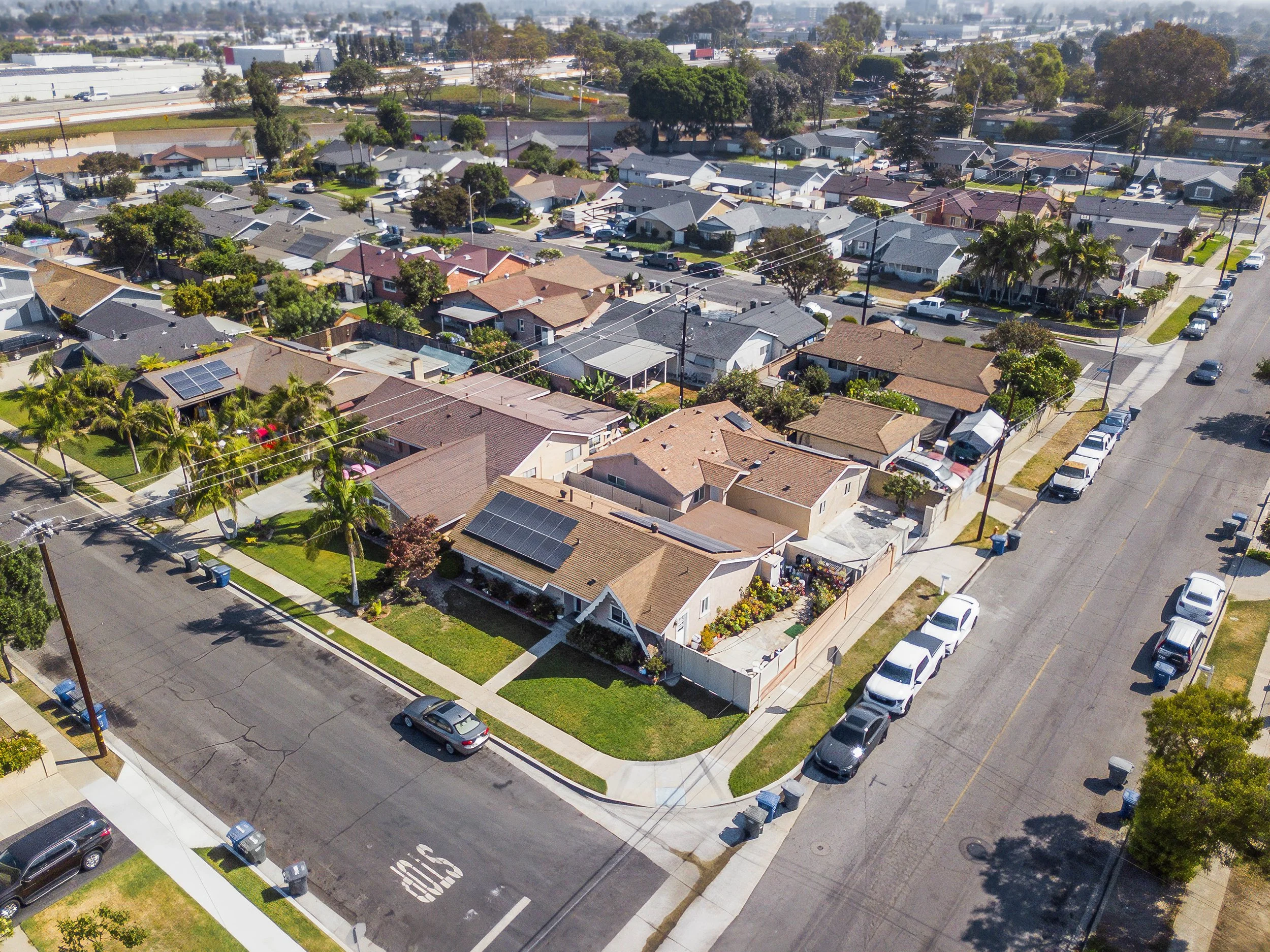
Everyone hears about SB9. Very few people see actual proof of it working.
I'm going to show you exactly how I helped my investor build an SB9 unit + ADU on a single lot in Buena Park back in 2024 — before it became a hot topic — and how that same property is now generating $9,000 a month in rental income across three units.
No theory. No projections. Real numbers.
Why We Picked Buena Park
We specifically chose Buena Park for two reasons: the price point and the lot layout.
Buena Park has a lot of properties with RV parking strips along the side or rear of the lot. That extra usable space is exactly what makes an SB9 + ADU play possible — you need enough lot area to physically build a second unit on the back parcel, and Buena Park's older residential stock tends to deliver that.
The price point matters too. At the $800k–$900k range, you're buying into a market where you can still make the numbers work after construction costs. Compare that to markets like Anaheim or Garden Grove, where ADU property comps have pushed into the $1.2M–$1.9M range and the margins get tighter on a value-add play like this.
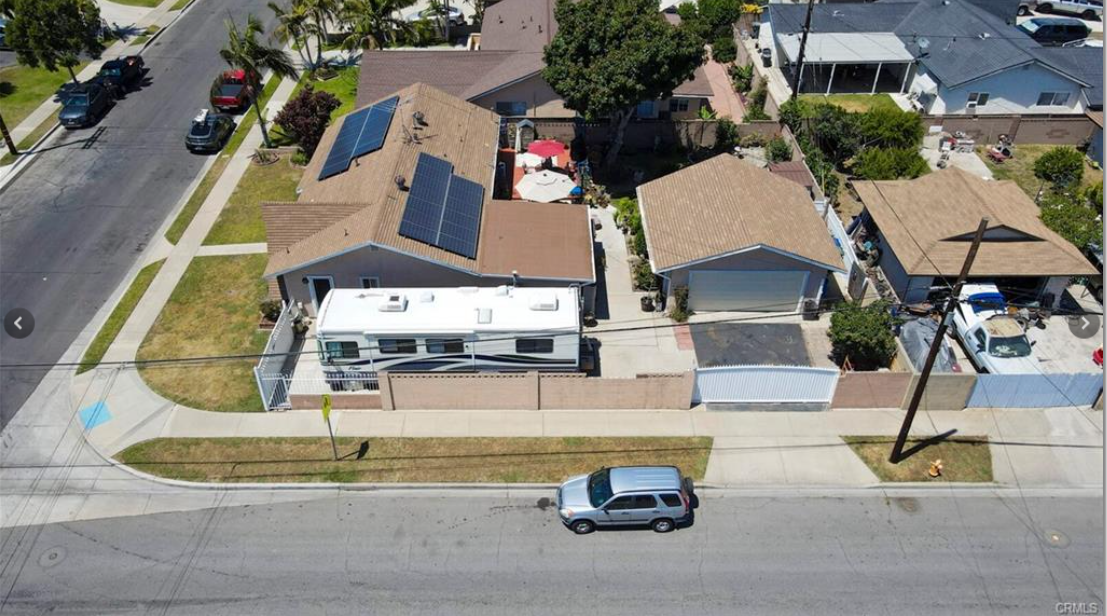
The Purchase
Purchase price: $875,000
Down payment: 55%
SFR mortgage payment: $3,400/month
We knew going in that the SFR would break even. The existing house would cover the mortgage — nothing more, nothing less. That was intentional. The entire investment thesis was built around what would happen in the back.
One important detail: we had to discount the SFR rent from the market rate of $3,600/month down to $3,400/month because the garage was going to be demolished as part of the build-out. The new tenant would have less of the lot and no covered parking. We disclosed the upcoming construction upfront — a lot of prospective tenants walked when they heard that. The one who stayed didn't mind the discount and the construction timeline. That's the tenant you want.
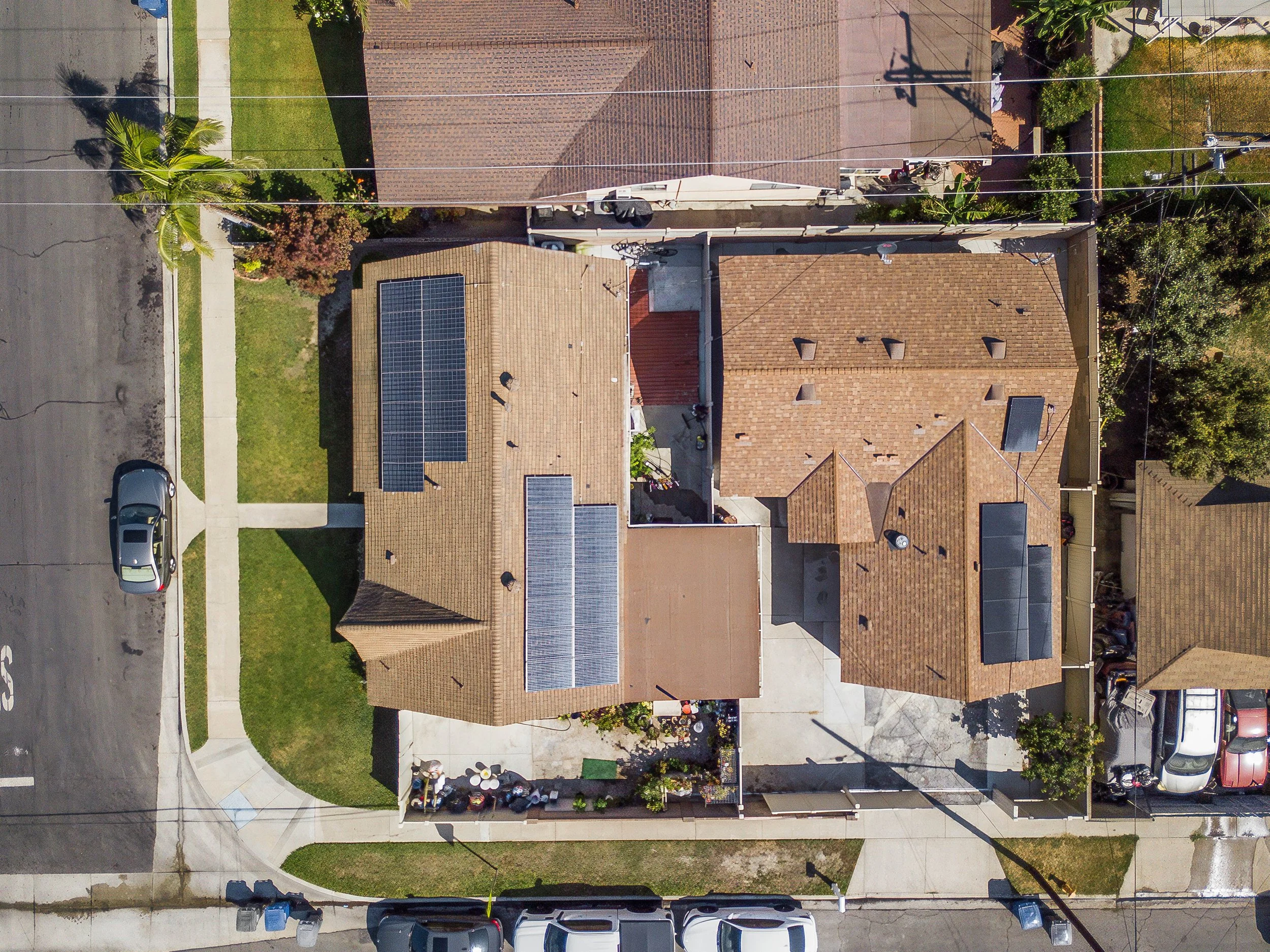
The SB9 + ADU Plan
While we were in escrow, I had our architect walk the lot and assess the options. He came back with a plan to add both an SB9 unit and an ADU — two separate new rental units on the same single-family lot.
Here's what SB9 actually allows: under California Senate Bill 9, signed into law in September 2021, a property owner in a single-family residential zone can add up to two residential units without going through discretionary review or a public hearing. It's ministerial approval — the city has to say yes if you meet the objective standards. Combining SB9 with a standard ADU on the same lot is how you get three rentable units from a property that started as a single-family home.
The build:
3 bed / 2 bath - $3,400
ADU 2 bed / 2 bath $2,800
SB9 unit 2 bed / 2 bath $2800
Build costs (2024 pricing):
Permits: $35,000
Construction: $350,000
Timeline: approximately 1 year
Construction costs have gone up since then, so if you're running this play today, model higher. But the framework is the same.
The Numbers That Matter
When all three units are occupied at current rents:
$3,400 + $2,800 + $2800 = $9,000/month in gross rental income
The mortgage on the SFR ($3,400) is covered entirely by that unit. Everything from the ADU and SB9 unit — $6,000/month — is income above the break-even line.
That's what income stacking across multiple units on a single lot looks like when it's actually built. Not a pro forma. Not a "could rent for" estimate. A live rent roll.
How We Financed the Build
The construction budget was funded separately from the acquisition. If you're looking at a similar project, understanding how DSCR loans, HELOCs, and construction financing handle multi-unit ADU builds differently is worth your time before you start pulling permits. The right product depends on your equity position, the timeline, and whether you're planning to refinance into a long-term hold after the units are stabilized.
In this case, the financing structure worked because my investor had the equity to cover the construction out of pocket and refinance once all three units were rented. The math only works if you go into it with a clear plan for how the build gets funded from day one.
What Made This Work
A few things had to line up for this deal to function:
1. The lot layout. Not every single-family lot in Buena Park — or anywhere — can support an SB9 + ADU build. You need the square footage, the right setbacks, and no disqualifying conditions (historic designation, rent-controlled existing tenants, etc.) under California's state ADU and SB9 guidelines. The Buena Park RV parking lots gave us exactly the rear yard access we needed.
2. The tenant disclosure. Being upfront about construction during the leasing process for the SFR saved a lot of friction later. Yes, we lost prospective tenants over it. The one we kept was the right one — and the rent discount was worth the stability.
3. The architect's involvement during escrow. We didn't wait until after close to figure out what was buildable. We had the architect assess the site during escrow so we knew exactly what we were buying and what it could become. Running that pre-close due diligence on the buildability of the lot is non-negotiable on a value-add deal like this.
4. The one-year timeline. This was not a quick flip. From escrow through permit approval through construction completion, you're looking at twelve months on a project of this scale. If your investor can't stomach a twelve-month construction period, this isn't the right play.
The Bottom Line
$875k purchase. $385k in construction and permits. One year of build time. And now: $9,400/month across three units on a single lot in Buena Park.
That's the real SB9 + ADU case study. It works — but only if you buy the right lot, plan the financing before you close, and go in with realistic expectations about what the process actually takes.
If you want to understand whether a property you're looking at could support this kind of play, reach out directly.
Call or text Dylan Serna at (714) 860-2868
Dylan Serna is an ADU specialist real estate agent serving buyers and sellers across Orange County and LA County. This post reflects an actual transaction and is intended for informational purposes only.